• Hi all and welcome to TheWoodHaven2 brought into the 21st Century, kicking and screaming! We all have Alasdair to thank for the vast bulk of the heavy lifting to get us here, no more so than me because he's taken away a huge burden of responsibility from my shoulders and brought us to this new shiny home, with all your previous content (hopefully) still intact! Please peruse and feed back. There is still plenty to do, like changing the colour scheme, adding the banner graphic, tweaking the odd setting here and there so I have added a new thread in the 'Technical Issues, Bugs and Feature Requests' forum for you to add any issues you find, any missing settings or just anything you'd like to see added/removed from the feature set that Xenforo offers. We will get to everything over the coming weeks so please be patient, but add anything at all to the thread I mention above and we promise to get to them over the next few days/weeks/months. In the meantime, please enjoy!

Hammer handle - quick question

Chris152

Sapling
Joined
May 2, 2021
Messages
452
Reaction score
64
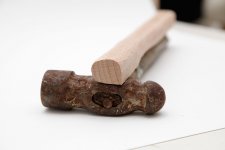
Having nearly finished roughing out a replacement handle for one of my dad's old hammers, I realised I have the rings running across the handle rather than in the direction of impact. Is it worth persevering with, or start again?
_MG_0391.jpg
The wood's steamed beech.
Thanks
C
 
Woodbloke":3smlu0ol said:
As far as I’m aware it don’t make any difference - Rob
Right or wrong, I like your answer, Rob! I recalled the advice for making a bokken for my lad, in which it's clear you need to rings to follow the direction of impact and wondered if it was the same for hammers. I'm sure it'd depend on how much impact they get, in so far as it may be relevant at all.
Thanks, back to the garage... :-)
C
 
Going a cross the shaft will flex slightly under impact and reduce the overall energy imparted to the nail. The actual amount is effectively negligable and thus ignorable in practice.

Or in English, doesnt matter a jot.
 
I haven’t watched it but this video may be of interest. Ash or Hickory seem to be the preferred woods for hammer handles.

[youtubessl]iD4yaJp8E0Q[/youtubessl]
 
Speaking from experience having made an axe handle with the growth rings running that way, it isn’t the best idea in Ash anyway, the grain begun to split apart along the handle’s length after a few hard swings, Beech may be different.
 
It probably matters only because of the direction of wedge, which is usually side to side to spread the wood into the taper of the hole, which is greater (and more efficient) on the longer axis. The wedge running that way here would risk splitting the handle.
 
I just checked, and several of my hammers have handles like yours and have survived ok so far.

But I do think you need to take a wire brush to that head, which will be easier while it's still off :)
 
AndyT":3cr404qq said:
I just checked, and several of my hammers have handles like yours and have survived ok so far.

But I do think you need to take a wire brush to that head, which will be easier while it's still off :)
Yes, I hadn't seen your post, Andy! Live and learn, eh? :-)
 
Don't worry, it's only really the ends that need to be clean. And dads can take the blame for all sorts of things ;)
 
AndyT":353pr842 said:
Don't worry, it's only really the ends that need to be clean. And dads can take the blame for all sorts of things ;)
This one's missing a generation - my dad was the last to use it, and I'm sorting it out for my lad to use, he's just starting a metalworking course. I enjoy restoring tools, but it's best when it belonged to someone special, he'd have been delighted to think of his grandson using his kit.
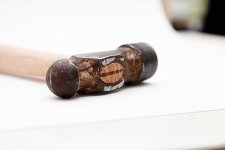
_MG_0400.jpg
I guess it's common, written on the head is
'Brades
271-24oz
Made in England'.
 
That's a quality tool. Brades were one of the biggest Birmingham makers, eventually being absorbed into the Spear and Jackson conglomerate.

Here's a catalogue entry from 1963 - 12 bob with a hickory handle:

BookReaderImages.php


More catalogues - including some very good chromolithographs - here, showing how they exported tools to South America and elsewhere

https://archive.org/details/internation ... -addeddate
 
That's good news, Andy - thanks.

And what an amazing archive site, I'd not seen it before. Could spend years rooting around in there!
 
Chris152":13w0e49q said:
AndyT":13w0e49q said:
Don't worry, it's only really the ends that need to be clean. And dads can take the blame for all sorts of things ;)
This one's missing a generation - my dad was the last to use it, and I'm sorting it out for my lad to use, he's just starting a metalworking course. I enjoy restoring tools, but it's best when it belonged to someone special, he'd have been delighted to think of his grandson using his kit.

I guess it's common, written on the head is
'Brades
271-24oz
Made in England'.
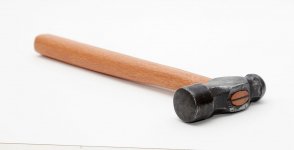
Sorry if you know this, don’t forget to polish the face of the head on some sandpaper, saves bent nails as well as bashed fingers. Still using my Brades hammer - same as the last one on the photo, only 45 years now! Ian
 
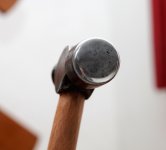
Thanks Cabinetman, I had no idea about that. I watched a video and came up with this - most of the dents are gone but there are still some, and I don't want to take more off in case I alter the shape of the face. I don't think it'll be used for hitting nails so much as used for shaping metal, but tbh I don't know.
_MG_0406.jpg
 
I actually found time to sit down to watch the video I posted a link for. Like most folks I was surprised by the result, the “correct” grain orientation broke first! In isolation this doesn’t mean much as there may have been unseen defects in the timber. One consideration not mentioned was that of vibration. If you’re a Blacksmith say, using a hammer for much of the day, transmitted vibration could be a big deal. Using a handle with the grain running in the right orientation is supposed to reduce the vibration. Axe users seem to treat the subject quite seriously, no doubt due to the risk of injury should a haft fail.
 
What is the explanation for polished heads avoiding bending nails?
I've heard it lots of times but not seen why/how
The first few youtubes I looked at were about polished heads and metal work to avoid any scars being transferred from the hammer to the job when riveting/planishing.

Bob
 
9fingers":3w0m6out said:
What is the explanation for polished heads avoiding bending nails?
I've heard it lots of times but not seen why/how.

Bob

I've heard that too but thought it was coarse sandpaper to leave a slightly rough surface, but free of grease etc.

It goes alongside the suggestion that you can bet someone they can't knock a nail in, if you smear some handy ear wax on the face of the hammer.
 
AndyT":2mvg01bs said:
9fingers":2mvg01bs said:
What is the explanation for polished heads avoiding bending nails?
I've heard it lots of times but not seen why/how.

Bob

I've heard that too but thought it was coarse sandpaper to leave a slightly rough surface, but free of grease etc.

It goes alongside the suggestion that you can bet someone they can't knock a nail in, if you smear some handy ear wax on the face of the hammer.
Yes I can believe that one, I suppose nobody actually hits the nail exactly without an angle in one or the other direction, and the earwax makes it slide off the head of the nail. Interesting about coarse sandpaper, I shall have to try that, reminds me of a recommendation to rub the shaft of my Gramercy holdfasts round and round with course sandpaper to provide grip.
Ian
 
Back
Top