• Hi all and welcome to TheWoodHaven2 brought into the 21st Century, kicking and screaming! We all have Alasdair to thank for the vast bulk of the heavy lifting to get us here, no more so than me because he's taken away a huge burden of responsibility from my shoulders and brought us to this new shiny home, with all your previous content (hopefully) still intact! Please peruse and feed back. There is still plenty to do, like changing the colour scheme, adding the banner graphic, tweaking the odd setting here and there so I have added a new thread in the 'Technical Issues, Bugs and Feature Requests' forum for you to add any issues you find, any missing settings or just anything you'd like to see added/removed from the feature set that Xenforo offers. We will get to everything over the coming weeks so please be patient, but add anything at all to the thread I mention above and we promise to get to them over the next few days/weeks/months. In the meantime, please enjoy!

Hi I'm new here

PeterCpjc

Seedling
Joined
Apr 14, 2025
Messages
8
Reaction score
2
Location
Crewkerne, United Kingdom
Name
Peter Charlton
LOCATION
Crewkerne, United Kingdom
Hi, I have been back in the UK (Somerset) for 2 years. We lived in Sweden for 23 years before that. I currently work as a Joiner and Roofer in the Somerset Crewkerne Yeovil Martock area. In a previous life, I was a time-served engineer at Rolls-Royce, but I prefer wood. With my engineering background, I have been buying up solid old machines at low cost as they needed repairing. I am pleased to find thewoodhaven2 as I can share my experience with different machines and others' for expertise and help. I started with a Kitty 5 combo and have been working my way to bigger machines that suit my needs.
 
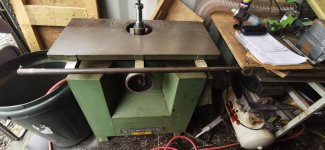
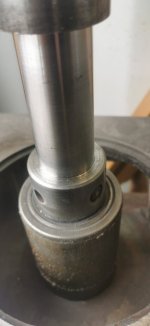
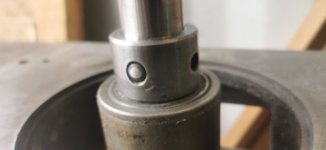
I do have an engineering question, but I'm not sure where to post it. I have a Startrite T 30 Spindle moulder. Can anyone give me a heads-up on how to remove the spindle before I start taking it all apart?
 
Welcome Peter, thats how I started with machines, the next thing I knew I had 15 lumps of cast iron ranging from 200kg upto 2.5tonne and 10 machines stood in the garden waiting to be rebuilt. I have since kerbed my addiction and only have 1 machine in the garden.
I've not done any startrite machines but if you post a pic
 
Welcome from Salisbury. A background in engineering with RR doesn't come any better. As to your Startrite spindle moulder query....hit it wiv a big 'ammer? Jesting of course but there's an element of truth therein as when I was climbing the steps with my dad to get into the sharp end of Concorde in the hanger(s) at Heathrow , I actually witnessed a maintenance technician taking a very large maul to the main landing gear. I kid you not! - Rob
 
Welcome Peter, thats how I started with machines, the next thing I knew I had 15 lumps of cast iron ranging from 200kg upto 2.5tonne and 10 machines stood in the garden waiting to be rebuilt. I have since kerbed my addiction and only have 1 machine in the garden.
I've not done any startrite machines but if you post a pic
I am thinking of reducing the spindle from 11/4" to 30 mm as all my blocks are 30 mm. Here are some photos
 

Attachments

  • IMG_20250415_134219.jpg
    IMG_20250415_134219.jpg
    133.3 KB · Views: 4
  • IMG_20250415_134145.jpg
    IMG_20250415_134145.jpg
    56.8 KB · Views: 4
  • IMG_20250415_134204.jpg
    IMG_20250415_134204.jpg
    46 KB · Views: 5
Welcome Peter.

I am thinking of reducing the spindle from 11/4" to 30 mm as all my blocks are 30 mm. Here are some photos

I'm not familiar with the T30, but my hunch would be to look inside the base first and see if there's a drawbar pulling the shaft down from inside.
 
Welcome Peter.


I'm not familiar with the T30, but my hunch would be to look inside the base first and see if there's a drawbar pulling the shaft down from inside.
Yes I'll have to take the motor and the whole shaft assembly (one integrated unit) away from the table first. Not a simple operation! I am considering bolting a grinder to the table and using the slow height adjustment as a feed to grind the shaft to the smaller size. Any thoughts on that?
 
Engineering in situ with an angle grinder? I'm really not sure about that, Peter.
 
Welcome aboard Peter :)
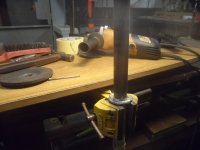
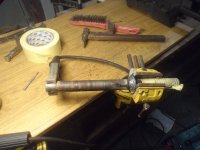
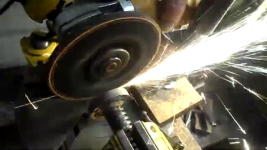
I've had the oppertunity to do a lash up turning job with an angle grinder for non precision stuff before,
using a pillar drill to rig up this grinder to the chuck, and clamped the tool up to make it somewhat solid.
I wouldn't recommend such for anything more than the doing of drudgery work, for non precision components...
Thinking the discs I had would become more accurate with some use, they didn't, and I got no impression of how
out of circular things actually were,
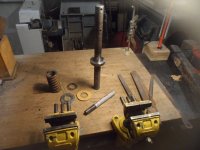
Bearing in mind, the only half accurate thing required in this job, was to have a nice face for the spring to press against,
so I finished off things by hand.
SAM_4396.JPG
SAM_4402.JPG
Cylinderical grinding .png
SAM_4426.JPG

IIRC, Did I read of some folks on this here site whom may have asked utoober "doubleboost" to do some jobs for them?
Might be worth looking into that kinda thing?

All the best
Tom
 
Welcome aboard Peter :)
I've had the oppertunity to do a lash up turning job with an angle grinder for non precision stuff before,
using a pillar drill to rig up this grinder to the chuck, and clamped the tool up to make it somewhat solid.
I wouldn't recommend such for anything more than the doing of drudgery work, for non precision components...
Thinking the discs I had would become more accurate with some use, they didn't, and I got no impression of how
out of circular things actually were,
Bearing in mind, the only half accurate thing required in this job, was to have a nice face for the spring to press against,
so I finished off things by hand.
View attachment 33035
View attachment 33036
View attachment 33037
View attachment 33038

IIRC, Did I read of some folks on this here site whom may have asked utoober "doubleboost" to do some jobs for them?
Might be worth looking into that kinda thing?

All the best
Tom
Yes, I am very hesitant to go down that road thanks for relaying your experience I need it to be more accurate than that.
 
Yes I'll have to take the motor and the whole shaft assembly (one integrated unit) away from the table first. Not a simple operation! I am considering bolting a grinder to the table and using the slow height adjustment as a feed to grind the shaft to the smaller size. Any thoughts on that?

If you tried to do it like that, you will be relying very heavily on the rise and fall travel being absolutely 100% in line with the shaft as it rises and lowers, otherwise you may end up with a tapered shaft.

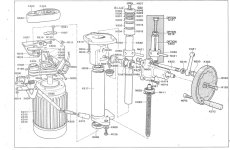
I found this image of the assembly online, it looks like you will need to disassemble the whole machine to get the shaft out. If you could at least manage to get the driven pulley off the bottom of the shaft, hopefully the shaft should slide out from above, provided it's the same diameter throughout and doesn't have steps in for the bearings to seat on.

1744837862889.jpeg
 
Welcome aboard Peter :)
I've had the oppertunity to do a lash up turning job with an angle grinder for non precision stuff before,
using a pillar drill to rig up this grinder to the chuck, and clamped the tool up to make it somewhat solid.
I wouldn't recommend such for anything more than the doing of drudgery work, for non precision components...
Thinking the discs I had would become more accurate with some use, they didn't, and I got no impression of how
out of circular things actually were,
Bearing in mind, the only half accurate thing required in this job, was to have a nice face for the spring to press against,
so I finished off things by hand.
View attachment 33035
View attachment 33036
View attachment 33037
View attachment 33038

IIRC, Did I read of some folks on this here site whom may have asked utoober "doubleboost" to do some jobs for them?
Might be worth looking into that kinda thing?

All the best
Tom
Looks like an acceptable job for the parameters of the situation.
 
If you tried to do it like that, you will be relying very heavily on the rise and fall travel being absolutely 100% in line with the shaft as it rises and lowers, otherwise you may end up with a tapered shaft.

I found this image of the assembly online, it looks like you will need to disassemble the whole machine to get the shaft out. If you could at least manage to get the driven pulley off the bottom of the shaft, hopefully the shaft should slide out from above, provided it's the same diameter throughout and doesn't have steps in for the bearings to seat on.

View attachment 33040
Hi Trevanion, how's Pembrokeshire at this time of the year? I lived in Éire (also known as Southern Ireland) then Scotland for many years before I moved to Sweden, but I have never been to Wales.
Awesome, you managed to find that diagram, thank you!!!! After a initial inspection turning the whole machien on its side and pearing up its skirt, I had kinda assumed that everything had to come apart, and it was not an easily interchangeable shaft like some spindle molders. The rise and fall mechanism is very smooth and relatively slow (the build quality is notable). I will at least put a micro gauge on the spinning shaft while I raise it and lower it to see if it is out of true. Thanks again for your considered input and the diagram. Regards Peter
 
Back
Top