• Hi all and welcome to TheWoodHaven2 brought into the 21st Century, kicking and screaming! We all have Alasdair to thank for the vast bulk of the heavy lifting to get us here, no more so than me because he's taken away a huge burden of responsibility from my shoulders and brought us to this new shiny home, with all your previous content (hopefully) still intact! Please peruse and feed back. There is still plenty to do, like changing the colour scheme, adding the banner graphic, tweaking the odd setting here and there so I have added a new thread in the 'Technical Issues, Bugs and Feature Requests' forum for you to add any issues you find, any missing settings or just anything you'd like to see added/removed from the feature set that Xenforo offers. We will get to everything over the coming weeks so please be patient, but add anything at all to the thread I mention above and we promise to get to them over the next few days/weeks/months. In the meantime, please enjoy!

Home-baking gluten free loaf

RogerS

Moderator
Staff member
Joined
Jul 21, 2014
Messages
15,492
Reaction score
1,223
Location
Somerset
I have no experience of baking bread but would like to have a go at making some gluten-free bread for my wife. Preferably brown with grains in. This is so she isn't reliant on xanthan-gum soaked, gut-cramping offerings from supermarkets. So......

... any suggestions, sourcing ingredients etc. This is a new 'country' to me.
 
Thanks Malc but I looked at the search results and there's no flour there that I can see.
 
As far as I know (please check) one of the original grains from before hybridisation is suitable and available pretty easily, Spelt flour, we use it for Sourdough and cakes.
Ian
Ps, not without gluten but some people can eat Spelt, this may help.
 
Last edited:
It's tricky. I bake GF frequently for another person and having tried numerous GF flours I use this now: https://www.freee-foods.co.uk/produ...tm_term&utm_content=143052116635&gad_source=1

I do not find the traditional sites like Bakery Bits are all that clued up on coeliac baking.

Your issue is going to be getting stretchiness in the dough and sufficient rise. This recipe works: https://glutenfreeonashoestring.com/gluten-free-bread-recipe/

But if I compare the output with a home made sourdough it is not in the same league. That said I still I prefer the hot dutch oven method to the method on most internet places (including the one above) as it gives better rise and better crust (initial rise with lid on in the oven, then off and spray for final crust). You may have different preferences. I also have a steam oven, and you might not but you don't need a lot of moisture in the dutch oven method - just a mister will do when you whip the lid off.

Make sure your dried yeast is super fresh, not an elderly tin, and activate it properly before you add to the mix, if you are not getting foaming in a little warm milk (under 35C) within 10 mins, then yeast is duff. Or use fresh yeast fairly generously. I do not do hand stretches for GF as I find it kills the rise and has no real benefit as it is not stretching any gluten, so I just use mixer with dough hook. Salt gives taste but also kills yeast so I mix, let it autolyse for 30 mins and then quick final mix with salt that I dissolve in small amount of warm water.

If you add seeds such as caraway etc then go easy as they can overpower. I also add ascorbic acid (vit c) as it improves the flavour of GF.

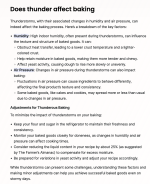
Good luck. Might take a few goes. Don't bake in thundery weather.
 
I wasn't aware of this either but it is based on science
Screenshot 2024-07-17 at 08.38.22.png
 
Thanks Roger
I now recall my mother nagging about not slamming doors when she was baking victoria sponges. Mind you she religiously added ingredients in specific order even changing from a wooden spoon to a metal one when adding the flour.
I seem to make quite respectable cakes by bunging all ingredients in together which makes me query some of these “rules”
 
Yes. It is based on experience too. I bake quite a lot, and now sell some of it. As I mainly bake sourdough loaves with natural yeast and hence slow fermentation, the bread proves for a day and then is usually retarded in a fridge overnight in bannetons. Thundery weather noticeably inhibits the rise. I do have an oven capable of proving now (consistent 30 degrees) but can't fit all the dough in when doing several large loaves.
 
I'm afraid I'm just a "Tesco packet into the bread maker" home baker but do get the odd" minimal rise-brick loaf". I will try correlating these with weather conditions from now on.
Nowt wrong with that. I started years ago with a Panasonic bread machine. But gluten free bread is a tricky thing to get right as we want it to taste and look like a conventional loaf but without the ability to add "strength". People often suggest adding husk powder, which is not ideal if the loaf is aimed at coeliacs, or ancient flours (which really defeats the object as you are looking for zero gluten not just a bit): so bakers cooking for someone who actually has the risks associated with being coeliac have to be very aware. Commercial bakers tend to add xanthan gum among other things to deal with the lack of gluten. You can add well soaked chia seeds as they make a gummy jelly like substance that reminds me of frog spawn, but I think it adversely affects both flavour and crust (others may love it). Bread machines may be OK for GF for all I know, if you can control temp and time at given temps, but the way most experienced "artisan" bakers get rise from GF flour is to prove very slowly, use a deep tin (to shove upwards), cook maybe 20C lower than you would for a normal loaf, and add a fair bit of steam. The reason why I use a fully preheated ie (before the dough goes in) Dutch Oven (ie heavy metal casserole with lid) inside our ovens is that water released from the dough creates a self steamed environment, then it just needs a good misting with an atomiser when the lid comes off. I actually drop the temp 20C before taking the lid off as otherwise the top is brown before the loaf is as cooked as I like in the middle, so it can be a bit cakey. I can get four of these cast iron dutch ovens in my baking oven at a time. It takes 15 or 20 minutes longer in the oven to get a half decent GF loaf than say sourdough (25+20 is typical for me with sour).

But I am just a home baker, not an expert. Others may well have better knowledge.
 
Panasonic bread maker works for us, extremely rare to get a failed loaf. We've used one for yers and on our second machine.
 
Adrian

Where do you get your yeast from ?

I see that a lot of the recipes talk about a paddle on a mixer etc. Is there anyway of going without ? Reluctant to shell out if the end result does not meet with approval!
 
I don't think the yeast is that important as i used to use supermarket packets when I started bread making.

Now i buy fermipan from Amazon


I empty the packet into a click lid plastic container and keep it in the freezer. Lasts a year easily and is as active at the end as when it went in. 5 grams makes a loaf but amount isn't critical.
 
For baking gluten free the yeast quality is important in my experience. It's not like a loaf with strong flour and a ferment at all. However, for GF I find a cheap tin of Allinsons dried yeast from Waitrose works fine. But (as for making brioche etc) I activate it in some warm milk. It must foam a bit. As proving with GF takes longer, some people use less yeast than in a normal loaf. I don't. For normal baking I don't use any yeast as I have a ferment on the go all the time. But I do also keep a supply of fresh yeast cubes that are fine in the freezer. I then grate these as a booster if needed. The quantity of yeast is obviously dependent on the amount of flour and water.

You don't actually need a mixer at all, or a paddle. The whole thing can be done by hand, especially as GF dough does not stretch. But a planetary mixer with a dough hook is very useful and gives good results. I have four mixer bowls to fit a KitchenAid mixer and each will have enough capacity to do two large loaves. This is handy as I do the mix, autolyse, then add the salt and remix. To get good results you need at least 15 mins pref 20 mixing in the machine. Likewise by hand.

Some recipes suggest adding salt at the beginning. Good luck with that if baking GF as salt kills yeast and in my experience if going down the low yeast route salt inhibits the rise significantly. There is no downside to adding salt after autolyse (just don't forget as bread is bland without it).
 
I envy you the sourdough. I've tried maybe thirty times, I've tried starting my own, I've bought cultures, I've been given cultures. I've even kept the stuff at the optimum temperature and bought a jug water filter, and only once did I get a loaf that rose.
 
Back
Top