• Hi all and welcome to TheWoodHaven2 brought into the 21st Century, kicking and screaming! We all have Alasdair to thank for the vast bulk of the heavy lifting to get us here, no more so than me because he's taken away a huge burden of responsibility from my shoulders and brought us to this new shiny home, with all your previous content (hopefully) still intact! Please peruse and feed back. There is still plenty to do, like changing the colour scheme, adding the banner graphic, tweaking the odd setting here and there so I have added a new thread in the 'Technical Issues, Bugs and Feature Requests' forum for you to add any issues you find, any missing settings or just anything you'd like to see added/removed from the feature set that Xenforo offers. We will get to everything over the coming weeks so please be patient, but add anything at all to the thread I mention above and we promise to get to them over the next few days/weeks/months. In the meantime, please enjoy!

In praise of cabinet scrapers.

Mike G

Petrified Pine
Joined
Jul 30, 2014
Messages
12,482
Reaction score
3,033
Location
Suffolk
Name
Mike
I have a Stanley 80 cabinet scraper with a thin, original plate. Does anyone else use these type of tools? I think they are utterly wonderful, and that they have a role for the machine & power-tool -orientated woodworker as well as the hand-tool guys. Let me explain.

If you are the sort of woodworker who will put a board through a planer thicknesser, then sand it with a belt sander and/or a ROS, then you will spend quite a lot of time sanding before you can get to your final finish. At that point, it is my view that the surface of the wood is sort-of hazy with minute scratches and dust compressed hard into the pores. It'll finish OK, and it's the way I guess most modern woodworkers work. But for me, the finish from a blade is subtly cleaner, crisper, and shinier......and.....here's my claim.......it's easier (and possibly quicker) to achieve than a sanded finish. I suggest that after you've done your first sanding, which on oak might be with 60 grit, for instance, grab a cabinet scraper and get to work. It will take you directly from a scratched coarse sanded finish to your final finish in just a couple of minutes.

The beauty of the number 80 -type cabinet scrapers is that they are incredibly easy to sharpen and to set up. Far easier than any plane. Sharpen the blade to any angle you like, drop it into the tool which is sitting flat on your bench, do the retaining screws up, and give a turn or two to the thumbscrew. That's it (there are some who will tell you that you need to roll a burr. You don't). You'll soon be taking off gossamer thin shavings, no matter the grain direction. On wood with which even a close set cap iron struggles, your cabinet scraper will work beautifully. The only skill you need to learn is starting and stopping without leaving a mark.....gentle on, gentle off, and if you go over the edge of a board just angle the tool a little so the blade leaves the board on the skew. It's that simple.

For hand tool woodworkers, your board preparation can go: scrub plane, fore plane, cabinet scraper. Personally, I use my number 6 as both a scrub plane and a fore plane, so board preparation by hand involves one plane and a cabinet scraper. So long as they are sharp you'll be fine. I've just at the weekend dealt with an absolute pig of a piece of oak, reversing grain everywhere, and far too wide for my planer thicknesser. Scrub planing tore out quite a lot, so I followed it with a quick cross grain sand with a coarse belt in the belt sander, then sharpened the number 6 and set the cap iron tight to the edge. No tear out, but the horrible noise of the edge whacking into hard grain in the wrong direction did nothing for my mood. No tear out, but the finish in those areas isn't perfect. Pick up the Stanley 80, and the heart gladdens as beautiful piles of whispy shaving accumulate at the end of the board. Two or three minutes a side for a board 350 wide by 1500 long.

They're £20 to £30 on Ebay, or often seen much cheaper in job lots. Do yourself a favour and invest.
 
I've had one since before I made my No1 guitar (1999). I use it regularly on the guitars.

Occasionally, I also use a heavy duty Stanley blade as a scraper.

They work especially well for me after I have glued in the binding and purfling, then scraping the wood down to their level, and then a tiny bit more.
 
I use a card scraper a fair bit and find them of similar merit. especially for wood perfling/binding in a similar way to Malcom.

In fact I'll often make a quick little one up out of a Stanley knife blade for some bits that would take way to long to get a good sanded finish on.

haven't got a cabinet scraper but I'll keep my eyes peeled for one, it could prove to be a worthwhile tool addition.
 
Your thumbs will thank you, Dave! So much easier to use on big jobs or for any length of time than a card scraper.
 
i know you will choke on your tea Mike but I bought a hock blade for my #80 and I felt that it made life much easier. The thicker steel of the Hock blade kept the hook longer, learning how to burnish it properly was a revelation too.
 
I bought mine from Doris over in the other place a few years ago and find it is one of my go to tools. If I remember rightly it is a Faithful made one though not Stanley or Record. After a bit of fettling and practice getting a small bur, it has worked great

For me soo much better than using a scrapper plate due my joints hurting too much when doing so
 
Andyp":38l4c41q said:
i know you will choke on your tea Mike but I bought a hock blade for my #80 and I felt that it made life much easier. The thicker steel of the Hock blade kept the hook longer, learning how to burnish it properly was a revelation too.

There's two approaches to cabinet scrapers, and scrapers in general. One approach relies on a burr, and card scrapers can't work any other way. However, cabinet scrapers work beautifully without a burr. Just sharpen it like a chisel (although the closer the angle is to 45 degrees the longer the edge will last), without a burr, and away you go. This is what I do with mine. If you want to use it with a burr, then yes, a slightly thicker plate will help.
 
Mike G":ir8lyin9 said:
Andyp":ir8lyin9 said:
i know you will choke on your tea Mike but I bought a hock blade for my #80 and I felt that it made life much easier. The thicker steel of the Hock blade kept the hook longer, learning how to burnish it properly was a revelation too.

There's two approaches to cabinet scrapers, and scrapers in general. One approach relies on a burr, and card scrapers can't work any other way. However, cabinet scrapers work beautifully without a burr. Just sharpen it like a chisel (although the closer the angle is to 45 degrees the longer the edge will last), without a burr, and away you go. This is what I do with mine. If you want to use it with a burr, then yes, a slightly thicker plate will help.

This whole thread is really interesting. I hadn't realised there were two different approaches. I got myself a cabinet scraper second hand in a junk shop for next to nothing after having found the work out with a card scraper to be hard work without the pleasure factor you get from hand planing or whatever. I very quickly concluded the #80 is a wonderful thing and use it all the time.

I must admit that I've always followed it with the various grades of sandpaper, but having read this I might try applying finish straight to the scraped surface and see how it compares. That would save a lot of boring sanding! I'll have to try the unburnished edge approach as well: I just naïvely assumed it should be sharpened like a card scraper.
 
I hadn't used my no.80 for a little while, but I picked it up the other day and it was, as you say Mike, a pleasure to use.

I have sharpened mine with a "hook" (easy enough with a burnisher) but might try it without. (I have a tendency to turn the hook over a bit too far I think - same with card scrapers.)
 
part of the reason I use card scrapers is because I can make them for free from dead hardpoint saws. :)
 
Agree with scrapers. A few years ago I did a violin making course for a few weeks in Cremona, and scrapers were used not only to give a polished finish to wood (in hands more skilled than mine) but also to thickness the tops and backs and create the hollows after roughing with a gouge. I came back with a few for instrument making. All had been home made.
 
I have one and it is one of my most used tools in the workshop ,it's a versatile problem solver. I've been doing a load of mitre folds this week for the kitchen and its been great for getting off the last bits of glue squeeze from the sharp edge which I have not hit with the sander. Everyone should have one.
Mike have you got a toothed plane in your armoury, I trested myself to an Ulmia one from ebay for my birthday last year, they are fantastic for anything that has naughty grain. Its first test was on the gnarliest bit of flamed Oak from the fire pile. Leaves lots of little fine ridges that I knocked off with the scraper. Its a really impressive tool.
 
I have the Veritas No.80 which has a slightly more refined casting than the original Stanley machine. I've used both extensively and the Veritas is in my book the better implement. That said, one or other are 'must have' bits of kit.
The one grumble I have is that the blades aren't long enough to fit comfortably in a Veritas Honing Guide, so I dispensed with the original and made a much longer one from an old card scraper, though as Novocaine has done, it's quite easy to make scraper blades from old hard point saws.
I hone the bevel at 45deg on the 'Scary Sharp' films and I don't bother with a hook although I sometimes turn one if I can be ar$ed to to it :D .
Brilliant bit of kit - Rob
 
MJ80":2k3k72d8 said:
......Mike have you got a toothed plane in your armoury, I trested myself to an Ulmia one from ebay for my birthday last year, they are fantastic for anything that has naughty grain. Its first test was on the gnarliest bit of flamed Oak from the fire pile. Leaves lots of little fine ridges that I knocked off with the scraper. Its a really impressive tool.

No, I haven't. In fact, I've never laid eyes on one. How on earth do you sharpen it?
 
Mike G":xri1ymzo said:
MJ80":xri1ymzo said:
......Mike have you got a toothed plane in your armoury, I trested myself to an Ulmia one from ebay for my birthday last year, they are fantastic for anything that has naughty grain. Its first test was on the gnarliest bit of flamed Oak from the fire pile. Leaves lots of little fine ridges that I knocked off with the scraper. Its a really impressive tool.

No, I haven't. In fact, I've never laid eyes on one. How on earth do you sharpen it?

See here Mike at Workshop Heaven. I've never used one or sharpened one (just the same as a normal blade I think) but have heard very good things about them for nasty grain - Rob
 
If they are anything like the small luthiery toothed scraper plane that I have Mike, the blades have long grooves cut in them and you just give them a quick regrind. Mine is ancient and only about an inch wide. Works well for removing material in tricky spots.
 
Once you master a Stanley No 80 there is nothing better for finishing. Much better for your thumbs and fingers. A better finish can be achieved with no sanding. The downside is having to use an ordinary card scraper in the bits where the No 80 cannot go. I also agree avoiding start marks is a constant problem. Not too much pressure to start and not dropping the plane back on the wood at the start I think but it is difficult to get a good rhythm without the odd mark.
 
I have always put a burr on the blade so useful to hear about the alternative. It is a great example of the simplest tools often being the most satisfying to use.
 
Toothed irons are just sharpened on the bevel at 25 deg (bearing in mind they usually have a york pitch). No back bevel or flattening as then it wont work properly - that's the voice of experience talking there :oops:
 
Am I the only one who's never managed to get a decent surface finish with one of these?

Great for scraping old finish off prior to sanding though, less clogged discs and belts.
 
I have 4 card scrapers sitting unloved because I haven't got a bloody burnisher :lol:

The Veritas scraper plane looks tempting though, I do remember using a card quickly becomes pretty unpleasant on the thumbs.
 
novocaine":15p5pz64 said:
Got a screwdriver Bill? It's all I've ever used.

Yeah I've seen that method get used, I'll give it a go since I am in need of a scraper to finish one of my current projects.
 
I use an old knife-sharpening iron thingy (What are they called?). But a drill bit works just as well.
 
Mike G":w3el6u8a said:
I use an old knife-sharpening iron thingy (What are they called?). But a drill bit works just as well.

Ah, that's the wrong tool, Mike. You need one of these:

https://www.classichandtools.com/ac...urnisher-Curly-Maple-CB-250cmlh.html#SID=1475

I've got a book or two here somewhere that goes over making a burnisher for spindle moulder cutters, specifically french head cutters as these are a scraping cutter with a negative cutting angle (they literally just slot into the shaft) so you have to turn a burr on the edge to make them work, very good surface finish on super hard, uncompliant timbers and used to be a furniture maker's weapon of choice but have been illegal to use commercially for a VERY long time. Anyway, back to the burnisher, in the books they always specified that a burnisher was made from a worn-out round file, with the teeth ground off and polished to the nth degree.
 
TrimTheKing":2f8dm0ad said:
I've got one of these and can attest that it's bloody brilliant!

https://www.axminstertools.com/veritas- ... ane-701915
I had the LN version and can attest it was bloody horrible :( principally because the blade's about 5mm thick and there's no way that it can be bowed, whereas with the Veritas, you can. A whole different kettle of worms. The scraper plane that's really invaluable is the little LN 212 which has got me out of all sorts of scrapes (where did I put my coat? :lol: ) - Rob
https://www.axminstertools.com/lie-niel ... ane-421006
 
That's something I've never used or considered Mike so thanks for that, I use card scrapers but as little as possible as my thumbs hurt for days though I did make a simple holder which was sort of successful for a while.

I've just had a quick look and the Faithful version is available for £18 however it's got the old grey matter stirring and looks as if it wouldn't be difficult to make one. :eusa-think:
 
Lons":30mq03g3 said:
..... looks as if it wouldn't be difficult to make one. :eusa-think:

No, I agree, it wouldn't. Eminently possible to make a decent wood-bodied one for yourself, I reckon.
 
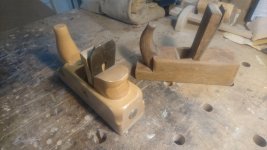
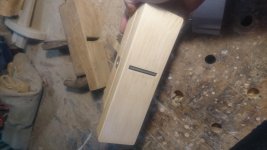
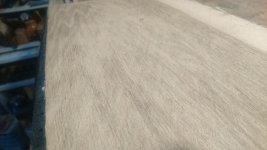
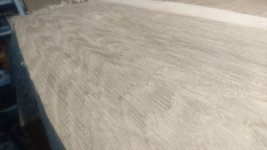
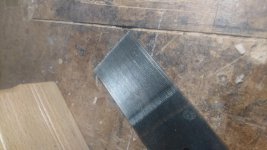
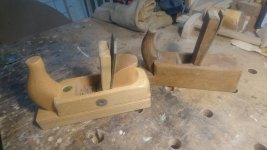
Here is a quick look at the scraper planes. I had a look and they are going for a song over here with a little bit of looking if anyone is interested I'm sure we can sort out getting them back to the island. Hand tools here, especially the wooden planes are not carrying as much as a premium as the UK. I have picked up a couple of bargains.

I'll let the photos and captions do the explaining.

DSC_1844.JPG

DSC_1849.JPG

DSC_1850.JPG

DSC_1853.JPG

DSC_1845.JPG

DSC_1847.JPG

DSC_1848.JPG
 
That'll soon clean up, Bill. Bear in mind that there is a difference between a scraper plane (solid blade) and a cabinet scraper (flexible blade) in the way they are used, set up, and sharpened. I made myself a scraper plane decades ago and can't remember when I last used it, but my cabinet scraper is used all the time.
 
Mike G":3u5juw4v said:
That'll soon clean up, Bill. Bear in mind that there is a difference between a scraper plane (solid blade) and a cabinet scraper (flexible blade) in the way they are used, set up, and sharpened. I made myself a scraper plane decades ago and can't remember when I last used it, but my cabinet scraper is used all the time.

Well obviously a cabinet scraper is a lot more useful for smaller pieces and doing minor adjustments. The guy is selling a load of LN planes, all boxed, that have been left in a damp shed.
 
Woodbloke":2ifnpkh7 said:
I had one, don't go near it! A nightmare to set up and use and I tried over several years to get the hang of it; sold it on somewhere 'else' in the end - Rob

Noted!
 
billw":fyictt7s said:
.......Well obviously a cabinet scraper is a lot more useful for smaller pieces and doing minor adjustments.......

I think you'll be surprised, Bill, by how much material they can remove. It comes off in shavings. One of the boatbuilders I follow on Youtube faired the whole hull of his current project with one. It really isn't just for the final lick 'n polish.
 
Back
Top