• Hi all and welcome to TheWoodHaven2 brought into the 21st Century, kicking and screaming! We all have Alasdair to thank for the vast bulk of the heavy lifting to get us here, no more so than me because he's taken away a huge burden of responsibility from my shoulders and brought us to this new shiny home, with all your previous content (hopefully) still intact! Please peruse and feed back. There is still plenty to do, like changing the colour scheme, adding the banner graphic, tweaking the odd setting here and there so I have added a new thread in the 'Technical Issues, Bugs and Feature Requests' forum for you to add any issues you find, any missing settings or just anything you'd like to see added/removed from the feature set that Xenforo offers. We will get to everything over the coming weeks so please be patient, but add anything at all to the thread I mention above and we promise to get to them over the next few days/weeks/months. In the meantime, please enjoy!

Kitchen Table - Finished!

Hi Nick I love this project as it is very similar to a coffee table I made this year based on a David Charlesworth design featured in the first edition of furniture and cabinet making. If possible can you make the 4 legs so that where they join there is a small square hole otherwise it creates an horrendous dust trap
Really nice work
 
Hi Nick I love this project as it is very similar to a coffee table I made this year based on a David Charlesworth design featured in the first edition of furniture and cabinet making. If possible can you make the 4 legs so that where they join there is a small square hole otherwise it creates an horrendous dust trap
Really nice work
I hadn't thought about the dust trap! Too late to do anything about that now though. I'll stick the hoover in it occasionally.
 
Sorry for the lack of updates on this recently. I have been progressing things (fairly slowly), but a busy Summer has meant posting on the forum has been difficult.

First up, I promised a video which shows how the ellipse jig works. Hopefully this makes it clear for anyone who has been struggling to visualise it from the photos:
.

I used that to finalise the shape of the template for the table top having first jigsawed away most of the spare material.
 
I used the template to draw the outline on to the actual table top and then cut close to the line with a jigsaw. I don't know if it's my cheap and nasty saw or the blades, but the jigsaw is my least favourite tool!

IMG_3203.jpeg
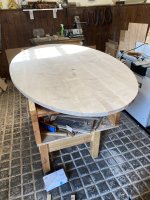
Since then, I've been doing a lot more flattening. The top actually seems to move quite a lot - it seems to want to "curl up". I've got it pretty good and I'm hoping the under structure will help keep it flat.

IMG_3207.jpeg
 
Since then, I've been doing a bit more detail work on the legs and other parts of the support structure.

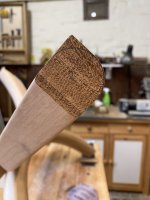
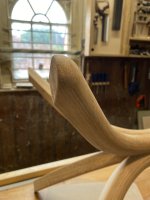
I added quite a heavy round over to the rails and outside curve of the legs (the latter being a progressive round over to match tapering of the leg. I need to take some photos of the finished articles, but to achieve a consistent round over on the rails, I first marked guidelines and then spokeshaved a 45 degree chamfer before adding further facets and, finally, smoothing it all out with sandpaper.

IMG_3248.jpeg

IMG_3250.jpeg
 
I like this a lot. Very elegant and much smarter than the basic one I'm attempting. (I see some top flattening in my near future).
 
I designed the table with various brass components to connect various parts of the undercarriage together, and to connect the undercarriage to the top.

The brass is housed into the top side of the various components. I did the housing for the easy bits (where the brass is just in one component) by hand. Marked it out with a knife. Sawed the sides. Chiselled out most of the waste. And finally finished it with a router plane (one of my favourite tools, and one of the very few hand tools I've bought new - which I did because it was the same price as old ones at the time!).

IMG_3258.jpeg

IMG_3259.jpeg

IMG_3260.jpeg


IMG_3261.jpeg

IMG_3262.jpeg

Some of the brass components get housed into three wooden parts - the tops of two legs and a cross rail. I started trying to do that by hand but, principally because I had already tapered the legs, it was too difficult so I decided to do these by router.

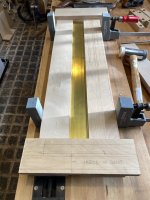
To do that, I needed to make a jig. I'm afraid I'm not going to get a Steve Maskery style video out of the jig construction. Four bits of ply and some screws! To get it the right size, I clamped two bits of straight edged ply either side of the brass and then screwed the ends on while it was clamped up.IMG_3257.jpeg

I tried the masking tape and superglue trick to hold the template in position, but didn't trust it for this so screwed it into the tops of the legs.

IMG_3266.jpeg

This was the finished result:

IMG_3267.jpeg

IMG_3268.jpeg
 
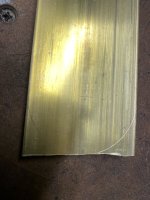
I rounded the ends of the brass. That was just a case of scribing the shape with dividers, cutting the corners off with an angle grinder, using a flap disk on the angle grinder to get close to the final shape and, finally, touching it up on the bench grinder (I know it's not safe to use a bench grinder for brass, but it really was just to tickle the edge).

IMG_3263.jpeg

IMG_3264.jpeg

You'll see from some earlier photos that they have slotted holes (which will allow for movement of the top). To make those, I drilled three holes next to each other and filed the final shape.

The final step with the brass will be to polish it up and give it a coat of wax.
 
The brass screws into the legs and rails with brass countersunk screws.

IMG_3269.jpeg

The table top is held on with threaded brass inserts which tax M6 screws. There are 16 inserts and I was a bit nervous about putting these in as it wouldn't be hard to get one or misaligned. However, it went OK, and all of the screws go in!

This is all of the components in place (albeit that the brass pieces are not screwed into the:

IMG_3271.jpeg
 
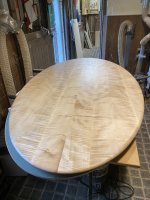
Today, I went back to working on the table top. The edge has an elliptical round over on both sides, which gives it a more delicate look. I'm not a huge fan of using the router, but (apart from a short interlude to repair the speed controller on my router, which wanted to run flat out) it went well.

I then did a LOT of sanding. I hand sanded the edge and used a random orbital sander for the rest. No photos of that.

With that done, I decided to oil it. I'm using Osmo PolyX matt.

IMG_3272.jpeg

IMG_3273.jpeg

IMG_3274.jpeg
 
I designed the table with various brass components to connect various parts of the undercarriage together, and to connect the undercarriage to the top.

The brass is housed into the top side of the various components. I did the housing for the easy bits (where the brass is just in one component) by hand. Marked it out with a knife. Sawed the sides. Chiselled out most of the waste. And finally finished it with a router plane (one of my favourite tools, and one of the very few hand tools I've bought new - which I did because it was the same price as old ones at the time!).

View attachment 28433

View attachment 28434

View attachment 28435


View attachment 28436

View attachment 28437

Some of the brass components get housed into three wooden parts - the tops of two legs and a cross rail. I started trying to do that by hand but, principally because I had already tapered the legs, it was too difficult so I decided to do these by router.

To do that, I needed to make a jig. I'm afraid I'm not going to get a Steve Maskery style video out of the jig construction. Four bits of ply and some screws! To get it the right size, I clamped two bits of straight edged ply either side of the brass and then screwed the ends on while it was clamped up.View attachment 28438

I tried the masking tape and superglue trick to hold the template in position, but didn't trust it for this so screwed it into the tops of the legs.

View attachment 28439

This was the finished result:

View attachment 28440

View attachment 28441
Interesting!
 
Today, I went back to working on the table top. The edge has an elliptical round over on both sides, which gives it a more delicate look. I'm not a huge fan of using the router, but (apart from a short interlude to repair the speed controller on my router, which wanted to run flat out) it went well.

I then did a LOT of sanding. I hand sanded the edge and used a random orbital sander for the rest. No photos of that.

With that done, I decided to oil it. I'm using Osmo PolyX matt.

View attachment 28446

View attachment 28447

View attachment 28448
Wow Nick, love the grain and the brass work is great.
 
I'd forgotten about this table. What a good project this is. It's actually going to look rather simple and elegant when finished, but that hides an awful lot of work and thought. I'm not a huge fan of highly figured wood, but that maple looks great. You're going to have the conundrum, when it's finished, of setting the table without a cloth to show off the table, but risking damage with every movement of crockery or dropped piece of cutlery...or, hiding everything under a cloth and keeping it safe.
 
I'd forgotten about this table. What a good project this is. It's actually going to look rather simple and elegant when finished, but that hides an awful lot of work and thought. I'm not a huge fan of highly figured wood, but that maple looks great. You're going to have the conundrum, when it's finished, of setting the table without a cloth to show off the table, but risking damage with every movement of crockery or dropped piece of cutlery...or, hiding everything under a cloth and keeping it safe.
It's ended up looking a bit more figured than I thought it would! I'm hoping not to be too precious about the table.
 
That does look amazing and very neatly and ingeniously made. Could you expand a bit on why you need all the splendid brass? I'd imagined you were just going to put some slotted or oversized holes through the tops of the legs and up into the table top.
 
That does look amazing and very neatly and ingeniously made. Could you expand a bit on why you need all the splendid brass? I'd imagined you were just going to put some slotted or oversized holes through the tops of the legs and up into the table top.
I don't know if it's really necessary!

I wanted something (other than the table top) which tied the legs and rails together so that the substructure is freestanding without the table top. It didn't seem right not to be able to take the table top off without everything else falling apart. That's the role of the longer brass pieces.

Originally, I had planned to do holes in the rail running the length of the table, and slotted holes in the central cross rail, but I decided to continue with the brass theme. I decided it would look better without holes in the wooden components.

I took inspiration for this from some projects I saw at Edward Barnsley.
 
Thats very fine workmanship there it all looks very nicely had crafted. I'd be very proud to own the table it's quite a marsterpiece.
 
Just an echo, here. Nick..that is outstanding.
Agreed, excellent job - Rob

Edit: I might have considered housing the brass plates into the underside of the top rather than the legs and curved frames, so that it's flush with the underside. That said, it's a much more difficult thing to do, but I've done it on a couple of projects - Rob
 
Last edited:
The pace seems to be picking up a little now.

The 'spine' has been finished:

IMG_3279.jpeg

The next job was finishing the shaping of the feet on the legs. I needed to go from this:

IMG_3284.jpeg

To this:

IMG_3282.jpeg

The question is how to do that in a repeatable way. It's difficult to do much layout work because of the tapers. In the end, I decided that I could get away with marking a circle on the bottom of the foot.

IMG_3280.jpeg

My weapon of choice was one of these Shinto saw rasps. I do have a more traditional rasp, but it's a bit too coarse for this.

IMG_3286.jpeg

I started by curving over the top of the foot. I could do this by eye, just trying to get a fairly smooth curve from top to tip.

IMG_3287.jpeg

IMG_3288.jpeg

I then worked to the circle marked on the bottom of the foot:

IMG_3289.jpeg

That left two 'corners' on the top which needed to be removed.

IMG_3292.jpeg

I then moved over to sandpaper to smooth out the final shape and added a fairly heavy round over on the bottom to protect the edges.

IMG_3283.jpeg

For the second four, I've changed the order of the process a bit - starting by working to the circle before rounding over the top, but it doesn't make much difference. Both methods produced a consistent shape.

All that's left is a bit more sanding of the legs before oiling, and a fair amount of brass polishing.
 

Attachments

  • IMG_3290.jpeg
    IMG_3290.jpeg
    113.2 KB · Views: 0
Not been in this thread for a while, such high quality work. I love the attention to detail with the brass underneath that no one will ever see.

Top stuff (y)
 
Really nice shaping work and excellent how-to-do-it photos.
 
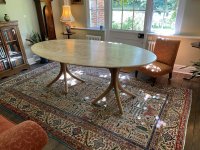
I think it's done. Yesterday I shaped the remaining foot that I hadn't done on Tuesday and gave the legs a final sand and a coat of oil (I decided one coat is enough). I then set about polishing up the final bits of brass and completed that this morning. That meant there was nothing for it but to put the it all together!

I decided to first put it together in the front hall because doing it in the kitchen (where it is ultimately destined for) involves dismantling and moving the old table. I didn't want to do all of that only to discover some major problem with the new table. Fortunately, there were no significant issues.

IMG_3299.jpeg

IMG_3301.jpeg

IMG_3304.jpeg
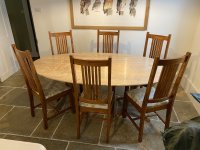
I grabbed our dining room chairs, just to see how they'd fit round it. Six chairs fit really well. We could seat eight people at the table, but wouldn't have that many chairs around it permanently (our kitchen is a bit small for that).

IMG_3306.jpeg

All that was left was to move it to its final resting place in the kitchen.

IMG_3311.jpeg

We'll make do with the old kitchen chairs for the time being, until I get round to making some new ones. This has been the biggest, most time-consuming project I've undertaken, but it has been a lot of fun. The chairs will be another challenge. Watch this space...
 
I think it's done. Yesterday I shaped the remaining foot that I hadn't done on Tuesday and gave the legs a final sand and a coat of oil (I decided one coat is enough). I then set about polishing up the final bits of brass and completed that this morning. That meant there was nothing for it but to put the it all together!

I decided to first put it together in the front hall because doing it in the kitchen (where it is ultimately destined for) involves dismantling and moving the old table. I didn't want to do all of that only to discover some major problem with the new table. Fortunately, there were no significant issues.

View attachment 28586

View attachment 28583

View attachment 28584
I grabbed our dining room chairs, just to see how they'd fit round it. Six chairs fit really well. We could seat eight people at the table, but wouldn't have that many chairs around it permanently (our kitchen is a bit small for that).

View attachment 28585

All that was left was to move it to its final resting place in the kitchen.

View attachment 28587

We'll make do with the old kitchen chairs for the time being, until I get round to making some new ones. This has been the biggest, most time-consuming project I've undertaken, but it has been a lot of fun. The chairs will be another challenge. Watch this space...
Nick, top notch and I love the contrast with with your chair colour .
 
Last edited:
Very nice the top looks really eye catching but so do the legs. Very well done to you.
 
Last edited:
That looks great, Nick. The brass looks like over-kill to me, but no-one will ever see it. I'll be interested to see your chairs.

You've got the same stone on your floor as I have.
 
Last edited:
Thanks for the kind comments.

We've started using the table and I'm pleased to report that it seems nice and solid. There's some very small deflection if you push hard on the edge, but it won't be an issue in normal use.
 
Really like it, a single set of legs would look good for a smaller table.
 
Nice table and love the artwork too.

Just a thought. Can chairs be made with splayed legs like that? A quick google can’t find any examples so perhaps not.
 
Nice table and love the artwork too.

Just a thought. Can chairs be made with splayed legs like that? A quick google can’t find any examples so perhaps not.

The thought crossed my mind, but, even if that is possible, I think it might look a bit too funky. I think I'll be going for something fairly simple and conventional which are similar in size to the dining room chairs shown in the photo above. The current chairs (photo below) we have in the kitchen (which are really dining room chairs) have very high backs which we aren't all that keen on. They overpower the room somehow.

IMG_3314.jpeg

The picture is a print of a painting by Jim Moir (better known as Vic Reeves). I bought it for my wife a few years ago and made the frame for it.
 
That looks great, Nick. The brass looks like over-kill to me, but no-one will ever see it. I've be interested to see your chairs.

You've got the same stone on your floor as I have.
I was worried about the floor, because it's not very flat and I could foresee hours of adjusting legs to get the table to sit there without it wobbling. However, I was lucky to find it was rock solid exactly where we wanted it! Having said that, a couple of the legs are just off the floor. Visually it looks fine, so I might just add some kind of pad (some thin leather perhaps) just to give it a bit more contact.
 
Excellent table very nice curves and well executed.
 
The picture is a print of a painting by Jim Moir (better known as Vic Reeves). I bought it for my wife a few years ago and made the frame for it.
I caught the back end of a programme on TV a while back showcasing his painting. He is really good.
 
Back
Top