• Hi all and welcome to TheWoodHaven2 brought into the 21st Century, kicking and screaming! We all have Alasdair to thank for the vast bulk of the heavy lifting to get us here, no more so than me because he's taken away a huge burden of responsibility from my shoulders and brought us to this new shiny home, with all your previous content (hopefully) still intact! Please peruse and feed back. There is still plenty to do, like changing the colour scheme, adding the banner graphic, tweaking the odd setting here and there so I have added a new thread in the 'Technical Issues, Bugs and Feature Requests' forum for you to add any issues you find, any missing settings or just anything you'd like to see added/removed from the feature set that Xenforo offers. We will get to everything over the coming weeks so please be patient, but add anything at all to the thread I mention above and we promise to get to them over the next few days/weeks/months. In the meantime, please enjoy!

Machining long lengths

RogerS

Moderator
Staff member
Joined
Jul 21, 2014
Messages
15,616
Reaction score
1,324
Location
Somerset
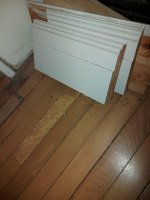
In the process of making up more skirting board like this
20221120_172756.jpg
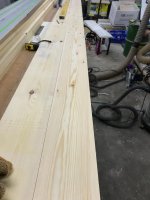
I'd like to make them as long as possible this time. Longest length I can reasonably handle/fit in is 4.2m but I'm finding that, when I try to machine the shorter edge after planing the larger flat side, I end up with bananas. I have additional infeed and outfeed tables which makes the overall length at the planer about 2.5m - see red arrows. Two outrigger roller supports provide support at the ends.
20221120_172536.jpg

Am I asking the impossible ? Any tips or tricks ?

TIA
 
Does it matter? Usually you can push the bow down when you’re nailing it in place, practically everything you get from a builders merchant is severely bowed, cupped, and twisted, but it’ll usually go on OK.

On something of that length, you will have a very difficult time straightening it as it will just likely follow the bow in the whole length on each pass. In an ideal world you need to start the cut at the centre of the piece and work towards each end until it looks reasonably straight when you sight it down the length, then carefully take a pass on the whole length.
 
If you’re struggling & have a tracksaw cut the top edge with that then thickness the board with the fresh cut down first then flip it over & thickness the sawn edge.
 
This is quite a regular thing for me - not with a spindle, but long lengths. The tips from the others are great. I detest doing long lengths for planing or putting through the router table on my own, even though I have rollers, so wait until me wife is able to help with infeed then outfeed, so I can make sure the wood is in cutter contact optimally throughout the process. Sounds daft I suppose but really helps to get a better result.
 
I had a go with Dan't suggestion but the cut that I'd made was so far out of whack, I didn't stand a snowballs'. So I then tried Doug's approach.

My two shorter Festool guide rails give me about 2.8m so I needed something to line them up down the length of the 4.2m board. Used a chalkline which worked well. Cut nearly to the end of the guide rail then shifted it up to finish off the cut. As far as I could see the cut was pretty straight. Certainly much better than my previous attempt.

Then I had the brainwave of using that edge as my reference guide, to run the Festool track saw along, suitably clamped on top of the piece I was cutting. No guide rails needed. Should work. It didn't! So no brainer but to stick to the guide rails and chalk line.

But then :idea: If I place the guide rail down for the first cut and then clamp a long straightedge behind it then all I need do is slide the rail up to make the final part of the cut. I don't need the chalk line.
IMG_0369.jpeg

Proof of concept, I offered up this 'new method' edge to what I've been calling my reference edge and it ain't bad.

IMG_0370.jpeg

The other advantage is that by judiciously placing that guide rail cut, I can thickness the other edge in one pass. But that's a Work in Progress... :oops:

The only other thing was to create a good workflow since these long boards are not exactly easy to work with. I'd previously thicknessed across the wide faces. So all that was left to do was :

cut with the guiderails
thickness the remaining edge
store
repeat with the next board
 
Back
Top