• Hi all and welcome to TheWoodHaven2 brought into the 21st Century, kicking and screaming! We all have Alasdair to thank for the vast bulk of the heavy lifting to get us here, no more so than me because he's taken away a huge burden of responsibility from my shoulders and brought us to this new shiny home, with all your previous content (hopefully) still intact! Please peruse and feed back. There is still plenty to do, like changing the colour scheme, adding the banner graphic, tweaking the odd setting here and there so I have added a new thread in the 'Technical Issues, Bugs and Feature Requests' forum for you to add any issues you find, any missing settings or just anything you'd like to see added/removed from the feature set that Xenforo offers. We will get to everything over the coming weeks so please be patient, but add anything at all to the thread I mention above and we promise to get to them over the next few days/weeks/months. In the meantime, please enjoy!

Mike builds a teardrop (cedar roof)

I suppose you can get away without a trap as it’s just going into your waste water container? Also it is an outdoor kitchen.
Will you have one of those drawers with an oblong out of the back?
 
I suppose you can get away without a trap as it’s just going into your waste water container? Also it is an outdoor kitchen.
Will you have one of those drawers with an oblong out of the back?
Yes, there'll be no trap, as there will be no stored waste. The drawers will be by pretty simple and orthodox.........to a point.
 
Last edited:
I received a delivery of brass hinges and screws. They're both pretty small. I did a test on some scrap:

IMG_8925.jpg

....and quickly realised that the screw holes are going to have to be drilled extremely precisely. Two drills per screw (1.5mm and 2mm). Here's why:

IMG_8930.jpg

It took quite a while, chopping out and paring for 6 hinges:

IMG_8929.jpg

One of the issues was lack of space:

IMG_8931.jpg

Now imagine a mallet and chisel in there.

One of the other issues was that in blending in the curves, the straight stiles weren't completely straight, which meant that scribing for depth wasn't always possible, and a straight edge had to be substituted:

IMG_8932.jpg

Ho hum. The doors were eventually all hung in their frame.

Next.........drawers.

First, I made a side panel for the back of the teardrop, with reinforcement behind to take the screws for fixing the drawer runner:

IMG_8933.jpg

Overnight, I had glued up some 15mm pine I'd had for a while, because the drawer configuration I wanted called for a 220mm deep bottom drawer:

IMG_8934.jpg

I cut this to slightly-over-long, and flattened:

IMG_8935.jpg

.....and brought them to precise length and squareness on the shooting board:

IMG_8936.jpg

I'm going to run through dovetails in detail, so if you've seen this before, skip ahead to the next post.

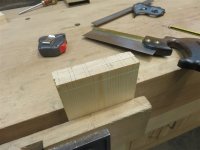
After knifing all the shoulder depths, (knifing, note.....I don't use a gauge) I marked out the tail boards in pairs:

IMG_8937.jpg

I don't mark the sloped cuts, nor use a guide. I just pick an angle, cut it by eye all across the board, and then cut the other slope back across the board, again, by eye. Precision of the angle is somewhere between unnecessary and silly:

IMG_8938.jpg

.....and then hog out the waste with a (broken) coping saw:

IMG_8939.jpg

The shoulders get a little dip chiseled up to the knife line, before being sawn off with a tenon saw:

IMG_8940.jpg

The one concession I make to my new-ish bench is to chisel down onto a piece of scrap ply:

IMG_8942.jpg

The nexty job is fundamental and critical: laying out the pieces in position, marking the outside, and marking each joint:

IMG_8941.jpg

Now, on to the pin board. I've used a guide for the last few years, and it makes the next stage very quick and precise:

IMG_8943.jpg

Always keeping the reference edge of the boards against a fence, laying out and clamping with the vice takes seconds. Then mark with a knife:

IMG_8945.jpg

IMG_8946.jpg

The sawing as before, staying on the waste side of the knife line, just:

IMG_8948.jpg


I don't mark all the verticals. One mark covers two cuts:

IMG_8947.jpg
 
That's all the tails and pins done. Ordinarily, I would run a groove for the bottom of the drawer, but height (depth) is critical here, and in order to maximise I did a rebate instead. The only sensible approach for stopped rebates is a router table, I reckon:

IMG_8949.jpg

IMG_8950.jpg

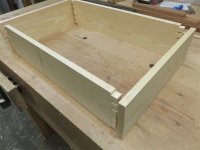
On to gluing up:

IMG_8951.jpg

This will be a tricky little detail to finish off in the morning. The short grain is very short indeed:

IMG_8952.jpg

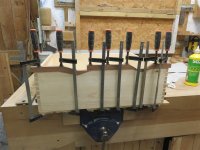
Glue drying:

IMG_8953.jpg

The following day I cleaned up the outsides with various planes, then went and got the biggest standard cereal box from the kitchen:

IMG_8954.jpg

That located a support, necessary as a 600 ish by 500 ish 6mm ply base would otherwise sag. I thought I'd do a sliding dovetail...but one-side-only. The other will be bare faced. I cut a bit of scrap to length and width. then sawed a shoulder and pared a dovetail at any old random angle:

IMG_8955.jpg

After transfering the depth and the angle to the drawer, I plunged in with a router:

IMG_8956.jpg

It's only a very slight taper. I next chopped out at the stopped end:

IMG_8957.jpg

That little manoeuvre allows you to saw all of the side walls to full depth:

IMG_8958.jpg

It takes seconds to clean out the waste with a chisel:

IMG_8959.jpg

You can't actually do a test fit until you've done both joints:

IMG_8960.jpg

After gluing that in place I glued and pinned on the ply bases:

IMG_8961.jpg

Fitting the drawer runners is too mundane to bother photographing, so here are the drawers in place:

IMG_8964.jpg

Before I could hang the top drawer, I had reinforced the hole around the sink:

IMG_8963.jpg

This was necessary because a bit of 4x1 was glued and screwed to the underside of the worktop to take the LH drawer runner of the top drawer, so had to screw into something solid.

Here's the current state of play:

IMG_8965.jpg

IMG_8966.jpg

IMG_8967.jpg

IMG_8968.jpg
 
Last edited:
Looking good Mike. I know you’ve documented it before but can’t be may people who cut dovetails with so little marking out!!
 
Looking good Mike. I know you’ve documented it before but can’t be may people who cut dovetails with so little marking out!!
That's why I show it, Matt. It's been ridiculously over-complicated on Youtube, on forums, and on Facebook etc. It doesn't need to be fancy, or immaculately set-out. As long as the necessary cuts are square across or down the board, it doesn't much matter what shape they are. There's no way old cabinet makers churning out drawers all day long marked out each cut.
 
That's why I show it, Matt. It's been ridiculously over-complicated on Youtube, on forums, and on Facebook etc. It doesn't need to be fancy, or immaculately set-out. As long as the necessary cuts are square across or down the board, it doesn't much matter what shape they are. There's no way old cabinet makers churning out drawers all day long marked out each cut.
Yes too right, and I’m glad it’s not just me wondering what’s got into modern woodworkers.
Marvellous as per normal.
That curvy front panel is terrific in that it looks as if it goes in and out as well as everywhere else. Maybe that would have added a bit to the job though lol.
 
I agree it's great to see how you mark out your dovetails.
As long as the necessary cuts are square across or down the board, it doesn't much matter what shape they are.
This must be right, although I'd add that it's sometimes important that the shape (whatever that might be) of each dovetail is exactly the same.

I'm thinking of finer furniture and boxes where the dovetails are permanently on show (not dovetails on drawer sides). I think that type of furniture is a more modern thing. Carcass dovetails would probably have been veneered over on older fine furniture?

In that case, I think most people would want to lay out the shape of each dovetail.

I'm also very pleased to see someone else likes shreddies (or own brand equivalents)!
 
Looking very good Mike.
Brass screws breaking?! I have the T-shirt, medal.
Learnt the hard way after having to drill out the broken bits.
 
.....and then hog out the waste with a (broken) coping saw:

How about we set up a Mike fund for a new coping saw? 5p from each of us could buy him a swanky model. 😊

I'm surprised you're thinking of carting cereal boxes on your trips Mike. You can buy square sided lightweight plastic canisters with excellent vacuum sealing lids that will hold all you need while away and take up less space. They're only a couple of quid or so each. We used smaller ones also for tea and coffee. Just filled and emptied before and after each trip. Same for the dried dog food.

We bought ours from ASDA and Home Bargains I think
 
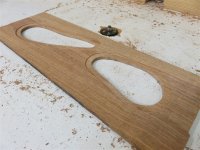
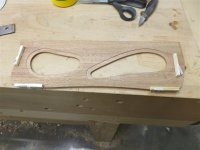
This teardrop was always meant to be a bit of fun: some light-hearted workshop-time, and something a bit frivolous. Well a boring pair of plain pine drawers didn't quite fit in with that. So, I cut up some cardboard:

IMG_8971.jpg

IMG_8970.jpg

Time for some Dutchmen. I wouldn't want to see a mix of pine and sapele on the top edge of the drawer front when the drawer was open:

IMG_8972.jpg

IMG_8973.jpg

IMG_8979.jpg

....and then once that was planed flush, some scraps on the top:

IMG_8978.jpg

IMG_8980.jpg

IMG_8981.jpg

IMG_8984.jpg

I took the last photo because of the shaving in the mouth of the smoothing plane.

I had a board of 5-ish mm thick sapele, but it wasn't very big. I had to make the best of it I could:

IMG_8982.jpg

IMG_8983.jpg

I added lots more clamps......but that lot is very delicate.

Whilst the glue was drying, I darkened up the face of the ply:

IMG_8985.jpg

I added 3 or 4 coats to that, and got it appreciably darker.

When the drawer front emerged from clamps, I cleaned it up with anything which would work. I was as careful as careful can be:

IMG_8986.jpg


.......but not careful enough:

IMG_8987.jpg


So, I scraped the dry glue off and tried again. There was a suspect joint at the other end which also got done a second time:

IMG_8988.jpg

That was the week. It was so bits-and-pieces, with one glue-up after another having to wait for the previous to dry, that I didn't really achieve an awful lot.

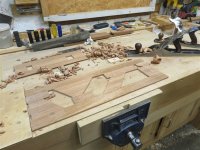
With both false fronts finally glued and cut out, I took them to the router table to remove a margin from the back face, to allow the rattan to fit:

IMG_8989.jpg

Then, I just played around a bit with various rasps and sandpaper until I had the inner shapes nicely fair and rounded (as per the RH one below):

IMG_8990.jpg

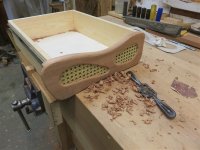
After cutting out and hot-melt-gluing the rattan into place, it was time to glue the face on:

IMG_8991.jpg

The face was located by some little scraps hot glued to the back:

IMG_8992.jpg

........and finally all together in clamps:

IMG_8993.jpg
 
Out of clamps:

IMG_8994.jpg

I had left the top unshaped until it was glued, and then jig-sawed it, before using a spokeshave and sandpaper to round it all over and give it its final shape:

IMG_8995.jpg

IMG_8996.jpg

The bigger drawer had fallen a bit behind because of the breakages, so that was next:

IMG_8997.jpg

.......before gluing up:

IMG_8998.jpg

Whilst that was drying, I turned my attention to the cupboards inside the sleeping area. First, I took a pattern of the curved roof using a tick stick, and transferred it to some 6mm ply:

IMG_8999.jpg

......then cut them out, before offering up and doing a final adjustment:

IMG_9000.jpg

Here's where the cupboards will be going:

IMG_9003.jpg

I declamped the drawer in due course, and did a final fit:

IMG_9001.jpg

IMG_9002.jpg

There'll be a panel in front of the sink eventually, but I'm out of rattan for the moment.

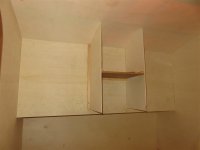
Back to the bedroom. I have decided to do a central area first, and have it stand slightly proud of the cupboards on either side. I want to avoid just a plain run of cupboards across the full width of the teardrop. The idea behind the middle unit is that it will have an open bottom shelf big enough to take an open lap-top, so that woodworking and shipbuilding videos can be watched at night before bed.

I got this far:

IMG_9004.jpg

IMG_9006.jpg

There are some real awkwardnesses to overcome if I'm to avoid seeing lots of ply.
 
.............The idea behind the middle unit is that it will have an open bottom shelf big enough to take an open lap-top, so that woodworking and shipbuilding videos can be watched at night before bed...........

Love it (y) Your priorities are spot on Mike.
 
All great but I wondered why you didn’t make the drawers edges mirror each other (boring and predictable) then I realised that you’ve done away with the need for knobs!
The absence of knobs/ handles is essential, because quite a lot is going to happen directly against the front of the drawers, and there is not a lot of space.
 
Goudi is beginning to grow on me.

Do you know how much a the finished teardrop, fully loaded, is going to weigh?
 
Do you know how much a the finished teardrop, fully loaded, is going to weigh?
I think around 600kg, Andy. I wouldn't be surprised if it sneaked up to 650. There is an absolute limit of 750kg, because it is un-braked and that's the legal limit. I did an extensive exercise in estimating the weight of everything before I started and realised I would have to seriously mess up somewhere to get anywhere near that limit.
 
This is interesting Mike, over here is a single axle does not require electric brakes but a dual axle does.
I have had both and the braked trailer needed an annual inspection.
 
This is interesting Mike, over here is a single axle does not require electric brakes but a dual axle does.
I have had both and the braked trailer needed an annual inspection.
.....and that's also interesting, because here trailers tend to have spring-activated brakes rather than electric ones. Vive la difference!
 
duke said:
This is interesting Mike, over here is a single axle does not require electric brakes but a dual axle does.
I have had both and the braked trailer needed an annual inspection.

.....and that's also interesting, because here trailers tend to have spring-activated brakes rather than electric ones. Vive la difference!

I didn't know they were electric in the US but wise they are subjected to regular inspection where in the UK they aren't and there are many unroadworthy trailers on the roads. If pulled over they can of course still be the subject of procecution.

I have an Ifor Williams twin axle with GW of 2500kg with spring brakes and a little single axle sub 750kg unbraked. An interesting point is when we had the motorhome I had a little Skoda Citigo adapted to be towed and that arrangement was almost identical to the caravan / trailer spring overun system but using the car brakes as in the UK it's treated as being a trailer when towed. However there is a much more expensive electric system available and that's the only time I've come across it here.
 
Back
Top