• Hi all and welcome to TheWoodHaven2 brought into the 21st Century, kicking and screaming! We all have Alasdair to thank for the vast bulk of the heavy lifting to get us here, no more so than me because he's taken away a huge burden of responsibility from my shoulders and brought us to this new shiny home, with all your previous content (hopefully) still intact! Please peruse and feed back. There is still plenty to do, like changing the colour scheme, adding the banner graphic, tweaking the odd setting here and there so I have added a new thread in the 'Technical Issues, Bugs and Feature Requests' forum for you to add any issues you find, any missing settings or just anything you'd like to see added/removed from the feature set that Xenforo offers. We will get to everything over the coming weeks so please be patient, but add anything at all to the thread I mention above and we promise to get to them over the next few days/weeks/months. In the meantime, please enjoy!

Mike builds a teardrop (doors)

That’s the boyo, have you built a steam box yet? Not sure how much experience you have of this Mike, so please disregard.
I suspect that you will be using dry-ish Ash, but thin strips. Suggest about 10 mins for say 30mmx6mm you need to get the stuff out of the box and into place fairly quickly but only medium speed to actually bend it, the fibres have to have time to slide.
Looking forward to seeing this!
Ian
 
That’s the boyo, have you built a steam box yet? Not sure how much experience you have of this Mike, so please disregard.
I suspect that you will be using dry-ish Ash, but thin strips. Suggest about 10 mins for say 30mmx6mm you need to get the stuff out of the box and into place fairly quickly but only medium speed to actually bend it, the fibres have to have time to slide.
Looking forward to seeing this!
Ian
Thanks Ian. Useful. It's many years since I've done any bending......and that wasn't much. And you've guess the size pretty closely.....it's actually 40 x 5mm.

I was thinking of a little longer than 10 minutes. Is there a danger or downside in over-cooking the wood? Although it is kiln dried ash, I actually bought it probably 30 years ago, so I'm hoping it's not as awkward as the the over-dried kilned ash can sometimes be. Some off cuts of bog oak will also be going in the steam box, to see how it behaves. I want to be bending some for real in two or three months time.
 
Thanks Ian. Useful. It's many years since I've done any bending......and that wasn't much. And you've guess the size pretty closely.....it's actually 40 x 5mm.

I was thinking of a little longer than 10 minutes. Is there a danger or downside in over-cooking the wood? Although it is kiln dried ash, I actually bought it probably 30 years ago, so I'm hoping it's not as awkward as the the over-dried kilned ash can sometimes be. Some off cuts of bog oak will also be going in the steam box, to see how it behaves. I want to be bending some for real in two or three months time.
Well I don’t think it will make much difference as to time, 10–20 mins, but it would always be the case that you would need to experiment a little to be confident before starting the big job.
 
Just a quick thought the last time I laminated Maple it was roughly those dimensions and without steam, 4mm thick bent 90degrees to approx around a 100mm diameter, so I think you will be able to bend this with no problem.
 
I can't remember who or where it was, but somewhere recently I came across someone who said they had good results with a long, heavy gauge plastic bag, rather than making up a more permanent steam box.
 
I would give it half an hour just to be safe you won’t get the wood over the boiling point.
I would get it soaking now it will help the heating.

Pete
 
I would give it half an hour just to be safe you won’t get the wood over the boiling point.
I would get it soaking now it will help the heating.

Pete
Oh, OK. I'll do that in the morning, and steam in the afternoon.
 
I can't remember who or where it was, but somewhere recently I came across someone who said they had good results with a long, heavy gauge plastic bag, rather than making up a more permanent steam box.
I’ve seen people use soil pipe as a simple box for long lengths. In fact it was one full of water for soaking and then another one for steaming.
 
I can't remember who or where it was, but somewhere recently I came across someone who said they had good results with a long, heavy gauge plastic bag, rather than making up a more permanent steam box.
Acorn to Arabella steamed their oak planks like that. Boil-in-a-bag seems to be faily common in wooden boatbuilding.
 
I’ve seen people use soil pipe as a simple box for long lengths. In fact it was one full of water for soaking and then another one for steaming.
Yes, I did that last time I steamed anything. It ended up with the pipe bending quite alarmingly.
 
What's that? I've never heard of it.
If I remember correctly: a mixture of glycerin, water, and alcohol. Spray or souse it on, depending on section, allow to soak in.

Edit, from Joe Woodworker:

"There's an old veneer softener recipe of consisting of 3 parts water, 2 parts yellow glue, 1 part vegetable glycerin".
 
What's that? I've never heard of it.
This, @Mike G, is the one I use for bending instrument sides. (It looks like there's a 30% sale on.)

It is intended to soften the veneer enough to flatten it under weight pressure, but the converse is true, to soften straight timber to bend it.
 
I'll start with a little aside. I want to order a hob. I eventually found the dimensions and a good photo of the one I've got my eye on, and so could draw it out full size to check for utility:

IMG_9007.jpg

IMG_9008.jpg

IMG_9009.jpg

That's in the pipeline.

On to more important matters. Last time I posted I had started work on the bedroom cabinets, and had got the carcase of the centre unit done. Time to make up the face frame. These are sapele, and located on the shelves with grooves:

IMG_9010.jpg

IMG_9011.jpg

......and fitted on the unit:

IMG_9012.jpg

This I then screwed into place, enabling me to take measurements for the shelves which go either side (with their "fiddle"):

IMG_9013.jpg

IMG_9014.jpg

Then on to the face frames for the units either side of the central one. As always, mortice & tenons, bridles, and half-laps:

IMG_9015.jpg

IMG_9016.jpg

IMG_9017.jpg

IMG_9018.jpg

IMG_9019.jpg

I next prepared the stock for the doors, and tried out my thicknessing jig for the first time in anger:

IMG_9044.jpg

It worked very well. It needs to, as I have to thickness this lot for the louvres:

IMG_9045.jpg

I was in a rush, so I used the bandsaw for the door bridle joints:

IMG_9046.jpg

Before assembling the door stiles & rails, I needed to cut out for the louvres. Time for a jig. Or two:

IMG_9047.jpg

IMG_9048.jpg

That latter photo shows a wedge which I inserted and marked into each end of the channel in the jig, to check that it went in the same distance, and thus that the groove was parallel. I tried it in action, and it worked. I sawed down each "wall", and then chiseled out in between. The danger was that it would be easy to damage the jig in the process (particularly of chiseling), so I had to be very careful. I added a notch to space each housing correctly:

IMG_9050.jpg

Back in a minute......
 

Attachments

  • IMG_9049.jpg
    IMG_9049.jpg
    152.7 KB · Views: 5
A lot of woodworking is repetitious. Oh well......

IMG_9051.jpg

I then had to make the mirror-image jig, for the opposite stile of the door:

IMG_9052.jpg

......and that resulted in some pleasing chevrons:

IMG_9053.jpg

I could now glue up the two main doors:

IMG_9055.jpg

As everyone who has ever made a framed door knows, there's a reasonable amount of work in cleaning up and fitting into the frame. All done with hand planes and a scraper:

IMG_9056.jpg

When the doors were at this stage I could measure for the louvres, and then set about thicknessing and planing to length:

IMG_9057.jpg

I then ground to a complete halt. I'd ended up with louvres 7mm thick, and wanted to round them over on the front edge. I didn't have any tool at all which could form a round-over of the right radius. The ONLY thing I could find was a bead cutter for my combination plane.........but the plane needs a reference surface to work. There was no way of using the plane for the shape. Eventually, after a cup of tea and a think, I decided to try roughing off the waste with a plane, then using the cutter as a hand-held scraper:

IMG_9058.jpg

IMG_9059.jpg

Yeah........good enough, with care.

IMG_9060.jpg

I did 35 or 40 louvres, which took a while.

I had cut the louvres a tad over-length so that I could shoot them to their final dimension one by one:

IMG_9061.jpg

IMG_9062.jpg

I glued them into their grooves:

IMG_9064.jpg

First thing this morning I chucked a bundle of ash strips into the pond:

IMG_9065.jpg

I had previously chopped out for the brass butt hinges, so it didn't take long to hang the doors. They were then pushed into place as a dry fit in the teardrop:

IMG_9066.jpg

The middle compartment at the bottom is designed to fit a laptop so that we can sit watching woodworking videos in bed (;)).

IMG_9067.jpg

On to other things. I gathered up 4 scaffold boards, some carpet, some Celotex, and a couple of coat hangers. Time to make a steam box:

IMG_9068.jpg

I seem to have missed the photo of it completed. I'll grab one tomorrow.

The reason I need a steamer is that I want to start building the main doors of the teardrop, and before I do that I must line the door openings. This is what they looked like:

IMG_9069.jpg

IMG_9070.jpg

The latter photo shows a screw against which the steamed ash strips will be pushed as it is bent around two 150mm radius curves. It also shows the edge of the lining ply, one of the reasons the opening needs lining. The other reason is to prevent end-grain cedar strips being on show.......but that will become clear in due course.

I steamed 7 strips of 5x40mm ash for half an hour, and then bent 4 of them into place. It went very well.....and left me with three spares. I had fully expected multiple breaks, but broke none:

IMG_9071.jpg
 
Last edited:
It's vicariously satisfying to see all this lovely construction being done with proper joints and mostly using hand tools.

Personally, I'd have enjoyed a reason to use a wooden hollow or beading plane to shape the edges of the louvres and would have popped out to buy one if I hadn't already got a choice of options, but I can also see the pleasure you are getting from getting so much done.
 
It's vicariously satisfying to see all this lovely construction being done with proper joints and mostly using hand tools.

Thanks Andy. As I hope I've said more than once, this whole project is a bit of fun, so I actively look for chances to do some fun hand tool work.

Personally, I'd have enjoyed a reason to use a wooden hollow or beading plane to shape the edges of the louvres and would have popped out to buy one....

I've got two. One was close to the right size....but not close enough. And I've nowhere to pop out to buy one, unfortunately. I contemplated making one, and I got half way through making a scratch stock, but ultimately, I just wanted to get on.
 
Mike, you do more in the time I have a coffee break than I can do in a week. :ROFLMAO:
Fascinating stuff. (y)
 
Here's that photo I promised of the completed steam box. The door is a scrap of OSB, and the hinge a stapled-on old tea-towel:

IMG_9073.jpg

This morning I glued and pinned the bent linings into place, then demolished the steam box:

IMG_9074.jpg

IMG_9075.jpg


Oh, and I forgot to mention........bog oak doesn't steam bend. My two test pieces cracked up under mild bending pressure, and they'd been steaming for an hour or more by the time I got to them. That could prove to be a bit of a pain later on.
 
I like your louvered doors Mike.
Seeing the wood soaking in the pond put a smile on my face. Years ago I needed to skirt the risers of a curvalinear deck. So I soaked the wood in their swimming pool. It became bendy but I had to kerf the backside of the boards in a few areas.
 
Excellent work Mike. (y)

The louvers look good!
Not much cupboard space for 2. Will you just use a cardboard box for your clobber?
More than 2 nights will pose a problem.
 
Excellent work Mike. (y)

The louvers look good!
Not much cupboard space for 2. Will you just use a cardboard box for your clobber?
More than 2 nights will pose a problem.
I see the cupboards as just a place for the clothes you take off, and your clothes for the morning, plus a toilet bag. There'll be a bag or suitcase in the car for clean clothes. I'm very much balancing space against storage...space in the "room", I mean. The commercial one I worked on last year felt claustrophobic to both my wife and me, so I want a more open feel in ours. The gap under the cupboards is larger than normal, too, for the same reason.
 
Ok.

When we caravaned - wear T today, hang up to air and wear 2 dats later.
Socks & jocks washed daily.
Also when we went for 4 weeks overseas. (except business clothes for few days and wedding clobber)
 
Ah, yes, now you mention a boatbuilder I realise it was our own @Don McDermott


First of all, @Mike G, your work is absolutely splendid, I've just been scrolling back through all the photos, really lovely! I'm curious, how thick was the oak you steamed, and how long did you steam it for?

Steaming with a plastic bag is a very good method indeed, although it has a few drawbacks. One, it can rile up some traditional boatbuilders! I had a slightly heated argument with an Aussie boatbuilder on Facebook about steaming my dinghy planks in a bag. He insisted it didn't work, even though I was providing video evidence that it did. Secondly, if you don't support it properly, you can sometimes tear the bag. Lastly, if you need to be constantly opening and closing the steam bag, it can be a bit difficult. I steamed the dinghy ribs in a bag, and although it worked, I would rather have used a steam box for that.

But the plus side is that it takes up much less space (which always seems to be a problem for me, both for the dinghy and now for the wherry, I'm operating in very cramped conditions), and you can steam things in situ, which is particularly helpful if you are on your own and dealing with large pieces of timber.
 
First of all, @Mike G, your work is absolutely splendid, I've just been scrolling back through all the photos, really lovely!

Thanks Don, much appreciated.

I'm curious, how thick was the oak you steamed, and how long did you steam it for?

It was ash, and only 5mm thick. The first piece steamed for 25 minutes, and the last probably an hour (they all went in together....and things get a bit frantic when steaming, as you know, so I didn't watch the clock too closely). The radius of the bend was the issue, being only 150mm.

Steaming with a plastic bag is a very good method indeed, although it has a few drawbacks. One, it can rile up some traditional boatbuilders! I had a slightly heated argument with an Aussie boatbuilder on Facebook about steaming my dinghy planks in a bag. He insisted it didn't work, even though I was providing video evidence that it did. Secondly, if you don't support it properly, you can sometimes tear the bag. Lastly, if you need to be constantly opening and closing the steam bag, it can be a bit difficult. I steamed the dinghy ribs in a bag, and although it worked, I would rather have used a steam box for that.

But the plus side is that it takes up much less space (which always seems to be a problem for me, both for the dinghy and now for the wherry, I'm operating in very cramped conditions), and you can steam things in situ, which is particularly helpful if you are on your own and dealing with large pieces of timber.

Acorn to Arabella steamed 2" (I think) thick oak planks in a bag, in situ....so clearly your Facebook Aussie doesn't know what he's talking about. They would get the bulk of the plank in place, and just steam the difficult bits at stem and stern. There was always a lot of condensate to drain, so they took care to arrange a small opening at one end of the bag or the other so that it could just run out under gravity. They steam bent their oak frames, too, but I believe they were done in a box.
 
Oh, and I forgot to mention........bog oak doesn't steam bend. My two test pieces cracked up under mild bending pressure, and they'd been steaming for an hour or more by the time I got to them. That could prove to be a bit of a pain later on.
It was the test pieces of bog oak I meant, I see you did say you'd steamed the pieces for an hour, but I was just curious how thick they were.
 
Oh, I see. They were 6 or 8mm thick. It's weird stuff, bog oak. I suspect the cell structure has broken down entirely in the thousands of years they spent in the acidic soup of the bog.
 
Oh, I see. They were 6 or 8mm thick. It's weird stuff, bog oak. I suspect the cell structure has broken down entirely in the thousands of years they spent in the acidic soup of the bog.
I see. It probably is the cell structure, as you say, but might be worth trying another test with a shorter steaming time, an hour for 8mm might have been too much for it and caused it to crack? I'd go for twenty minutes, which roughly fits with the old "hour per inch" steaming rule. Did you soak it before steaming? I have no idea if that helps bog oak as I've never dealt with it before, but I don't suppose it could hurt it!

You may have seen this on Reddit, but I just found someone steaming bog oak.
 
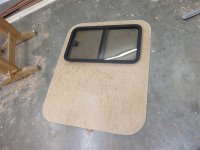
Time to get on with the doors. I offered up a piece of my pattern material, and marked it up in the shape of one of the door openings. I then cut that out, and put one of my newly-acquired windows in place, and marked around that:

IMG_9076.jpg

IMG_9077.jpg

To make the frame, I squared up and then sawed some more Douglas fir, so make 2x1s for the frame. That's finished size, so that the insulation is exactly the depth of the framing:

IMG_9078.jpg

IMG_9079.jpg

After laying one of the side pieces in place on the pattern, I chopped out some 1/2" wide mortices:

IMG_9080.jpg

....before getting to work on the tenons:

IMG_9081.jpg

IMG_9082.jpg

After stewing for a while, I decided that I needed to line the outside of the door, to protect the ply from getting any weather should anything get past the 2 seals. So, I had to off-set an appropriate amount on my pattern:

IMG_9083.jpg

I then cut out the ply skins carefully:

IMG_9084.jpg

I cleaned those up with a plane, and sandpapering block. They form the guide for the near-final shape, because I'll be using a router with a trim bit.

On with the frame. I knew that the rounded corners of the door would mess with the obvious structure. I had toyed with the idea of a 45 degree piece at each corner, but came to the reaslisation that everything would be much stronger (and squarer) if I lifted the rails away from the corners, then fitted secondary timbers around the window opening, and top and bottom of the door:

IMG_9085.jpg

IMG_9086.jpg

IMG_9087.jpg

In a brief diversion from the doors, my rooflight was delivered:

IMG_9088.jpg

......with a problem. It was designed only for a thinner roof, despite what it says on the box. Ho hum. I pressed on with the framing for it:

IMG_9090.jpg

IMG_9091.jpg

Back to the door. I made some little corner pieces for the window opening, and let them in:

IMG_9094.jpg

IMG_9095.jpg
 

Attachments

  • IMG_9089.jpg
    IMG_9089.jpg
    140 KB · Views: 2
Looking good Mike, and yes, we've all spotted the teaser appearance of a lump of bog oak in the background... 😀
 
Looking good Mike, and yes, we've all spotted the teaser appearance of a lump of bog oak in the background... 😀
That's for some knobs for the cupboard doors. I made a test one out of pine, and have lost it (presumed burnt). There's lots of bog oak coming up soon. In fact, very soon.
 
On the back of those inset triangles I made some bigger triangles, and glued them in:

IMG_9096.jpg

IMG_9097.jpg

When those dried, that was the frames completed:

IMG_9098.jpg

The really pleasing thing, as anyone who has ever built a door will agree, is that they are both flat as a pancake without the merest hint of a twist anywhere. I glued and pinned the ply on:

IMG_9099.jpg

Once that had dried, I roughed off the worst of the excess frame with a jigsaw, and then used the router with a bearing-guided trimming bit to bring the frame flush with the ply:

IMG_9100.jpg

There's good reason I dislike the router (you know, apart from the noise, and the dust.....):

IMG_9101.jpg

It just caught in some end grain and blew the wood to pieces. I chopped the loose stuff out, and glued in a Dutchman:

IMG_9102.jpg

IMG_9105.jpg

It doesn't have to be perfect, as it will never be seen again. It just needs to be strong and stable. Here's a shot of one of the window corners. Again, that should all be invisible, but it's a good robust detail:

IMG_9104.jpg

Whilst the above repair was drying, I took the other door to the teardrop and offered it in place:

IMG_9103.jpg

This allowed me to carefully mark up all around for a final fit (pre the steam-bent surround going around the entire door). Back to the workshop for a final tweaking of the fit, before inserting it back into place with some carefully made packers to keep the gaps even.
 
Back
Top