Jonathan":1hpncvhr said:
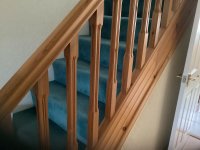
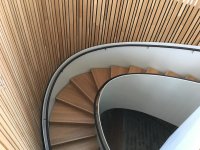
Question for Dan......you got any experience in machining curved handrails, would love to here if you have.
It's something I've never done.
Last week I was asked to look a big project, I would love do to it, but do not have the time, or have any idea how long it takes.
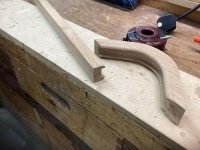
I have moulded single-curvature handrails but not double-curvature which is an entirely different skill level again, it's not often you get complex staircases in this part of the country so I have had little chance to do that kind of work. Single-curvature is fairly simple but does require a bit of jigging to make it work well, for example if you wanted to do a 150mm radius 90-degree bend you would first mould the top face which requires running the convex curve against the bed of the spindle moulder and the top against the fence, this is best done with a curved "ramp" of sorts on the bed to help control the piece and ideally some form of hold-down roller from above to keep it held well against the ramp and another pushing it against the fence. When working like this you do have to be mindful of the projection of the cutters being too large and fouling the work on the concave curve because if the projection is too large for the given handrail radius the cutters will distort the profile, the smaller the cutter block the better the results. You then mould the sided with the handrail flat on the bed and the curves worked against a ring fence or bearing rings.
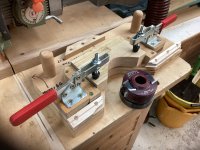
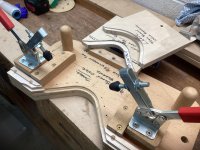
Double-curvature gets much more complicated as there is a twisting motion to moulding the handrails and jigging becomes very difficult, back in the day machine woodworkers made of sterner material than today's would run wreathed handrails by hand over what was called a "Dumpling Block" which was a half-round block with a bored hole in the middle for the spindle moulder shaft to pass through and was bolted to the table. This way the handrail was effectively floating above the table and couldn't foul on anything as you freehand twisted and turned it against the cutters bearing against a ring, roller bearing or even the shaft itself if using a slotted/french spindle, definitely not a job for the faint of heart. Here's a machine by Kirchner (Guilliet also made similar machines) which had a flip-up table which gave more room around the spindle and a foot could be attached in front of the spindle for such work as described above.

At around 6:45 in this French silent film you can see this exact setup in use carving furniture parts in a factory:
https://www.ina.fr/video/VDD10045545/la-fabrication-d-un-siege-a-l-ecole-boulle-video.html
Mike Jordan":1hpncvhr said:
Don’t use any tooling which Is not modern limited projection type. Whitehill blocks still appear on eBay when they really belong in the bin!
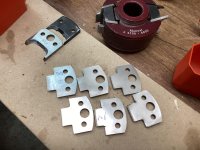
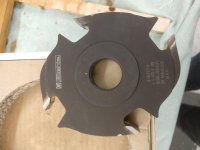
Yes, I agree that the overwhelming majority of this tooling needs to be either refurbished or disposed of. I have a few cutter blocks in my own collection for demonstrations purposes that are for lack of a better word, fecked. This is a block I have which looks in very good condition, the nuts aren't rounded over like many examples and overall it doesn't look beaten up, but it isn't usable.

At some point in its past an operator has placed small cutters right on the edge of the block jaws and tightened the block very tight which has distorted the block which is really only clearly visible when held up to the light. Cutters should be inserted at an absolute minimum of 3/4" into the block so that the cutter is under the screw and the block cannot become distorted.

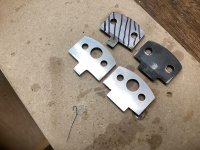
This means that a cutter is only being clamped at the very back of the jaws which makes the block very dangerous to use as the cutters could be ejected during cutting as they are not being clamped across their whole face. Here I've clamped a cutter in and I can fit a .003" shim behind it to show just how severe it is.

I also have this block which I believe has suffered a double ejection during cutting after clamping cutters right on the edge of the block, the madness is that someone seems to have just ground the worst of the marring off and continued using it in this condition.



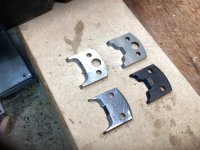 ]I thought this might be of interest to spindle moulder enthusiasts. Most of my work before retirement involved furnishings for narrow boats and Dutch barges. This is a method of edging block board that I have frequently used, it avoids the need to clean off lipped edges and gives a “fiddle rail”. It’s very quick and easy to make and apply once you have the necessary cutters