• Hi all and welcome to TheWoodHaven2 brought into the 21st Century, kicking and screaming! We all have Alasdair to thank for the vast bulk of the heavy lifting to get us here, no more so than me because he's taken away a huge burden of responsibility from my shoulders and brought us to this new shiny home, with all your previous content (hopefully) still intact! Please peruse and feed back. There is still plenty to do, like changing the colour scheme, adding the banner graphic, tweaking the odd setting here and there so I have added a new thread in the 'Technical Issues, Bugs and Feature Requests' forum for you to add any issues you find, any missing settings or just anything you'd like to see added/removed from the feature set that Xenforo offers. We will get to everything over the coming weeks so please be patient, but add anything at all to the thread I mention above and we promise to get to them over the next few days/weeks/months. In the meantime, please enjoy!

Mixing spindle moulder cutters

Mike Jordan

Sapling
Joined
Mar 10, 2017
Messages
430
Reaction score
19
Location
Littleover Derby.
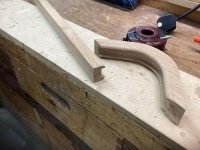
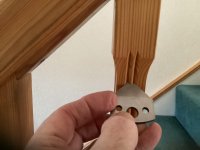
569D2407-F506-4C71-8448-6281AB0A6975.jpeg]I thought this might be of interest to spindle moulder enthusiasts. Most of my work before retirement involved furnishings for narrow boats and Dutch barges. This is a method of edging block board that I have frequently used, it avoids the need to clean off lipped edges and gives a “fiddle rail”. It’s very quick and easy to make and apply once you have the necessary cutters
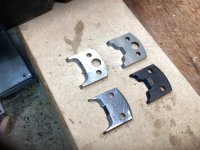
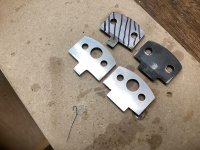
The cutters are purpose made using off the shelf profiles which are easily altered and are of very similar weight to avoid any balance and vibration issues.
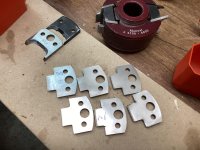
A full set of standard cutters F25 (two knives and two limiters) were ground as shown to enable the outside faces the the material to be rounded over before the inside edges are moulded using one set of rounding cutters and a single square edged cutter and limiter mounted in the block.
The single square edged cutter was made from a cutter blank together with its limiter
2B4E22B4-42BB-4819-913B-8C34E923EC27.jpeg
As you can see from the final photo the block board thickness has varied down the years.
 

Attachments

  • 2ED7FB2F-C64C-4318-853D-3FA9F2044836.jpeg
    2ED7FB2F-C64C-4318-853D-3FA9F2044836.jpeg
    364.2 KB · Views: 1,885
Very inventive, to grind that profile entirely on one cutter would be very difficult and skilled work (by hand and grinder anyway), but two different profiles on two cutters in the same block to make up a more complex moulding is easier, and it used to be fairly common practice with the older Whitehill blocks.

From "Modern Woodworking Machine Practice" by J. Raymond Foyster:

8PA2DgE.png

Moulding against the grain on that elbow must've been fun!
 
That’s brilliant, so obvious when you see it, I wish I’d seen it before and will definitely be using the idea in the future. Thanks for posting.
 
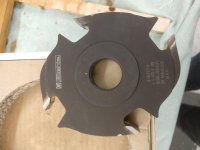
Thinking about it my espagnolette locking system cutter works on a not dissimilar principle the narrower tips with the longer projection cuts the narrow deeper groove whilst the wider shallower groove is cut by the shorter projecting wider tips.

B70F1C94-4094-437A-BE88-212EB81EF42A.jpeg

Not thought of doing this sort of thing with a standard block mind, something to bear in mind.
 
As mentioned, it wasn’t uncommon to use two different cutters in a whitehill block to get a complex shape but the set up took time and care. The locating pins of the limiter block makes accuracy easy.and repeat set ups identical.
 
71F081D9-DC13-4025-92B4-3340FC3F62F6.jpeg
I think this is self explanatory, the maximum amount removed is 6mm. The corner is then band sawn off and the process repeated. My jig takes a block of wood 180mm wide which easily makes four corners.
The straight lengths of edging are finished all round before fitting but the corner pieces are machined on the inside faces only and finished off after the glue has cured.
The bearing shown is 100mm diameter but I have three sizes of guide bearing and a number of cutter block sizes to make a flexible system.
It’s vitally important to ensure that the material is free of defects that might cause pieces to fly off.
This is not a task for the inexperienced!
 
Cabinet man. Its always better and safer to err on the side of caution, the edging material can also be used on an outside corner by cropping the board at 45 degrees and cutting two 22.5 angles.
 
Very interesting.

I have come close to getting a spindle at home (had one in Germany even but didn't ship it) and finally concluded that if I am a bit scared of my router table, a spindle moulder is worse. As an amateur with no training and no experience although I wish I had one, I just think I would not be safe.

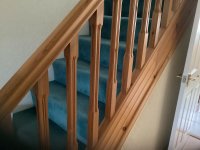
Those stair balusters have given me a hankering again :shock:
 
AJB Temple":yyo8jgpo said:
I have come close to getting a spindle at home (had one in Germany even but didn't ship it) and finally concluded that if I am a bit scared of my router table, a spindle moulder is worse. As an amateur with no training and no experience although I wish I had one, I just think I would not be safe.

Being scared of your equipment is healthy so long as it doesn't prevent you from actually using it, I'd rather work with someone that's overly aware of the danger rather than someone that is completely oblivious to it like the apprentice I mentioned the other day. If it helps, I'm far less comfortable with a router table than I am with the spindle moulder, the main reason for that being that I have had hundreds of hours of my life spent on the spindle moulder, very few on the router table. I do feel the spindle moulder is actually safer in some regards compared to the router table for a few different reasons, one is that with the router being smaller it's quite easy to become complacent with it as shown by many "Influencers" online who have near misses with them.

When you do eventually get one (you will cave in one day) you'll wonder how you did without it for so long, it's such a versatile machine.

There are a few courses for Spindle Moulding which may be worth investigating, I believe Peter Sefton still runs courses, not sure if Marc Fish and Axminster still do. You can get a lot out of the Roy Sutton video though, that covers the vast majority of operations that you might want to do in a safe manner.
 
Adrian, with your love of architecture I would of thought a spindle moulder would open up so many possibilities for you. Imagine all the architectural mouldings you could produce.
When I get my way on a project I design all the moulding and get cutters produced so they are unique.
I would of thought you would get so much pleasure in designing your own mouldings.


Question for Dan......you got any experience in machining curved handrails, would love to here if you have.
It's something I've never done.
Last week I was asked to look a big project, I would love do to it, but do not have the time, or have any idea how long it takes.

Sent from my Redmi Note 9S using Tapatalk
 
I think a better term might be respect rather than fear of the machine. I have never owned a router table but I do frequently invert the machine and fit a plywood base to allow me to round over edges on pieces that are to small to hold down easily. I regard this as something to be done very carefully,
Power routers have been perhaps the most important and versatile tool to arrive during my woodworking years, they enable you to do all sorts of new things very quickly.
The router tables I have seen in use on YouTube and assorted videos of the “how to do it” variety don’t seem to be as well guarded as a spindle moulder.
I’m sure that training on a course would be a good idea but so would gaining experience by making modest size cuts on a properly guarded spindle moulder after viewing a video.
Two serious words of warning
Beware of American made videos ( their practises are frequently very dangerous)
Don’t use any tooling which Is not modern limited projection type. Whitehill blocks still appear on eBay when they really belong in the bin!
 
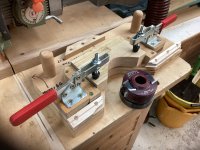
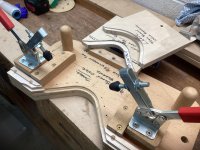
My template for producing the rounded corners was one of four different sizes that for hung on the workshop wall for about three decades. Only very recently did it occur to me that only one was needed with different sized inserts. The inserts fit on the dowel and the toggles secure the timber on top.
Proof if it were needed, that I do think, but slowly!

26D7D409-30AB-4295-AB26-E2D496D3D500.jpeg
 
Jonathan":1hpncvhr said:
Question for Dan......you got any experience in machining curved handrails, would love to here if you have.
It's something I've never done.
Last week I was asked to look a big project, I would love do to it, but do not have the time, or have any idea how long it takes.

I have moulded single-curvature handrails but not double-curvature which is an entirely different skill level again, it's not often you get complex staircases in this part of the country so I have had little chance to do that kind of work. Single-curvature is fairly simple but does require a bit of jigging to make it work well, for example if you wanted to do a 150mm radius 90-degree bend you would first mould the top face which requires running the convex curve against the bed of the spindle moulder and the top against the fence, this is best done with a curved "ramp" of sorts on the bed to help control the piece and ideally some form of hold-down roller from above to keep it held well against the ramp and another pushing it against the fence. When working like this you do have to be mindful of the projection of the cutters being too large and fouling the work on the concave curve because if the projection is too large for the given handrail radius the cutters will distort the profile, the smaller the cutter block the better the results. You then mould the sided with the handrail flat on the bed and the curves worked against a ring fence or bearing rings.

Double-curvature gets much more complicated as there is a twisting motion to moulding the handrails and jigging becomes very difficult, back in the day machine woodworkers made of sterner material than today's would run wreathed handrails by hand over what was called a "Dumpling Block" which was a half-round block with a bored hole in the middle for the spindle moulder shaft to pass through and was bolted to the table. This way the handrail was effectively floating above the table and couldn't foul on anything as you freehand twisted and turned it against the cutters bearing against a ring, roller bearing or even the shaft itself if using a slotted/french spindle, definitely not a job for the faint of heart. Here's a machine by Kirchner (Guilliet also made similar machines) which had a flip-up table which gave more room around the spindle and a foot could be attached in front of the spindle for such work as described above.

BRRdnD7.png

At around 6:45 in this French silent film you can see this exact setup in use carving furniture parts in a factory: https://www.ina.fr/video/VDD10045545/la-fabrication-d-un-siege-a-l-ecole-boulle-video.html

Mike Jordan":1hpncvhr said:
Don’t use any tooling which Is not modern limited projection type. Whitehill blocks still appear on eBay when they really belong in the bin!

Yes, I agree that the overwhelming majority of this tooling needs to be either refurbished or disposed of. I have a few cutter blocks in my own collection for demonstrations purposes that are for lack of a better word, fecked. This is a block I have which looks in very good condition, the nuts aren't rounded over like many examples and overall it doesn't look beaten up, but it isn't usable.

VGRhldX.png

At some point in its past an operator has placed small cutters right on the edge of the block jaws and tightened the block very tight which has distorted the block which is really only clearly visible when held up to the light. Cutters should be inserted at an absolute minimum of 3/4" into the block so that the cutter is under the screw and the block cannot become distorted.

gS3PiQs.png

This means that a cutter is only being clamped at the very back of the jaws which makes the block very dangerous to use as the cutters could be ejected during cutting as they are not being clamped across their whole face. Here I've clamped a cutter in and I can fit a .003" shim behind it to show just how severe it is.

IzOCMUE.png

I also have this block which I believe has suffered a double ejection during cutting after clamping cutters right on the edge of the block, the madness is that someone seems to have just ground the worst of the marring off and continued using it in this condition.


6xptrHM.png

hYXvFBb.png
 
That old French film was fascinating Dan, those boys were getting a real education. I wouldn’t want to have to make a Louis 15th upholstered chair with all the curves and carving! The spinning spindle whilst obviously dangerous by modern standards wasn’t as bad as I was expecting, no doubt the technician who was demonstrating it had done it a lot and made it look easy! But if that cutter came loose it would be pretty bad.
Towards the beginning of the film a boy was using a tool I haven’t seen before to clean up a shoulder, it was like a wooden Jack plane but I think it had sandpaper on the sole and no blade. Quite a few unusual bits of kit shown in the film.
Also an open fire at waist height in an alcove with the glue pots just shoved in ready to use, brill.
 
Thanks for sharing the vid Dan. CNC had probably saved many accidents.

I will try and post a photo of the hand rail job, it's double curve, and over many floors. As much as I would really love to take it on, I can't.
dd79e90b8b5dca6007590d1171863a28.jpg


Sent from my Redmi Note 9S using Tapatalk
 
Can't seem to post more than one image at a time
c27629b72ca4f5d7b9ac8bc3a444a929.jpg


Sent from my Redmi Note 9S using Tapatalk
 
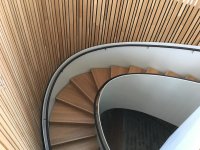
That’s a computer cnc type job, quite a nightmare for ordinary mortals, all I can think of is build it up in situ in thin layers, but obviously not a serious solution. This was a similar stair in a house I worked in, the white sides are solid rolled steel and form the support and strength, haven’t the foggiest how it was done. The oval shape was reproduced in the shape of the barrels supporting the mammoth desk I made, along with the random grooves on the walls which were mirrored on the outside of the barrels.

307FEE74-5321-4E88-9BEA-D0AA6638D9B8.jpeg
 
I come under the ordinary mortal category, it's difficult enough for me to type this message so CNC is never going to happen here.
Remember your barrel desk, super nice!

Sent from my Redmi Note 9S using Tapatalk
 
Thos distorted cutter blocks are an eye opener. This is why I feel unqualified to use a spindle, because I am not certain that I would realise there is a problem. I know btw that whitehill blocks are old tech.
 
Jonathan":q27uldck said:
I come under the ordinary mortal category, it's difficult enough for me to type this message so CNC is never going to happen here.
Remember your barrel desk, super nice!

Sent from my Redmi Note 9S using Tapatalk

Thank you, yes us computer Luddites should stick together lol
Adrian, yes they were pretty disconcerting, the modern ones with the retaining pins are an absolute doddle compared, they made it very simple for idiots like me to use!
 
AJB Temple":2ydqm686 said:
Thos distorted cutter blocks are an eye opener. This is why I feel unqualified to use a spindle, because I am not certain that I would realise there is a problem. I know btw that whitehill blocks are old tech.

As Ian said, the modern blocks are pretty idiot proof, the only thing that can really go wrong with them is loading the cutters incorrectly but all that will do is make a horrid noise when you try to commence a cut and not actually do any cutting. I've never come across a distorted modern euro block, even the aluminium ones, which is a testament to the clever design and advances of modern tooling.

I show the safety features of a modern block in this thread, which you've already read before but I'll link it here anyway if anyone else hasn't read it before: https://www.thewoodhaven2.co.uk/viewtopic.php?f=23&t=6606

Cabinetman":2ydqm686 said:
That old French film was fascinating Dan

Another you may enjoy are the Irish "Hands" documentaries, all of them are on YouTube and cover different crafts.

https://www.youtube.com/watch?v=Ng1W1F5F-sQ

https://www.youtube.com/watch?v=HNqXmhoS2Kk
https://www.youtube.com/watch?v=l38gpMWbzA8

Jonathan":2ydqm686 said:
I will try and post a photo of the hand rail job, it's double curve, and over many floors. As much as I would really love to take it on, I can't.

That one would be complicated to do, even more so if the people who have done the steelwork haven't paid too much attention to their own work as following something that's all over the place in wood is difficult and time-consuming. If each flight has the same rise, going, curvature, and the steelwork is perfect, you could create a "barrel" which is a negative replica of the form of the staircase which you can then form your handrail to if you're laminating or follow if you're shaping it from solid, that way you could make the multiple identical handrails using the same former.
 
Back
Top