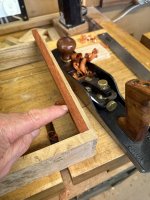
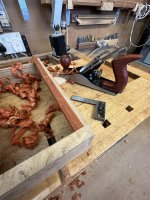
• Hi all and welcome to TheWoodHaven2 brought into the 21st Century, kicking and screaming! We all have Alasdair to thank for the vast bulk of the heavy lifting to get us here, no more so than me because he's taken away a huge burden of responsibility from my shoulders and brought us to this new shiny home, with all your previous content (hopefully) still intact! Please peruse and feed back. There is still plenty to do, like changing the colour scheme, adding the banner graphic, tweaking the odd setting here and there so I have added a new thread in the 'Technical Issues, Bugs and Feature Requests' forum for you to add any issues you find, any missing settings or just anything you'd like to see added/removed from the feature set that Xenforo offers. We will get to everything over the coming weeks so please be patient, but add anything at all to the thread I mention above and we promise to get to them over the next few days/weeks/months. In the meantime, please enjoy!

Modest Stanley No.4 Refurb

Woodbloke

Sequoia
Joined
Jul 22, 2014
Messages
7,177
Reaction score
1,061
Location
Salisbury, UK
Seeking to obtain a No.4 blade and chipbreaker to try out a back bevel scraper plane set up, a few days ago Lurker of this parish informed me that there was a reasonable Stanley No.4 at Wilton Mens Shed, going for the princely sum of a tenner, which I thought was a very reasonable:
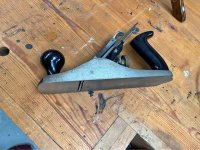
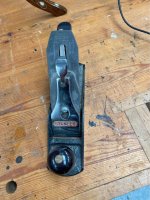
326551693_6185598454792272_6150711165240525930_n.jpg

327487269_8871144519592742_2800840142423407284_n.jpg

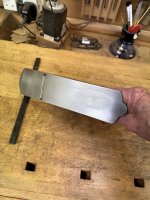
I've spent the last day or so applying a bit of plane fettling savy and TLC:
IMG_0740.jpeg

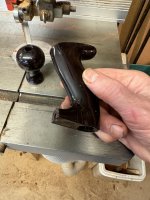
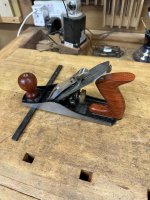
The sole has been flattened (but it wasn't too bad to start with), the frog has been properly bedded onto the body, so there's no 'rock n'role', all the nasty, sharp edges have been dressed. As the existing plastic knob and tote were falling apart:
IMG_0744.jpeg

...I made a new front knob and tote made from Paduk...and if you've never used it, it's fandabby!
IMG_0739.jpeg

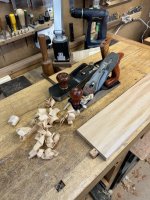
The original owner had far too much camber on the blade for a smoother:
IMG_0743.jpeg

...so this will need to be reground to make it a little less fierce, but the whole plane seems to be working quite well. As I've now found a Record No.4 blade and chipbreaker :eusa-doh: in one of my boxes, I may well treat this Stanley smoother to a new, thicker blade and flat chipbreaker (plus longer 'Y' lever) at some point in the future - Rob
 
Well, I for one think it can be useful to have more than one no 4. You can give yourself an instant choice of any variant of camber, mouth size and cap iro setting, or you can just avoid the need to break off and sharpen for a while.

What puzzles me is why a Men's Shed would be selling off a useful tool for such a trifling amount. I thought they were supposed to be equipped with a variety of tools for their members to use, and an old Stanley like that can easily be as good as a new plane costing over £100, or in Rob's hands, much better.
 
Cabinetman":8ozt1lz4 said:
You’ve made a really smashing job of the knob and handle Rob, the whole plane looks good to go, did you fettle the edges of the sole as well?
Yep, all the nasty sharp edges and burrs were smoothed off

9fingers":8ozt1lz4 said:
But as I recall there is only one door to your shop and you already have scores of other doorstops to hand :lol:

Even I have 100% redundancy when it comes to doorstops with 2 x no4s and one workshop door.

Bob

Yebbut Bob, just think how much more effective your doorstop No.4 would be if it were nicely fettled, had a decent blade and adorned with a couple of nice exotic knobs n'totes? :lol: :lol:

AndyT":8ozt1lz4 said:
What puzzles me is why a Men's Shed would be selling off a useful tool for such a trifling amount. I thought they were supposed to be equipped with a variety of tools for their members to use, and an old Stanley like that can easily be as good as a new plane costing over £100, or in Rob's hands, much better.

Duno Andy, I was surprised at the price as well. When I got home I checked Fleabay and similar offerings were going for at least £25 and often more. I suspect it was 'cos the tote was cracked and broken so in use it would have been swinging around the pivoting stud. The actual plane itself had seen hardly any use but I guess at some point the tote suffered a catastrophic ding wot broke it! - Rob
 
9fingers":1oph0ube said:
But as I recall there is only one door to your shop and you already have scores of other doorstops to hand :lol:

Even I have 100% redundancy when it comes to doorstops with 2 x no4s and one workshop door.

Bob

:lol: :lol:
If the formula is N+1, where N is the number of workshop doors, then I would need 3 number 4s. I rescued a box of planes a year or so ago for pocket-money, and now need at least an extra couple of doors.

Seriously, though, even in a fully machine-based environment I can't imagine how anyone would manage without a plane or two. Are you seriously saying that you never plane anything?
 
Woodbloke":2zj79zk0 said:
...I made a new front knob and tote made from Paduk...and if you've never used it, it's fandabby!....

Those look great, Rob. And no, I've never used paduk. Judging from you photo, I should.
 
Mike G":19qzws2u said:
Are you seriously saying that you never plane anything?

I think my no4 has only been used when fitting the odd door. So for me that is 18months -2years back.
I do have a little block plane which gets used for breaking a sharp edge or corner and I would not like to be without that.
I do have a little veritas router plane which was a gift from Axminster when we had a woodhaven1 show round but that has never been out of its box other than to look at.

So yes planes hardly feature in my woodworking.

Bob
 
Terrific job Rob. The new wood looks lovely.

Sent from my Pixel 4a using Tapatalk
 
Having mentioned that the camber on the No.4 iron was waaaaaaay to steep, I've re-ground it and honed on a far more moderate camber so it now cuts very sweetly. I was also a pondering in bed this morning whether or not it would be possible to bend the existing 'old skool' chipbreaker into a more modern, flatter version. It turns out it's entirely doable and only took around 30mins or so for a complete transformation, the main bit of kit being required is a mechanics mw vice for the bending process. I'll post some pics if there's some interest.

Whilst pondering on such things, I decided to have a go at putting on a camber on a BU iron. It's a very tedious business grinding away a 5mm thick tool steel ground bevel using a Tormek, even with a coarse diamond wheel, but once that was done I used the curved Veritas roller very kindly donated by Philly to apply a pretty steep camber to the edge, bearing in mind that what's seen sighting along the sole with a low angle plane is a very shallow camber.

With some degree of trepidation, I tried it out in the BU smoother and to my utter surprise and delight, it seems to work. Where there were tram lines yesterday planing the same bit of wood, there were none today. Tomorrows wearisome task is to grind a couple more BU irons for the LA Jack and Try Plane and apply the same sort of camber to each - Rob
 
A before and after on the chip breaker “bend” would be interesting please Rob. what is the difference between old skool and modern?
My go to smoothing plane is an LN 164 and has been for the past 20 years.i still have a couple of 4s and a longer 6 or 7 but not used that for yonks.
 
Andyp":1g2sl1gc said:
A before and after on the chip breaker “bend” would be interesting please Rob. what is the difference between old skool and modern?
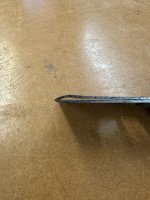
I'll sort some pics out forthwith Andy. 'Old skool' chipbreakers had a pronounced 'bump' just behind the edge which resulted in the iron being bent into a distinct banana shape when the breaker was screwed to it. Modern pattern chipbreakers are virtually flat and cause no bending of the iron.
Your smoother is a low angle plane so won't need a chipbreaker and works on the same principle as the Veritas LA planes - Rob
 
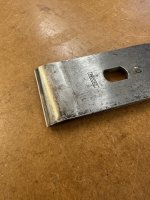
The first coupla pics are of the Record iron I found yesterday in one of my boxes, but the Stanley is identical:

IMG_0752.jpeg

IMG_0754.jpeg

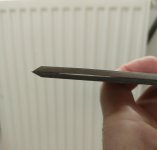
The chipbreaker causes the iron to bend when both are screwed together:

IMG_0751.jpeg

This is the Stanley chipbreaker after my metal mangling efforts this morning; there's still a 'bump' but it's much reduced and when screwed to the iron:

IMG_0755.jpeg

...there's a wee bit of bending, but it's a lot less. With the limited gear I've got at my disposal, it was very difficult to get the chipbreaker flatter as that would probably involved heat treatment and belting it with a large forge hammer on an anvil; I did it by progressively cold bending in a small vice - Rob
 
Chipbreaker? CHIPBREAKER!!!

Carruthers is on his way.
 
All these years and I’ve never noticed- or been concerned by the plane iron being bent, doesn’t reducing the curve like that alter the shavings? After all it was designed like that to stop the wood tearing/ lifting ahead of the cut, but then again I’ve never seen a shaving broken as depicted in woodwork books.
 
Rob. It would be very interesting to see you use this late Stanley for a while. I know you've a preferred selection of planes. But, seeing an experienced woodworker like yourself give it a workout would be enlightening.

Sent from my Pixel 4a using Tapatalk
 
Woodbloke":25jt16l7 said:
.......The chipbreaker [sic] causes the iron to bend when both are screwed together:......

.........and the lever cap forces the pair of them back straight again when it is clipped down. Doesn't it?

Put it this way..........it works. The system works with the cap iron bent the way it's bent. The iron doesn't move around on the frog, at all, and the precious gap between iron and cap iron is tight enough to prevent shavings getting forced in between. I suspect that you might have "fixed" something unnecessarily.
 
Mike G":3phtjea0 said:
Woodbloke":3phtjea0 said:
.......The chipbreaker [sic] causes the iron to bend when both are screwed together:......

.........and the lever cap forces the pair of them back straight again when it is clipped down. Doesn't it?

Put it this way..........it works. The system works with the cap iron bent the way it's bent. The iron doesn't move around on the frog, at all, and the precious gap between iron and cap iron is tight enough to prevent shavings getting forced in between. I suspect that you might have "fixed" something unnecessarily.

Put it this way then Mike and turn the question around. If it works, why aren't they made any more? All new planes have a straight cap iron which keeps the blade straight and thus beds it securely across the whole frog, which in theory ought to provide a more stable/chatter free planing experience - Rob

Edit - ....and no, the blade with a bendy chipbreaker is still bent when it's in the plane
 
During my teeny-tiny obsession - I mean passing interest - in metal plough and combination planes, it was noticeable (there being no pesky side walls in the way) that the cutters that were slightly curved along their length tended to give a better, chatter-free result. Much like a three-legged stool will more readily provide a stable seat on an uneven surface. I'd assume that a good deal more depends on the frog/cutter bed machining if the iron/cutter is flat than if it ain't. Desirability of this state of affairs would be individual preference, but for my money spending time flattening frogs only sounds fun if it involves an oval ball and Twickenham.*

Obviously this is in reference to a curve down towards the sole. If your iron or cutter is curved up, my commisserations - you have a lemon. Or the iron upside down.

*Yes, I suspect it'll be the other way around too.
 
Woodbloke":obvegq4h said:
.........If it works, why aren't they made any more?..........

Well, it obviously does work, and works beautifully.

As to the economics of mass-producing planes when no-one does hand-tool woodworking any more, it's obvious why they aren't made any more. Boutique tool makers exploiting fashion-conscious hobbyists....that's another side of the same coin.
 
Alf":2fg8z2g9 said:
but for my money spending time flattening frogs only sounds fun if it involves an oval ball and Twickenham.*

Brillaint Alf :) :D :eusa-clap:
:text-bravo:

Roll on Saturday
 
I would put my spindly weight behind Alf's thoughts.

The gentle spring imparted by a cap ion creates a bias for success. Pressure at the top, pressure at botom.

On the flip side, recent planes, such as Rob's now very attractive Bailey, may not have always featured the right profile. I sorted one of the apprentices Silverlines by putting in a spare Record cap iron. The Record cap iron was perfect, just the right amount of bend.

That's one of the lovely things about the Bailey, it's pretty forgiving. But, it's still possible to mess it up!


Sent from my Pixel 4a using Tapatalk
 
I confess I know very little about the differences but my thoughts were that the curvature of the cap iron was to stiffen the thin blade and provide a tight mating surface close to the edge to prevent shavings being jammed. Am I not right in thinking that modern blades tend to be thicker on decent planes so it's less important to provide that curve but that modern flat cap irons are more prone to the jamming issue unless perfectly maintained? Also a flat component is surely cheaper to produce even considering the extra steel used.
I don't own an expensive LN or Veritas example but have tried both and have seen it happen.

I'm not arguing here rather gaining new information from you lot who know know far more than me.

EDIT
I've just dug this out which I find interesting, just his opinion of course. https://www.youtube.com/watch?v=6rU_Bnf6NDY
 
The modern high-end tool makers have a strong incentive to produce things that look better, and look as though they ought to work better, whether or not they actually do.

The Bailey style cap iron works well even if there are slight imperfections in the machining of the iron, cap iron, or frog, but looks as though it's introducing gaps where there shouldn't be, even if they don't functionally matter.

The 'modern' style works equally well, but is a lot less tolerant of imperfections - if a thick flat cap iron has a tiny hump in the back, it just won't do its job at all because it won't be contacting the iron at the very front. The iron remaining completely flat also means that the frog needs to be even more flat than in the old style. There's a strong element here, whether conscious or subconscious, of "look how accurate our machining is, these two pieces mate perfectly", which makes the overall product feel higher quality. There's also an element of the modern trend to reduce user maintainability in favour of things that are, but also have to be, right from the factory - an old Stanley cap iron, if it's not mating properly, can be adjusted in a couple of minutes with a vice, a file and a coarse sharpening stone; a modern flat one, if it's not flat, is either a lot more work to flatten it or goes back to the retailer for a replacement.

Some people have reported that they chatter less, and I have no reason to disbelieve that. A heavier, stiffer cap iron could provide some reinforcement to the iron and keep it in place more rigidly, but that's not directly because of the flatness or full contact.
 
Lons":1w5kuk12 said:
Am I not right in thinking that modern blades tend to be thicker on decent planes so it's less important to provide that curve...
Also their frog surfaces are more accurately machined, one imagines.

Lons":1w5kuk12 said:
Also a flat component is surely cheaper to produce even considering the extra steel used.
I wondered about that too. It seems counter-intuative, but it wouldn't surprise me. There's also the perception of what's "better". "Fully machined" sounds great - "bent to shape" doesn't. :lol:

But I'd best shut up, because I'm speaking from dim memory of former warm (rather than heated) technical discussions on the theory of cap irons. By now Paul Chapman would have dragged the two-part cap iron into things (absolutely loved the things, he did), I'd react like one of Pavlov's hounds and automatically renounce it as the cap iron of the devil, and we'd fall to another to and fro on the merits (none, to my mind) and demerits (myriad, obviously) of the Stay Set and Clifton examples. Ah, happy days. Never did reach an accord on that one, beyond "Each to their own". :D

And while I reminisced, spb typed and posted, so yeah, what he said.
 
Alf":2l60bma3 said:
. By now Paul Chapman would have dragged the two-part cap iron into things (absolutely loved the things, he did), I'd react like one of Pavlov's hounds and automatically renounce it as the cap iron of the devil, and we'd fall to another to and fro on the merits (none, to my mind) and demerits (myriad, obviously) of the Stay Set and Clifton examples. Ah, happy days. Never did reach an accord on that one, beyond "Each to their own". :D
I often wonder what happened to Paul; he was a pretty regular visitor to Wilton some years ago but appears have completely dropped off the woodworking radar. Your'e right though Alf, the two-part cap iron was very close to his heart whereas I detested them with an absolute passion...we had 'interesting' discussions on more than one occasion! :eusa-whistle:

Regarding the present discussion, as ever it's 'horses for dooberies.' I for one have always disliked the bendy, traditional 'old skool' cap iron and much prefer the flatter, machined newer version.

spb":2l60bma3 said:
...an old Stanley cap iron, if it's not mating properly, can be adjusted in a couple of minutes with a vice, a file and a coarse sharpening stone; a modern flat one, if it's not flat, is either a lot more work to flatten it or goes back to the retailer for a replacement.

I take small issue with that; a new modern flat one, it it's slightly out of kilter (as some users on Workshop Heaven have mentioned) is just as easy to correct using a very fine file and finishing off with a diamond stone - Rob...who's just been down to Wilton Men's Shed and come back with a decent Record No.4 free and gratis :eusa-dance:
 
Woodbloke - Rob...who's just been down to Wilton Men's Shed and come back with a decent Record No.4 free and gratis :eusa-dance:

That's great for you as recipient but I've given tools to a men's shed and would be annoyed if I found they were giving them away free. I'd rather put them on ebay and give the proceeds to cancer research or the hert foundation
 
Woodbloke":9mh60dww said:
I take small issue with that; a new modern flat one, it it's slightly out of kilter (as some users on Workshop Heaven have mentioned) is just as easy to correct using a very fine file and finishing off with a diamond stone

Surely that depends in which direction it's slightly out - if it's mostly flat but then lifts up just before the front, you've got a lot of material to remove to get it mating properly.
 
spb":2hlpk7xh said:
Woodbloke":2hlpk7xh said:
I take small issue with that; a new modern flat one, it it's slightly out of kilter (as some users on Workshop Heaven have mentioned) is just as easy to correct using a very fine file and finishing off with a diamond stone

Surely that depends in which direction it's slightly out - if it's mostly flat but then lifts up just before the front, you've got a lot of material to remove to get it mating properly.

A few taps with a metalwork maul works a treat given that they're only made out mild steel! :lol: - Rob
 
Lons":3my6vv1r said:
Woodbloke - Rob...who's just been down to Wilton Men's Shed and come back with a decent Record No.4 free and gratis :eusa-dance:

That's great for you as recipient but I've given tools to a men's shed and would be annoyed if I found they were giving them away free. I'd rather put them on ebay and give the proceeds to cancer research or the hert foundation
That's fair enough but I didn't ask, I was offered one from a box full of the things, some of which had broken and brazed castings...those I told him to bin but keep the good bits. They also had a pristine Stanley No.4 complete with it's box, also in excellent condition. He didn't have a clue what it was worth and was surprised when I said it could be around £50-60, all of which, if sold, would go towards the Men's Shed - Rob
 
Just took a quick snap of my Hock O1 blade to show how it sits

IMG_20230309_143036944.jpg

The chipbreaker is very slightly cranked probably 1/2 a millimetre & when tightened up to the blade does very slightly deflect a little less than 1/2 a millimetre

IMG_20230309_144118640.jpg

The same is true of my Hock A2 blade
 
Doug":3rt4jfjh said:
Just took a quick snap of my Hock O1 blade to show how it sits

View attachment 1

The chipbreaker is very slightly cranked probably 1/2 a millimetre & when tightened up to the blade does very slightly deflect the blade a little less than 1/2 a millimetre


The same is true of my Hock A2 blade

There are loads of different 'off the shelf' replacement blades; how do you rate the Hock one Doug?
 
Woodbloke":3gk29gh8 said:
Doug":3gk29gh8 said:
Just took a quick snap of my Hock O1 blade to show how it sits

View attachment 1

The chipbreaker is very slightly cranked probably 1/2 a millimetre & when tightened up to the blade does very slightly deflect the blade a little less than 1/2 a millimetre


The same is true of my Hock A2 blade

There are loads of different 'off the shelf' replacement blades; how do you rate the Hock one Doug?

I like them a lot, I’d agree with the chap in the video Bob (Lons) linked to, I mainly use the A2 as it’s in my site plane, the O1 I picked up cheap when a mate was selling some gear so I bought it more as a spare & it’s not seen much use, interestingly they are both made in France.
 
Woodbloke":177208e7 said:
Lons":177208e7 said:
Woodbloke - Rob...who's just been down to Wilton Men's Shed and come back with a decent Record No.4 free and gratis :eusa-dance:

That's great for you as recipient but I've given tools to a men's shed and would be annoyed if I found they were giving them away free. I'd rather put them on ebay and give the proceeds to cancer research or the hert foundation
That's fair enough but I didn't ask, I was offered one from a box full of the things, some of which had broken and brazed castings...those I told him to bin but keep the good bits. They also had a pristine Stanley No.4 complete with it's box, also in excellent condition. He didn't have a clue what it was worth and was surprised when I said it could be around £50-60, all of which, if sold, would go towards the Men's Shed - Rob

No criticism aimed your way Rob, I'd also have accepted it if offered as would most people, maybe more of wondering why someone in charge didn't have a bit more knowledge or commonsense perhaps. At least it's gone to someone who appreciates it.
 
I'm impressed; gobsmacked even :eusa-dance: I've been faffing around for the last coupla days making a drawer (solid burr Oak with thru shovetails) for my latest project, having a Paduk slips, bottom(s) and a central runner (aka Rob Ingham). I've just started use Paduk for much of my stuff as it's twice as hard as Oak but is as easy to work...except that planing in a certain way will tear out the grain (and it even happens with Oak) :evil:

I was merrily planing away the excess on the underside of my drawer slips:

IMG_0887.jpeg

...and found to my dismay that the grain was tearing out, so I decided to use the re-furbed Stanley No.4 with a 'back bevel' to hopefully take out the tear. I honed the normal bevel to the standard 30deg, then turned the blade over and honed the back to also 30deg. When it's put back in the plane normal side up the effective pitch is now the frog angle (45deg) plus the back bevel (30deg) which makes 75deg, assuming that me 'riffmetic is correct.

It was hard work to push it across the Paduk (it's great stuff, but really dense) but the plane:

IMG_0888.jpeg

....left the Paduk über smooth, with no tear out and dead square - Rob
 
That must be very satisfying for you to have found a solution to the problem, and a useful reference for the rest of us, thanks.

For the sake of completeness, may I ask what was the effective pitch on the bevel-up jack that you were using at first?
 
AndyT":1tijp861 said:
For the sake of completeness, may I ask what was the effective pitch on the bevel-up jack that you were using at first?
Pretty standard Andy; honed at 35deg + 12deg bed angle so 47deg. I have until recently been using a higher angle to hone (42deg) but even that wouldn't have been effective on the Paduk - Rob
 
Back
Top