• Hi all and welcome to TheWoodHaven2 brought into the 21st Century, kicking and screaming! We all have Alasdair to thank for the vast bulk of the heavy lifting to get us here, no more so than me because he's taken away a huge burden of responsibility from my shoulders and brought us to this new shiny home, with all your previous content (hopefully) still intact! Please peruse and feed back. There is still plenty to do, like changing the colour scheme, adding the banner graphic, tweaking the odd setting here and there so I have added a new thread in the 'Technical Issues, Bugs and Feature Requests' forum for you to add any issues you find, any missing settings or just anything you'd like to see added/removed from the feature set that Xenforo offers. We will get to everything over the coming weeks so please be patient, but add anything at all to the thread I mention above and we promise to get to them over the next few days/weeks/months. In the meantime, please enjoy!

Moving an outside mains stopcock. Or not.

RogerS

Moderator
Staff member
Joined
Jul 21, 2014
Messages
15,214
Reaction score
964
Location
And off to pastures new
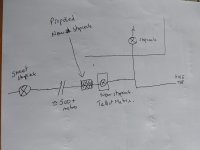
This is the current situation.
20260420_172842.jpg

The relatively new Talbot Matrix stopcock is going to be hidden by us extending the terrace over the top of it with block/beam and then large heavy tiles. This stopcock will not be then easily and simply accessible. Jury-rigging some sort of long-distance vertical access from the topside of the terrace is not on the agenda. I had originally thought that I would intercept the incoming pipe, route to a new accessible stopcock and then plumb back into the house and tap feed.

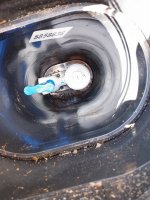
Current Talbot Matrix stopcock
20260420_145135.jpg

Incoming pipe connection ...earthfall just before I took the photo. The incoming pipe connection is nearly 30" deep and actually is rising vertically to the connection point which makes the incoming pipe rather deep. The pipe is also like nothing I have ever seen before. Possibly black. Definitely not the blue stuff. We do not have machine access. There must be a better solution.

20260420_171740.jpg
I think there is but wanted to run it past you guys in case I've missed something.

The solution ?

Leave all the outside stuff alone apart from moving/extending the pipe to the tap connection. If that pipe springs a leak, it's no big deal as it's all outside and we're not on a water meter. Fixing that would mean digging down to the original pipe but then so be it. Obviously we'll fix it but time would not be of the essence compared to a leak inside the house.

Insert a second stopcock in the incoming pipe where it rises vertically here ........
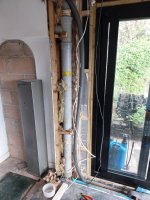
20260420_171848.jpg
as a backup to the existing interal stopcock that lives here
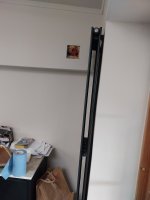
20260420_171857.jpg

I think this plan has wings. Do you ?
 
I would remove the Talbot altogether and put a clean run of new 25mm blue pipe in ( preferably from the street 🤨) with no joins.
Inspection chambers if you have to joint.
Hiding valves or fittings is trouble for the future.
The acme of hipocracy is that you can be prosecuted by the water companies for not fixing leaks if they ever decided to do a pressure test.
 
Last edited:
I would remove the Talbot altogether and put a clean run of new 25mm blue pipe in from the street with no joins......

Ordinarily, this would be the right thing to do. However, if I am following on correctly, that's about 500m of new pipework.

I personally would want an external stopcock within relatively easy reach. I'd at least be contemplating putting a new stopcock in at an obvious and find-able location, well before any branches (garden taps etc), and then running a new unbroken pipe in from there to the internal stopcock. I've had an outside pipe burst before now, ending up with an impressive fountain and a hole in the ground, and I wouldn't want to have to go half a kilometre to turn the water off if that were to happen again.
 
I'd at least be contemplating putting a new stopcock in at an obvious and find-able location, well before any branches (garden taps etc), and then running a new unbroken pipe in from there to the internal stopcock
I did exactly this back in Belfast 35 years ago, when lead pipes and inaccessability combined to dictate a new blue, 25mm mains connection, run around the perimeter of the house, to enter just below the sink.
The neighbours were dead jealous as their old silted-up lines gave dribbles and I had a thundering head of pressure.
Find a location on the mains pipe run and fit a new stopcock adjacent to the house Roger. That proposed 'extra' stopcock inside has me asking "Why?" and it's (by the look of it) going to be behind a plaster wall? Gypsum sheet and spurting water - from a faulty installation - are not good bedfellows.
Sam
 
Would it be possible to leave the water pipe/stopcock where it is, build a block enclosure under the floor level which is then covered with a hidden access hatch (as used with block paving)?
 
I'd do eactly what Martn, Mike and Sam said Roger.

I'd be very nervous leaving an existing stopcock or any connectors for your branched tee for that matter buried where they can't be easily and quickly reached. You're not on a meter now but very possibly will be at some stage and in any case a major leak can devastate the surrounding garden. Imagine the potential damage to your new terrace if it happened at the labot you buried under it.

I don't see the point in adding another internal stopcock if the existing is serviceable.

The black pipe isn't uncommon, I've seen it many times and it feeds our own house built in the late eighties. We used o refer to it as alkathene though I don't know if that's correct. Your issue in connecting to it on the street side of the Talbot is locating the pipe which if as deep as you describe will be a bit of a job. If you're going to do that you really need to hire a mini digger. The water companies used to lay their pipes very deep, usually at least 600mm but many much deeper to avoid freezing.

What's the issue with extending the Talbot chamber up to the new terrace and fitting an access lid? That's what I'd do.

Edit
Robert just beat me to that question. :)
 
I did exactly this back in Belfast 35 years ago, when lead pipes and inaccessability combined to dictate a new blue, 25mm mains connection, run around the perimeter of the house, to enter just below the sink.
The neighbours were dead jealous as their old silted-up lines gave dribbles and I had a thundering head of pressure.
Find a location on the mains pipe run and fit a new stopcock adjacent to the house Roger. That proposed 'extra' stopcock inside has me asking "Why?" and it's (by the look of it) going to be behind a plaster wall? Gypsum sheet and spurting water - from a faulty installation - are not good bedfellows.
Sam
My bad. I meant to post that the new stopcock is behind a maintenance panel and so eminently accessible.
I would remove the Talbot altogether and put a clean run of new 25mm blue pipe in ( preferably from the street 🤨) with no joins.
Inspection chambers if you have to joint.
Hiding valves or fittings is trouble for the future.
The acme of hipocracy is that you can be prosecuted by the water companies for not fixing leaks if they ever decided to do a pressure test.
As Mike G has pointed out. The run is 500m +. And the new internal stopcock is behind the maintenance panel
Ordinarily, this would be the right thing to do. However, if I am following on correctly, that's about 500m of new pipework.

I personally would want an external stopcock within relatively easy reach. I'd at least be contemplating putting a new stopcock in at an obvious and find-able location, well before any branches (garden taps etc), and then running a new unbroken pipe in from there to the internal stopcock. I've had an outside pipe burst before now, ending up with an impressive fountain and a hole in the ground, and I wouldn't want to have to go half a kilometre to turn the water off if that were to happen again.
The external stopcock was the original plan but not practical. I don’t mind a fountain !
Would it be possible to leave the water pipe/stopcock where it is, build a block enclosure under the floor level which is then covered with a hidden access hatch (as used with block paving)?
I did think about that but those tiles are damn heavy to lift. No opportunity to hide an access hatch either
The black pipe isn't uncommon, I've seen it many times and it feeds our own house built in the late eighties. We used o refer to it as alkathene though I don't know if that's correct. Your issue in connecting to it on the street side of the Talbot is locating the pipe which if as deep as you describe will be a bit of a job. If you're going to do that you really need to hire a mini digger.
No chance of a mini digger.
What's the issue with extending the Talbot chamber up to the new terrace and fitting an access lid? That's what I'd do.

Edit
Robert just beat me to that question. :)
The tiles would screw things up. Plus my arms aren’t long enough to reach that far down !
 
I'd be very nervous leaving an existing stopcock or any connectors for your branched tee for that matter buried where they can't be easily and quickly reached. You're not on a meter now but very possibly will be at some stage and in any case a major leak can devastate the surrounding garden. Imagine the potential damage to your new terrace if it happened at the labot you buried under it.
If there was a major leak then that’s the time to fix it.
 
If there was a major leak then that’s the time to fix it.
If the leak happened at the Talbot then you would need to partially destroy your new deck to get at it, or have I misunderstood?

You don't need long arms to turn a stopcock on or off just make up a suitable tool. Exactly what I did before they fitted the meter outside and brought it nearer the surface than the old stopcock. A small access maybe 150mm square would be easy for access though you'd see it in the tiles, probably not what you want.

If relocating and no possibility of a digger (why not? Even a micro which can get through a gate and dig a deep hole is worthwhile), then you need to dig a sizeable hole by hand and maybe shutter it to get enough room to fit a new stopcock. I think you'd have to get a couple of lads in to do that.
 
You make valid points, Bob. But where does one stop? I agree we could get a micro-digger in. Not too sure LOML could put up with any more hassle since she would have to replant a large part of garden….reasons that I won’t post on an open forum. I’ll give you a call later.

In an ideal world I would replace the lot but that would need a concrete breaker to reach the pipe that runs from the Talbot and into the house. Dig a bloody great hole in the existing terrace …of size and depth unknown. Demolish Studio 2 to get the new pipe into the house. Sorry life is too short and I will take the risk. Already spending way, way too much time and money on the hovel and both of us are fast running out of energy and patience.
 
Edit: If the beam/block spacing allows it, then I realise it is going to be a good idea to make a 600 x 300 tile removable to gain access to that stopcock ...if layout allows. I do already have a Rubi vacuum tile lifter which will easily handle that size of tile. Not too sure about the arm muscles on the geezer doing the lifting, though.
 
Understood Roger.
At the very least I'd read the small print to check you don't invalidate your insurance policy by burying the Talbot. The policies only normally cover the damage not repair of the leak but that could be very extensive should the worst happen which hopefully it never does and most likely won't.
 
Do you have a water meter with the stopcock in the street ? This allows everything after this to be isolated so why is there another stopcock outside, ie the Talbot ? This is where a water meter can be fitted and is this why this Talbot was installed ? I would not cover this up, to much risk if it does leak and does the water company intend to fit a new water meter here ?
 
Edit: If the beam/block spacing allows it, then I realise it is going to be a good idea to make a 600 x 300 tile removable to gain access to that stopcock ...if layout allows. I do already have a Rubi vacuum tile lifter which will easily handle that size of tile. Not too sure about the arm muscles on the geezer doing the lifting, though.
If you were to let or bolt a ring into the slab, you could probably use a lever to lift it with less effort. Probably also leave an extension tool in the pit to enable easier operation of the stopcock.

Not sure if this would help, but you can fit a push button "Surestop" emergency shut off device, which can be located anywhere convenient. Uses water pressure to close the valve on incoming supply in the house. Our indoor stop tap is difficult to access but we have a Surestop and it is very effective. About £70.
 
Back
Top