• Hi all and welcome to TheWoodHaven2 brought into the 21st Century, kicking and screaming! We all have Alasdair to thank for the vast bulk of the heavy lifting to get us here, no more so than me because he's taken away a huge burden of responsibility from my shoulders and brought us to this new shiny home, with all your previous content (hopefully) still intact! Please peruse and feed back. There is still plenty to do, like changing the colour scheme, adding the banner graphic, tweaking the odd setting here and there so I have added a new thread in the 'Technical Issues, Bugs and Feature Requests' forum for you to add any issues you find, any missing settings or just anything you'd like to see added/removed from the feature set that Xenforo offers. We will get to everything over the coming weeks so please be patient, but add anything at all to the thread I mention above and we promise to get to them over the next few days/weeks/months. In the meantime, please enjoy!

Napkin Rings

Andy Kev.

Nordic Pine
Joined
Jan 4, 2021
Messages
705
Reaction score
52
I've been tasked to produce a set of napkin rings and I've decided for no particular reason that they should be octagonal on the outside but have a conventionally circular hole. They'll probably be 3/8" to 1/2" thick.

I've found a bit of scrap from which I should be able to get a set of eight. I'm just going to drill into the board then saw out and refine the shapes. That would mean of course that one or two of the facets will be end grain. That got me thinking that maybe I should be drilling down into end grain but that would require a piece of wood about 3" x 3" to start with. So they will have a couple of end grain facets on account of me having no wood that thick.

My question is: are there considerations which mean you shouldn't work into end grain apart from the fact that it is presumably very difficult? Would the rings be more likely to break or would the wood be more likely to move and crack?

I'm sure that those will be daft questions to some of you but I honestly don't know what the answers are. It occurs to me that I have hardly ever seen accounts of people going into end grain except for e.g. dowels.
 
I don't think they are more likely to break, the short grain cross sectional area is the same ?

I haven't made napkin rings, but I have turned bangles on a pole lathe. I used a disc of log, in the round, shaped the outside and and removed the middle. Normally using green wood in the round you would worry about splitting, but having removed the centre it is free to shrink as it dries - the task is to guess how much to get the finished size right ! But anyway, my point was that choice of a dense wood is useful, I used some wild plum which seemed pretty tough.
 
Thanks Tony, that's interesting.

I might make both versions. Funnily enough, one of the bits of wood that I could use is plum. It seems to be very dense, so it might be worth a go.
 
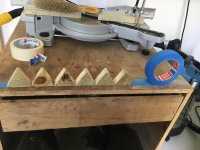
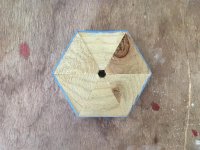
How about making 60 degree equilateral triangle on the CMS and gluing them into a hexagon before drilling the centre out?

Or even an octagon in the same way.
 
Er ... I would do but I don't know what a CMS is.

I've got a bit of paper which is a life size octagon with a point marking the centre. The point is for the centre bit. The octagon is what get's sawed out.

I'm not being obtuse, honestly, it's just that I reckon I don't need anything more than a bit of paper.
 
Andy Kev.":2hnm1oet said:
Er ... I would do but I don't know what a CMS is.

I apologise. It's the compound sliding mitre saw so you can make repeat angled cuts accurately to form a hexagon or octagon.

These might give you the rough idea that I am trying to explain rather poorly.

IMG_2098.JPG

IMG_2099.JPG
 
No need to apologise, Malc. I'd decided that CMS must be something like "Computer Mediated something or other"!

I didn't realise that that is what the saw in your pic is called. I thought they were known as chop saws (which is probably wrong). I'm basically a hand tool bloke with only very occasional use of machines. That said, I caught myself in a shop once looking at a Festool one of those but what a price!

My carefully drawn paper octagon with centre spot is a much cheaper and definitely quieter alternative.
 
I presume that the lady who wants them intends to use them.

One of the reasons that I came up with the idea of an octagonal outer is that they won't be able to roll around the table and if the napkins are suitably stiff (starched even - now there's something that won't happen), they would not touch the table and would so look quite classy IMO.

If the the prototype is a success, every female on my Christmas present list is going to get a set. Offcuts can be fine things.
 
You could glue three pieces of wood together with the middle piece having its grain at 90° to the other two. Very strong and if you use contrasting wood, decorative as well.
 
These get rolled out on high days and holidays although now I know how much they are worth I might keep them under lock and key :)

20221130_101751_resized.jpg

They are octagonal of course. Ihe inside is circular but narrower in the middle than at each end. Carved mice might be a step too far Andy.
 
Those are most impressive.

I'm glad I don't have the skills to make anything like that because I'd end up constantly making them for people. There is something to be said for being stunningly average and I think I shall stick to that!
 
Andy T: did you work out in the end what that ash bed frame of yours weighs? I reckon it must be quite hefty.
 
Andy Kev.":29lb1ef3 said:
Andy T: did you work out in the end what that ash bed frame of yours weighs? I reckon it must be quite hefty.

You're right, but I couldn't put a number on it. I could carry all the parts upstairs ok though and that's what mattered.

The legs ended up 67mm square which I hope is the sweet spot where they are strong but not oversized. I really don't like the trend for coffee tables with 4 inch fence posts for legs and 2 inch planks for the tops.
 
AndyT":2hjm69ik said:
Andy Kev.":2hjm69ik said:
Andy T: did you work out in the end what that ash bed frame of yours weighs? I reckon it must be quite hefty.

The legs ended up 67mm square which I hope is the sweet spot where they are strong but not oversized. I really don't like the trend for coffee tables with 4 inch fence posts for legs and 2 inch planks for the tops.

I had a dining table like that: solid oak, 4" square legs. I've still got the legs as they're bound to come in use one day. It might be a table saw job though to get them ripped.
 
Andy Kev.":12nmux7e said:
Those are most impressive.

I'm glad I don't have the skills to make anything like that because I'd end up constantly making them for people. There is something to be said for being stunningly average and I think I shall stick to that!

I hope you don’t think I made them Andy. There came from the Robert “Mouseman” Thompson’s workshops In the mid 70s.
I guess though that they are about the size and shape you are thinking of. They certainly work with our never been starched serviettes.
 
Andy, when will you post some pics?

I need to start on my Xmas goods and I usually do serviette holders for the kids.
Nee some inspiration :shock:
 
Andyp":2tjt0rel said:
Andy Kev.":2tjt0rel said:
Those are most impressive.

I'm glad I don't have the skills to make anything like that because I'd end up constantly making them for people. There is something to be said for being stunningly average and I think I shall stick to that!

I hope you don’t think I made them Andy. There came from the Robert “Mouseman” Thompson’s workshops In the mid 70s.
I guess though that they are about the size and shape you are thinking of. They certainly work with our never been starched serviettes.

I did think you'd made them!

I think that mine will be nowhere near as wide as those. I'm currently reckoning with about 3/4".

Phil: if I can finish my bedside table this weekend, I'll probably start on them on Monday. FWIW I reckon that the only tools which should be needed are the Forstner bit and a hand saw.
 
Andy Kev.":z222alup said:
Phil: if I can finish my bedside table this weekend, I'll probably start on them on Monday. FWIW I reckon that the only tools which should be needed are the Forstner bit and a hand saw.

Andy, thats fine, I have a hive to first finish off.
 
Right then, the story so far. First of all, get your octagon sorted out (me neither, that's why I went to p 135 of By Hand & Eye by Walker and Tolpin (Lost Art Press). It's bound to be in the internet as well.

Napkin One.jpg

The first measurement in the diameter of the hole. That is determined by the bit (in my case 1 7/8"). I then drew a second circle around that with a diameter of 1/2" more. Then with the aid of the lines drawn through the centre you make the octagon. Your template does not need the hole but it does need a tiny hole in the middle for marking the centre of the octagon. If I knew anything about metalwork, I'd copy the template in a bit of brass sheet.

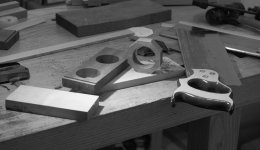
Then cut out your octagon and mark in your napkin rings:

Napkin Three.jpg

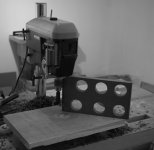
And drill them out:

Napkin Four.jpg

If you've got a band saw, the next phase of cutting them out will be done in minutes. I had to sell mine when I moved, so it was a matter of cutting them out by hand. Tomorrow I'm going to tidy them up and see if I've got some sort of finish available.

Napkin Five.jpg
 
Worked out well Andy, if it were me I think I would reduce the appearance of the thickness by planing a chamfer on all the facets or maybe putting in on a mandrel on the lathe to do it.
Perhaps I missed it what is the timber btw.
 
Ian, the wood is utile and it is surprisingly well-behaved when it comes to planing and sawing. It put up a fair bit of resistance to the forstner bit, though.

The thickness of it is subjective. These things are over 2" across, so to my eye the thickness is proportional. I bet that when I hand them over the wife will think one thing and the husband another (and both will be too polite to be honest).

I think they could stand being a bit thinner but "stand" is the key word. They're going to hold cloth napkins which will probably be 15" x 15" or more. Thicker means less likely to topple and the size of the napkins means that thicker might also be more acceptable in terms of proportion.

I've also had an idea for a radically enhanced design. I'll try to make it and if it works, will put up pics.

As for chamfering: I want to round the corners and edges of the octagon as well as the inner edge of the circle. I'm going to spray glue a bit of fine sandpaper to a sheet of glass and see how that works.
 
Just an off the cuff thought about grain direction and weakness. If you were to use thinner stock laminated together with the grain direction of one board at 90° to the other you would eliminate the weak point.
If you used two contrast timbers it could actually enhance the design.
 
I do like the contrasting timber idea and I think I'll give that a go.

What I would love to do but it is way beyond my skill level, would be a dark one but with a brass inlay along the middle of the edges. Gold would be even better because that would never have to be polished.
 
If you made a sandwich of dark timbers with brass sheet in between, would that be easier? Never tried it BTW.
 
I imagine that that would bring its own problems with it. I know nothing about metalwork and intend to keep it that way. It's all very much dwarf lords in their dark halls of stone. It's certainly a dark art to me although I do occasionally marvel at what some of those chaps get up to on their YouTube clips.
 
Sorry coming into this thread late but as long as wood is well seasoned I never found any trouble from any end grain splitting when turned from single piece of wood.
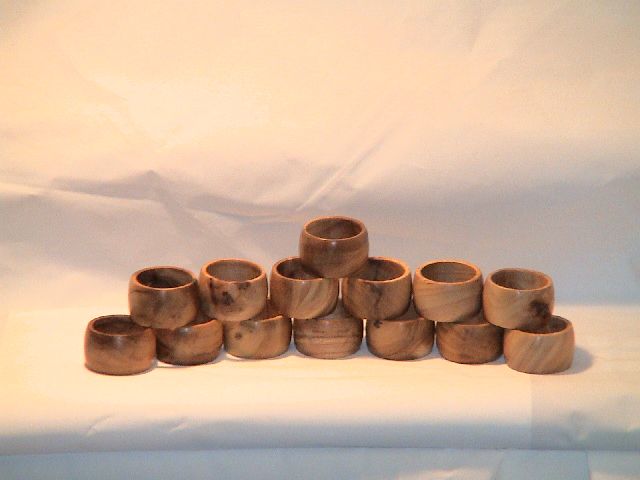
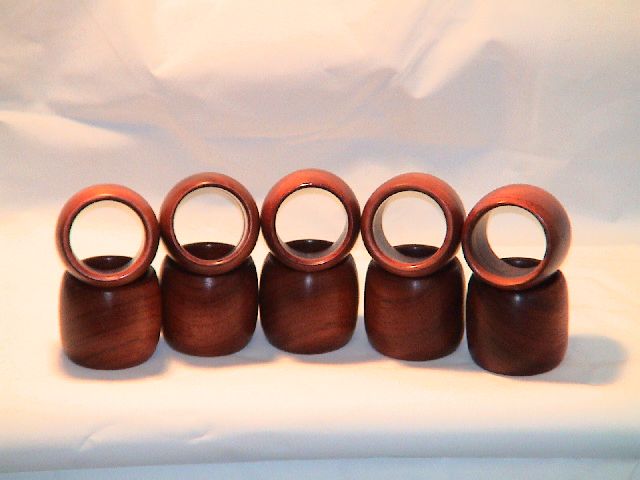
Looking back it was 2006 that I turned up these and I see them still in use by recipients.
DSC01557.JPG

Exeter Elm (30mm bore x 23mm)

DSC01555.JPG

Padauk (30mm bore x 40mm)

Incidentally never had a problem with them rolling about excessively as they usually lie edge on once empty.
 
CHJ, those look very professional and rather attractive.


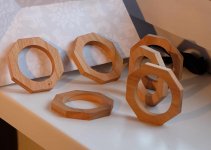
Meanwhile, I've been perfecting my amateurism. These are about as thin as I reckon you can go and still be aesthetically acceptable. They're about 5/16" thick and are of cherry given one coat of Osmo oil which is designed for kitchen working surfaces. The thicker ones which are a shade under 1/2" thick have already gone off to their new owner and I forgot to photograph them. I'm not claiming that these are any good but they do represent what I had in mind and I'm quite happy with them:

Thin Rings (j).jpg
 
You achieved a satisfactory completion of your prime objective of meeting recipients spec. Job done.

If you should get into turning there is a link on my web site (under Projects) on how the above were turned, I doubt I would change the method much if any more were requested.
 
Back
Top