• Hi all and welcome to TheWoodHaven2 brought into the 21st Century, kicking and screaming! We all have Alasdair to thank for the vast bulk of the heavy lifting to get us here, no more so than me because he's taken away a huge burden of responsibility from my shoulders and brought us to this new shiny home, with all your previous content (hopefully) still intact! Please peruse and feed back. There is still plenty to do, like changing the colour scheme, adding the banner graphic, tweaking the odd setting here and there so I have added a new thread in the 'Technical Issues, Bugs and Feature Requests' forum for you to add any issues you find, any missing settings or just anything you'd like to see added/removed from the feature set that Xenforo offers. We will get to everything over the coming weeks so please be patient, but add anything at all to the thread I mention above and we promise to get to them over the next few days/weeks/months. In the meantime, please enjoy!

New species to me

Malc2098

Sequoia
Joined
Jul 3, 2016
Messages
8,276
Reaction score
1,232
Location
Tiverton
Name
Malcolm
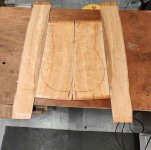
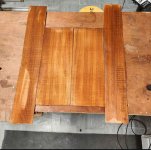
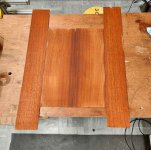
I've just taken delivery of these back and side blanks for acoustic guitars.
468017448_478217018042412_6904636509504549780_n.jpg


Bramley Apple, native to the UK, I believe. :)


468056226_604777995544990_8367037991066760606_n.jpg

Tzalam; or Caribbean Walnut, Sabicu or False Tamarind.


473208897_1577839752864061_8822169669916503757_n.jpg


Machiche; or Black Cabbagebark.


And there's me trying to stick with native species. They came my way as a job lot at a reasonable price. I'll definitely make up a Bramley Apple, but might sit on the other two and maybe sell them on while I'm working the native timbers I have in stock.

I've never heard of the exotic two before. Anyone have experience with them?
 
Careful with the apple, Malcolm. It's renowned for being unstable, so you can expect a relatively large amount of seasonal movement from it. I'm not sure that's a good thing in a musical instrument.
 
Careful with the apple, Malcolm. It's renowned for being unstable, so you can expect a relatively large amount of seasonal movement from it. I'm not sure that's a good thing in a musical instrument.
Yes, I can see a bit already, but the back will be braced and the sides will be laminated.
 
Do you slice them in half for a back and front panels.
They come bookmatched. That means the tonewood sawyer at the mill, rips a number of pieces from a board, hopefully close to quarter sawn, and adjacent pairs create a bookmatch. The fronts, or tops, are mainly from Spruce or Cedars as they are the pieces that vibrate from the strings vibration. They need to be light but strong to do so with sufficient volume and pleasing tone.
 
Machiche; or Black Cabbagebark.

I've got some really old bowl blanks that came from John Boddy and I think a couple of those are Cabbagebark, the grain is very similar to Iroko but a much darker timber, or at least much darker after it's been sat on a shelf for a number of decades. It can be difficult to tell the true colour of timbers once they've aged, I had a bowl blank of Chac Te Koke from the same job lot that was bright orange, but once you started working with it the colour came through as a really deep dark red, similar to Bloodwood.
 
Careful with the apple, Malcolm. It's renowned for being unstable, so you can expect a relatively large amount of seasonal movement from it. I'm not sure that's a good thing in a musical instrument.
I think I'd agree with Mike on this one Malc. Even when the sides are laminated and the back braced as you say, there's still going to be a tendency for the stuff to want to twist and warp. Elm is probably the worst timber for this sort of behaviour but if it's properly seasoned there's no problem with the stuff, not at least in my experience - Rob
 
Back
Top