• Hi all and welcome to TheWoodHaven2 brought into the 21st Century, kicking and screaming! We all have Alasdair to thank for the vast bulk of the heavy lifting to get us here, no more so than me because he's taken away a huge burden of responsibility from my shoulders and brought us to this new shiny home, with all your previous content (hopefully) still intact! Please peruse and feed back. There is still plenty to do, like changing the colour scheme, adding the banner graphic, tweaking the odd setting here and there so I have added a new thread in the 'Technical Issues, Bugs and Feature Requests' forum for you to add any issues you find, any missing settings or just anything you'd like to see added/removed from the feature set that Xenforo offers. We will get to everything over the coming weeks so please be patient, but add anything at all to the thread I mention above and we promise to get to them over the next few days/weeks/months. In the meantime, please enjoy!

Outside door frame - finished

NickM

Old Oak
Joined
Dec 8, 2020
Messages
1,496
Reaction score
785
Location
Near Basingstoke
In 2019, I made this door for a wall in our garden. This was actually the first proper woodworking project I did.
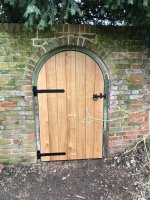
IMG_6098.jpeg

Unfortunately the frame (which was on its last legs when I made the door) has now failed and I need to make a new one.

I'll try to do a short WIP for this in due course, but the first question is to decide what wood to make it from. A few factors to bear in mind:
  • I think I'll probably paint it like the old one (though maybe not green) so appearance isn't a big factor.
  • It needs to be durable.
  • The old one was softwood of some sort and I think it actually lasted well, but I don't know if they make softwood like they used to?
  • I'm not all that keen on using exotic species.
I could use oak, but that would be expensive so I was wondering whether sweet chestnut might be a suitable and cheaper alternative?

Any thoughts on that or any other suggestions?
 
From my very limited experience (one garden chair!) sweet chestnut would be ideal. It's classed as durable, is physically lighter to handle than oak and is not an expensive exotic.

Will you be cutting hammer-head tenons to join the uprights to the arch? I hope so!
 
Chestnut would be OK, but I'm not sure you'll find it very easily, seasoned, in the sort of sections you'll need. I think pro joiners would probably be using iroko or similar, but that will be the same sort of price as oak.
 
From my very limited experience (one garden chair!) sweet chestnut would be ideal. It's classed as durable, is physically lighter to handle than oak and is not an expensive exotic.

Will you be cutting hammer-head tenons to join the uprights to the arch? I hope so!
I've not heard of a hammer-head tenon...
 
Chestnut would be OK, but I'm not sure you'll find it very easily, seasoned, in the sort of sections you'll need. I think pro joiners would probably be using iroko or similar, but that will be the same sort of price as oak.
Thanks Mike.

I'll look into what I can get. I wouldn't be averse to gluing up to get the size I need. I may need to do that anyway to create the arch (overlapping curved sections).
 
I once made a set of French doors with surrounding windows from Ipé. t was very successful (eventually) but VERY brittle. And it needed a special primer.
I think a good softwood that has been pressure treated, such as tanalised, should last a good few years, especially if regularly maintained.
S
 
Why not make it from the same wood that you used to make the door with? It looks like it is doing fine.

Pete
 
Iroko is an obvious contender, but you'd have to drag me kicking and screaming into the 'shop for me to work with the stuff. Whichever way you slice it (no pun intended) it's a really horrible material, so the other choice for me would be Oak - Rob
 
Like others have said, Iroko, and yes it’s not nice to work with.
My second choice would be Sipo its normally ok to work with.
Or look for some tight grained pine and treat the bottoms with old engine oil.
 
Around here it is common practice to apply stored used engine oil to preserve the exterior wood of outbuildings.
And once it gasses off there is little to no smell.
 
Around here it is common practice to apply stored used engine oil to preserve the exterior wood of outbuildings.
And once it gasses off there is little to no smell.
All exterior timber on my property that is in close contact to the ground gets a good soaking in old engine oil and no signs of termites in 20 years. Termites are a big problem here in Southern Spain
I’ve also had success in tinting new engine oil for timbers above ground. As Duke says the smell disappears quite quickly.
 
Why not make it from the same wood that you used to make the door with? It looks like it is doing fine.

Pete
That was oak, which is a possibility.

That photo was taken the day I installed the door which is why it looks good! That said, it is still doing well.
 
My vote goes to iroko every time, it’s not very nice to work with but its durability is better than any other material. Epoxy resin glue is a must for jointing but well worth any extra cost.
Mike.
 
Nobody has mentioned Accoya yet. I don't know how it compares cost-wise against iroko these days, but at least the dust isn't offensive. Plus durability is exceptional if you use the right adhesive and fixings.
 
Does a door frame like that have to be resting on the ground? Having the end grain, of any timber, resting on a moist surface will hasten it’s demise, IME. If the frame can be securely fixed into the wall with an air gap at the ground level this might help with longevity.
 
As a Teacher, I often manage to "aquire" ex Science bench tops which where always iroko.... I believe it was used due to its acid resistance.
 
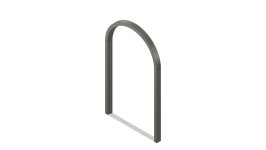
To help me work out what dimensions of wood I need, I've drawn the frame in CAD.

Here's the overall structure:

Garden Door Frame v3.jpg

At the moment, I've made the head from two layers of overlapping curves with 3 on the front and 4 on the back. My next job is to work out what width of wood I need to get the three arcs for the front. I could go 4 and 5 if I decide it's too wasteful to do 3 and 4. George Ellis's "Modern Practical Joinery" suggests 2 and 3 (and that's how the original frame was made), but that would require a really wide board I think.

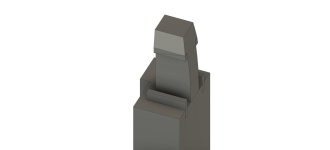
To keep Andy happy, and (but not as importantly of course ;) ) because that's how it's done in Ellis, I've included a hammerhead tenon to connect the head to the jambs. Here's the detail of the joint:
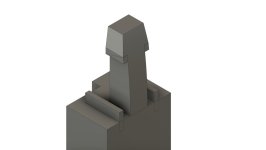
Hammerhead tenon joint.jpg

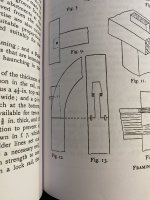
There are splines/tongues either side of the tenon as recommended in Ellis, and wedges to pull the joint up tight. I've guessed at the proportions of the tenon from the drawing in Ellis. Does it look about right to you? Here's the Ellis drawing:

IMG_4524.jpeg

I can't see any detail in Ellis on how to make the joint, but I should be able to work that out. The tricky bit will be "projecting" the hammerhead part onto the curved surface of the head, but I guess the best way of doing it will be to leave part of the outside edge of the head straight/vertical, cut the mortise and then shape the curve into the outside of edge of the head. It should be fun!
 
I'm glad that you're up for the challenge but please don't do it the hard way unless you really want to. I wouldn't have suggested it if I didn't think you could do a good job of it, but I don't want to put any pressure on you either way.

The trouble with the descriptions in the text books is that they rarely give any detail on the advanced stuff - presumably their original readers would have had colleagues to show them how.

However, do have a look at Hasluck's equivalent book here

BookReaderImages.php


It gives a few more hints and does concede that a handrail connector could be used instead.
 
I'm glad that you're up for the challenge but please don't do it the hard way unless you really want to. I wouldn't have suggested it if I didn't think you could do a good job of it, but I don't want to put any pressure on you either way.

The trouble with the descriptions in the text books is that they rarely give any detail on the advanced stuff - presumably their original readers would have had colleagues to show them how.

However, do have a look at Hasluck's equivalent book here

BookReaderImages.php


It gives a few more hints and does concede that a handrail connector could be used instead.
Thanks Andy. I'm joking about you swaying me! It does seem like a traditional way of joining this together and I'm keen to try it!

I'll have a look at that.
 
I've guessed at the proportions of the tenon from the drawing in Ellis. Does it look about right to you?
In one direction it looks fine to me. In the other....the amount the tenon penetrates into the curve.......it looks like the top of the tenon is very narrow. I think I'd be tempted to make it 5 or 10mm deeper/ thicker. The power of the joint is in the wedged shoulders, and it they're too short it could be compromised.
 
Just curious. How would the arch of a frame like that be held in position? Would the arch be screwed into the brickwork? If the verticals and the arch are mechanically fixed to the wall how much stress would the joint be under?
 
In one direction it looks fine to me. In the other....the amount the tenon penetrates into the curve.......it looks like the top of the tenon is very narrow. I think I'd be tempted to make it 5 or 10mm deeper/ thicker. The power of the joint is in the wedged shoulders, and it they're too short it could be compromised.
I was looking again at the drawings in Ellis and the book Andy posted and I agree. I think this looks better:

Revised tenon.jpg
 
Just curious. How would the arch of a frame like that be held in position? Would the arch be screwed into the brickwork? If the verticals and the arch are mechanically fixed to the wall how much stress would the joint be under?

The original seemed to have only the verticals attached to the brick. I wonder if that puts even less vertical stress on the joint because the head can move with the verticals?

It's almost certainly overkill but I'm keen to give it a go. It will keep me out of mischief...
 
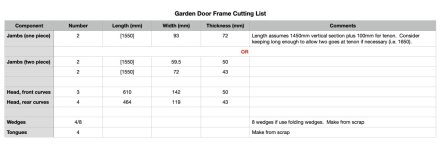
I've done a cutting list:

Untitled.jpg
I've included the option to make the jambs in two pieces. The join would be hidden in, and would form, the rebate. I think it will be easier and cheaper to find timber to make 50mm thick components than 72mm thick. Also, the head will necessarily be made in two layers, so if I do the jambs the same way, I'd only have to buy one thickness of board (i.e. one board if it's big enough). I'm pretty sure I'll go with the 2-piece option but I'll make a final decision when I go to the timber yard.

The dimensions for the curved parts of the head, are rectangles that are big enough to get the curves out of (plus a bit).

I think I'm going to look at air dried timber for this. It's going to be living outside anyway.
 
I was looking again at the drawings in Ellis and the book Andy posted and I agree. I think this looks better:

Yep. That looks more like it to me.

Just a note on the wedges. Your model appears to show a pair of folding wedges under each shoulder, but it's really straightforward to eliminate the upper wedge by simply having a sloped shoulder. It's one less cross-grain element allowing water to track into the joint.
 
I've added an edit, after it was "liked". I wouldn't want anyone to miss my super-dooper-important point! :)
 
Just thinking about how you'd cut the joint.
I'd assume that you would make the hammer head first, by sawing stop cuts then chiselling.

You'd lay it on a square face of what would become part of the circle, while it was still square. Mark round it, saw/bore/chisel. Test fit.

Then cut the curve, removing the bits of the joint that fitted most neatly!

I'd be using some sort of gap filling construction adhesive too. Or a bit of the sort of gloopy compound that boat builders use on scarfs.

Has anyone yone here actually done some of these? @Planeiron ?
 
Yep. That looks more like it to me.

Just a note on the wedges. Your model appears to show a pair of folding wedges under each shoulder, but it's really straightforward to eliminate the upper wedge by simply having a sloped shoulder. It's one less cross-grain element allowing water to track into the joint.
Yes, agreed. you'll see in my cutting list that I've envisaged 4 or 8 wedges depending on whether they're folding or not. I've seen the joint drawn somewhere with folding wedges, but I think a sloped shoulder makes more sense.
 
Just thinking about how you'd cut the joint.
I'd assume that you would make the hammer head first, by sawing stop cuts then chiselling.

You'd lay it on a square face of what would become part of the circle, while it was still square. Mark round it, saw/bore/chisel. Test fit.

Then cut the curve, removing the bits of the joint that fitted most neatly!

I'd be using some sort of gap filling construction adhesive too. Or a bit of the sort of gloopy compound that boat builders use on scarfs.

Has anyone yone here actually done some of these?
Thanks Andy. That's how I was thinking about it (and how I tried, poorly, to describe it in an earlier post). I'm sure the gap-filling nature of the adhesive won't be necessary though...🤞

If anyone has done this before, please reveal yourself!!
 
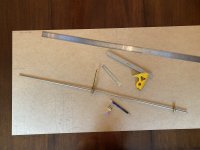
I've now done a full size drawing on a bit of MDF to use as a rod.

IMG_4528.jpeg

I'll also make a template for the arcs from some thicker MDF.
 
Never done one so this may be silly, but could the joints be cut on the inside face instead? This would stop a lot of water ingress hopefully.
But I think if I were doing this particular job for an outside location the only hammer would be the one in the toolbox. I would perhaps do a wedge type joint like on a cricket bat. Is it called a splice joint? Maybe even with a trenail through to tighten it up.
Not criticising the hammer joint I just feel it’s unsuitable for outside work.
Ian
 
Fair point Ian. I was just looking for a diagram of an arched door frame and in fact found something for the interior of a mansion. It does look fun though and with Nick's skills I expect it will be as good as anything outdoors in a Japanese temple.
 
Fair point Ian. I was just looking for a diagram of an arched door frame and in fact found something for the interior of a mansion. It does look fun though and with Nick's skills I expect it will be as good as anything outdoors in a Japanese temple.
I wasn’t very fair Andy sorry, and yes it reminds me of Japanese work too, I just didn’t want him to be disappointed in a few years to find that they’ve rotted.
Perhaps a strip of tarpaper siliconed to the wood between the wood and the brick might help?
 
Never done one so this may be silly, but could the joints be cut on the inside face instead? This would stop a lot of water ingress hopefully.
But I think if I were doing this particular job for an outside location the only hammer would be the one in the toolbox. I would perhaps do a wedge type joint like on a cricket bat. Is it called a splice joint? Maybe even with a trenail through to tighten it up.
Not criticising the hammer joint I just feel it’s unsuitable for outside work.
Ian
Thanks. The brick arch actually provides a lot of shelter for this. I think the old frame had been there for a very long time and although the bottoms of the jambs were rotten and one of the joints with the head had failed, it actually stood up really well. I'm now wondering about not painting it, so wouldn't want the joint on the inside. Whatever joint I use, there will always be some risk of water ingress, but I'm confident it'll be OK.
 
At the risk of being labelled a philistine, I would be tempted to make a softwood template for the arch and laminate it up in one piece from (say) 6 to 8 laminates of your chosen timber. I agree with others that iroko lasts forever and I’m lucky in that I have no reaction to it. However when it comes to gluing it, it’s essential to degrease it with meths or acetone.
 
Last edited:
At the risk of being labelled a philistine, I would be tempted to make a softwood template for the arch and laminate it up in one piece from (say) 6 to 8 laminates of your chosen timber.
That would definitely be a good way of doing it, but I'm trying to do this as traditionally as I can.
 
Back
Top