• Hi all and welcome to TheWoodHaven2 brought into the 21st Century, kicking and screaming! We all have Alasdair to thank for the vast bulk of the heavy lifting to get us here, no more so than me because he's taken away a huge burden of responsibility from my shoulders and brought us to this new shiny home, with all your previous content (hopefully) still intact! Please peruse and feed back. There is still plenty to do, like changing the colour scheme, adding the banner graphic, tweaking the odd setting here and there so I have added a new thread in the 'Technical Issues, Bugs and Feature Requests' forum for you to add any issues you find, any missing settings or just anything you'd like to see added/removed from the feature set that Xenforo offers. We will get to everything over the coming weeks so please be patient, but add anything at all to the thread I mention above and we promise to get to them over the next few days/weeks/months. In the meantime, please enjoy!

Panel hacksaw?

Chris152

Sapling
Joined
May 2, 2021
Messages
452
Reaction score
64
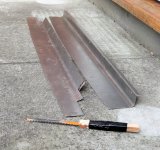
We're trying to cut a shallow curve in a meter length of 0.9 mm mild steel for a repair panel on a car. My jig saw is worse than useless, it follows the direction it wants. I checked out prices of good jig saws and they're expensive. Searching around, I see there's such a thing as a panel hacksaw, which has no frame and therefore can cut longer lengths, but can't find one for sale in the UK (google search). Any idea where we could get one?
Thanks, C
 
If you found one it wouldn't cut a curve, anyway, they have a flat blade with the hacksaw blade on the bottom. Curiously enough I saw one at the market yesterday - the first one I've seen for years.
 
Good job I didn't find one to buy then, Phil!

That nibbler looks useful but I could imagine making quite a mess with it, from the videos I've just looked at - I've cut a template using ply for the jig saw, but tbh the Stanley saw Andy linked to looks more controllable for me. The quicker the cuts, the more chance of irreversible damage. I wonder if I could just sandwich a section of a regular hacksaw blade between two bits of wood with resin to make a handle - looking at ads for the Stanley, it looks like it's just a regular blade? If so, what's a good make of hacksaw blade to buy, preferably one that keeps its teeth longest? I cut a couple of lengths of angle iron a couple of days ago using a hacksaw and that wasn't too bad, so .9mm should be easy enough.

One other thing - the steel has a coating of grease to keep it from rusting - any ideas what's best to remove it before priming?
Thanks
 
Chris152":2yg9j4ew said:
If so, what's a good make of hacksaw blade to buy, preferably one that keeps its teeth longest? I cut a couple of lengths of angle iron a couple of days ago using a hacksaw and that wasn't too bad, so .9mm should be easy enough.

I personally use Bahco Sandflex blades (Eclipse are also good) but what you need to make sure is you buy a blade that is suitable for what you're cutting, cutting a piece of thick angle iron with an 18tpi blade is a dawdle but you try and cut a 1mm sheet with an 18tpi blade you'll have a nightmarish experience with the blade constantly jamming up. If you were try a 32tpi blade instead of the 18tpi on 1mm sheet it would be a world of difference, despite it being a much finer blade it would actually cut quicker because you're not struggling to make it cut, it will cut smoother, and be a more enjoyable experience.

It's all down to how many teeth are in contact with the material, with an 18tpi blade there would only be 0.7 teeth per millimeter, so when you're trying to cut the material you're constantly trying to take a full-depth cut to the bottom of the gullet because the teeth are spaced apart further than the thickness of the material, whereas with a 32tpi blade there are 1.2 teeth per millimeter, so it's not possible for the blade to take too large of a bite as there is always a full tooth skating across the thickness of the material, self-limiting the depth of cut.

Chris152":2yg9j4ew said:
One other thing - the steel has a coating of grease to keep it from rusting - any ideas what's best to remove it before priming?
Thanks

Any de-greaser will work, I use brake cleaner because it's cheap but it's like gold dust at the moment as there seems to be a global chemical shortage.
 
Nibbler, sheer, gilbos or aviation sheers.

A reciprocating saw of any sort isnt the tool.for a thin panel unless you have a really fine blade and short throw (air saw).
 
Choose your weapon.

Degreaser. IPA. Also sold as brake cleaner.
 

Attachments

  • 20210809_182836.jpg
    20210809_182836.jpg
    413 KB · Views: 3,936
disc cutter. Thin metal cutting blade. use only enough disc to cut the steel, dont go deep.
with practice you can make extremely accurate curves.
 
Monodex cutter could do it for you.
Perhaps a Goscut might handle it also, suitable for tight radius cuts with the smallest cutter of the 3 supplied.
Cheers Andy
 
toolsntat":1fd2avap said:
Monodex cutter could do it for you.
Perhaps a Goscut might handle it also, suitable for tight radius cuts with the smallest cutter of the 3 supplied.
Cheers Andy

I've got a Monodex cutter you can have, Chris
 
Thanks all.
I went online after reading Trevanion's and bought a pack of 5 Bahco 32 tpi blades from Toolstation for £7.50, collecting today. I like the idea of working slowly, creating the correct shapes has taken us ages and I really don't want to make a mistake. Plus it's the only real bit of rust we've found on the car so hopefully we won't be doing this again soon, so investing much money isn't the plan if I can avoid it.
Tho we could make good use of some of that kit, Dave!
Trevanion - really appreciate your account of blades, I'd no idea about hacksaw blades' tpi, I thought they were all the same. But we do have lots of brake cleaner, so sorted on that front.
SB - the lad wants a disc cutter, and I'll get one one day if only for trying to carve with one of those attachments, but I've not used one properly and this'd potentially be a bad time to start trying, they look like they could be pretty brutal in the wrong hands?
Roger - let us try the hacksaw method and if that fails, I'll send a pm? I didn't know they existed til Andy mentioned it and it does look like they move at an appropriate pace! I really appreciate the offer.
I'll post an update in a few days to let you know how we got on.
Thanks again, C
 
Chris, a disc cutter is an amazingly versatile tool, and is reasonably safe under most circumstances, I would recommend sooner rather than later if you are restoring cars.
If you have access to sky tv, you can see all the car restoration programmes using them to cut intricate shapes in engine bonnets and other odd shaped surfaces. I especially recommend the Kindig Customs show. They are professional engineers, and the programme isnt dumbed down with incessant yelling and staged incidents.

I'm on my second, having worn the first one down to the bone after more than 20 years on metal, tile, stone, plastic, and most other materials. They are versatile enough that when I had a granite outside worksurface fitted, they cut out a circular hole in 1" thick granite for the sink to fit into.

But.... a disc cutter with a wood carving blade has a bad reputation. Stumpy nubs (a skilled woodworker on you tube) had a very narrow escape (but blood and gore was involved) and now hates the things with a vengeance.
 
sunnybob":3twbabf5 said:
But.... a disc cutter with a wood carving blade has a bad reputation. Stumpy nubs (a skilled woodworker on you tube) had a very narrow escape (but blood and gore was involved) and now hates the things with a vengeance.
That's that off my list of things to do then. I was seduced by short videos of people removing wood swiftly, I guess they omitted to show the fails...

I borrowed an angle grinder once, to dismantle the kids' climbing frame and it was pretty dodgy - the off switch was sticky and I had one catch which put the heeby jeebies up me. But I can see we need to learn to work with one at some point - the lad's starting a welding course in September so hopefully they'll show him how to use it then, I'm certainly not the person to do it after my brief encounter. :shock:
 
Angle grinders can be a useful tool for large-scale wood shaping, but using abrasive flap disks instead of the cutting ones.
 
Chris152":3q7lieqz said:
sunnybob":3q7lieqz said:
But.... a disc cutter with a wood carving blade has a bad reputation. Stumpy nubs (a skilled woodworker on you tube) had a very narrow escape (but blood and gore was involved) and now hates the things with a vengeance.
That's that off my list of things to do then. I was seduced by short videos of people removing wood swiftly, I guess they omitted to show the fails...

I borrowed an angle grinder once, to dismantle the kids' climbing frame and it was pretty dodgy - the off switch was sticky and I had one catch which put the heeby jeebies up me. But I can see we need to learn to work with one at some point - the lad's starting a welding course in September so hopefully they'll show him how to use it then, I'm certainly not the person to do it after my brief encounter.

Don't be totally put off the angle grinder, so long as you use it safely with proper cutting accessories you'll be fine. It's a very versatile tool (Disc cutting, grinding, flap-wheeling, wire-wheeling, polycarbide wheels, etc....) and a must-have if you're doing any kind of work in steel.

As Bob says, Stumpy Nubs did have an accident with one, if you haven't seen the video it is here:

[youtubessl]IIQu1e8DGUw[/youtubessl]

In a sort of impromptu case study, let's dissect what happened maturely without tarring all cutting equipment with the same brush, as there are a number of factors at play in Stumpy's accident that almost made him his namesake. The first factor is it is the chainsaw-type of cutting wheel, which has recently been effectively banned (token gesture) from being sold/marketed as an angle grinder attachment in the UK due to the high risk of injury:

https://www.gov.uk/government/news/uk-safety-alert-issued-for-angle-grinder-chainsaw-disc-attachment

The risk of injury comes from the fact that these cutters are poorly designed with little to no chip limitation, with any rotating cutter that is hand-held or manually fed by a human should be designed with chip limitation in mind. Chip limitation is where you have a piece of material in front of the cutting part of the cutter that limits the amount of material that can be removed in a single revolution, without it a cutter is free to take a full depth of cut in a single revolution, you may have seen this on "anti-kickback" circular saw blades in the past, like this:

AvxV6Yr.png

The nodule in front of the carbide tooth is raised from the saw plate to be about 1mm or so below the cutting arc of the tooth, which means the saw blade can only ever remove 1mm of material in a single revolution thereby helping to prevent a serious kickback. The chainsaw angle grinder attachments do have a depth gauge as with a regular chainsaw chain, but this only limits the depth of cut on a plunging cut rather than a scraping cut on the side of the wheel which is used most of the time with these attachments as shown in Stumpy's video.

The second factor is that Stumpy was effectively climb-cutting with the grinder. If you watch the video when he is carving out the workpiece you can actually see that he is struggling to control the grinder as it's bouncing about in his hands a bit, that was an early warning sign that the machine was liable to kickback and cause injury. This was happening because he was (possibly inadvertantly) using the wrong side of the cutting disc for his positioning, I'll show you in this little diagram below:

qEeLGDG.png

So as with any piece of woodcutting equipment with rotating cutters, be it a router, spindle moulder, planer, or saw there is a general rule that you work against the rotation of the cutter (there are some rare exceptions to the rule where climb cutting is preferable but 99% of the time you will be working against the rotation). I've marked on the image where the cut should be taking place in green to keep control of the grinder as you will be working against the cutter rotation in his particular position on the workpiece, but as shown in the video most of his cutting appears to be happening in the spot marked blue which means Stumpy is cutting with the rotation of the cutting wheel, climb cutting is the term used for this. Now, as you can see from the video Stumpy appears to be struggling to control the grinder as it digs into the material with the rotation of the cutter until it eventually digs enough that it "climbs" the material towards him, where a chip-limited tool may be controlled the unlimited cutter bites deep with each revolution, My Makita 4 1/2" grinder spins at 11,000RPM, which means in one-tenth of a second it will rotate 18 times, with the possibility of taking such large bites so quickly it uses the full power of the motor to fling itself back towards Stumpy as though it was a pinion gear meshed to a gear rack.

The same is true with cutting metal with the grinder also, if you are cutting a steel sheet with the cutting wheel in a vertical plane (the grinder nut would be facing to the left horizontally) you would want to cut with a pull cut as this would be working against the rotation of the cutter resulting in a safe and stable cut. Trying to cut with a push-cut in this position would make the grinder climb up the cut and try to shoot across the piece of metal.

The third factor in the seriousness of Stumpy's injury (This is my opinion, it is a bit of a contested subject) was glove entanglement. Now, using these attachments isn't a totally pleasant experience as you do get pelted with wood chips so one may be tempted to wear gloves to help prevent being sand-blasted by the chips, but this is a very dangerous practice with rotating machinery. Stumpy was going to get a pretty nasty injury, gloves or not, but I believe it may have been made more severe because of the cutter biting and pulling itself into the glove. You should never use gloves around rotating machinery for this very reason, where a solid piece of flesh would simply be cut, a loose glove with catch on the spinning cutter and the injury made worse. In theory, gloves should be fine on a grinder because you should have both hands on the grinder at all times (one on the body and the other on the handle) but I think with this type of tooling the risks outweigh the gains.

A fourth factor that may have been a contributor to the accident is that Stumpy Nubs has a neurological tremor in his hands that causes them to shake, I believe this generally isn't an issue with stationary machines, but when trying to manhandle a grinder I would imagine this doesn't help.

Now, if you're cutting wood like the above example and the chainsaw attachment isn't the one to use, which one is? You should buy from reputable companies such as Arbortech or Saburrtooth who have had years of research and development go into their tools (Arbortech started out because the owner thought the chainsaw wheel was way too dangerous!), Yes, they are more expensive than the cheap Chinese alternatives but can you really put a price on your own wellbeing? A hand or any bodily injury is debilitating and can put you out of work for a very long time if not on a permanent basis if the injury is severe enough.

https://www.arbortech-tools.com/

https://www.saburrtooth.com/

Both companies make excellent and safe-to-use products, there is still an element of danger to the cutters but they are far safer than any alternatives. The Saburrtooth cutters in particular are a very good one to purchase for a beginner for shaping wood with an angle grinder as they are more of an abrader than a cutter, with chip-limitation built into the tool by having the teeth only protrude so far away from the body of the tool.

In all, use the grinder with safe cutting techniques, use safe cutting equipment, avoid wearing gloves, and always wear safety glasses if not a full-face visor. If you follow those you will be as safe as you can possibly be!
 
When cutting metal can I also recommend fire retardant overalls, or stand well out of the way of the sparks.

5A28FA64-9638-4D3A-A6A4-D573703E225C.jpeg

Just as well I was wearing overalls.
 
Yes, that hasn't helped allay my fears much, Andy! That's not the crotch of your jeans is it???

Trevanion - your post's really helpful, tho I've chosen not to watch the vid - I don't want images like that playing on my mind if we're going to have a go. It's helpful as it describes what should be happening and what not to do. I have to admit, several times I've thought it'd be good to have one with a flappy abrasive pad, and you now have me wondering. I want to try cutting the steel with these hacksaw blades I've bought but since SunnyBob mentioned it, I've also been looking at disc grinders. Out of interest, would this be a decent one to start with if we decide to go down that road at some point? Doesn't seem too expensive.
https://www.screwfix.com/p/makita-ga453 ... lsrc=3p.ds
 
here we see Andy working on his car......
angledriver-1.jpg

warning, do not try this at home, Andy is a trained professional who has been doing this for years. ;)
 
Chris, I have that makita. Its a nice medium size.
Flap wheels are a must for removing deep body repairs.
I use mine for cleaning cement and grout off the backs of ceramic tiles that have to be reused, cleans them up like new with no breakages.
Slitting discs, yes. grinding discs, yes. ceramic tile cutting, stainless, you name it theres a disc for it.

Eye and ear protection is 100% mandatory :eusa-naughty: , everything else is personal choice.
No gloves (as said above), they are the devils instruments.

The scary part at first is the turning it on, the sideways torque for the first second is amazing.
If you are of the nervous type, start and stop it a few times with no disc at all. But dont let it run for any length of time with no disc.

Once running, hold it firmly with both hands, work out the direction of spin and feed it in very slowly and dont whatever you do let go. That way even if it kicks it cant bite you. The one handed trick is for advanced experts only. :eusa-whistle:

I have to admit here, that even though I have eye and ear protection, the only other thing I wear during the summer is my swimming shorts. :shock: Possibly too much information :eusa-hand: :lol:
 
Very good analysis from MrT, though I never watch gore videos.

I take the point about not wearing gloves with rotating machinery. However, I do wear tight fitting work gloves a lot of the time (never for lathe work) but certainly with a grinder. Most of the time I use a grinder for cutting stone and brick. 9" grinder is heavy and requires both hands (also the switch cannot be locked on) and protection from chips is necessary (I get eczema easily). Much prefer full face blower mask over my glasses when doing this kind of work too. Also wear gloves for operating big circular saw (Hilti), chain saws. Never really regarded gloves as a risk in such cases.
 
Chris152":368l981j said:
Yes, that hasn't helped allay my fears much, Andy! That's not the crotch of your jeans is it???

yep burnt through the overalls and singed my jeans.

Don't let this put you off. Just stand to one side of the spark trail. Fire retardant overalls are also readily available. £30 quid on Amazon & I expect elsewhere.
 
Taught from secondary school engineering class in the early 60's (the only useful lesson I ever had there), If youre using rotating machines............no gloves, no ties, no long hair, no rings, and shirt sleeves buttoned up tight.
 
Chris152":s0xnbswh said:
Out of interest, would this be a decent one to start with if we decide to go down that road at some point? Doesn't seem too expensive.

That's the Makita I've got and it does the job amply, I did burn out my first one but that was after 5 years of hard and constant use (when it died it had just spent a couple of days scrubbing concrete blocks and grinding cement snots off the inside of a building to prepare for paintwork, doing it in an enclosed space probably didn't do the motor any good as well as running a really heavy diamond cup-wheel for hours) which I don't think is too bad considering it was only something like £32 or so when I bought it, so I bought another without much hesitation. For me, it's definitely more comfortable to use than the equivalent size corded DeWalt grinder which seems far more bulky and cumbersome to handle one-handed compared to the Makita which has a much slimmer body.

AJB Temple":s0xnbswh said:
I take the point about not wearing gloves with rotating machinery. However, I do wear tight fitting work gloves a lot of the time (never for lathe work) but certainly with a grinder. Most of the time I use a grinder for cutting stone and brick. 9" grinder is heavy and requires both hands (also the switch cannot be locked on) and protection from chips is necessary (I get eczema easily). Much prefer full face blower mask over my glasses when doing this kind of work too. Also wear gloves for operating big circular saw (Hilti), chain saws. Never really regarded gloves as a risk in such cases.

I quite often use Maxi-Flex mechanics gloves (brilliant gloves, by the way) with the grinder so I'm not totally against them, I'm just saying I believe that was a contributing factor to the overall seriousness of Stumpy's injury. What occurs to me now that I didn't notice yesterday is that If you look at the photo I posted his hand is quite awkwardly placed on the handle. Your palm should be at the top of the handle with the fingers curled over the front, but it seems his whole hand is arched over the handle and his palm is more sat on the front of the handle than it is the top which put it straight in the firing line of the cutting wheel when the catch did occur. Perhaps if his hand was placed properly on the handle the accident could've been avoided completely.

Speaking of chainsaws, interestingly, you would think because you need both hands to operate a chainsaw that the hands would be one of the least injured parts of the body when it comes to chainsaw operators but in fact injuries involving the left hand are higher than any other body part for some reason! Injuries involving the right hand are almost non-existent though.
 
Schluter make a very nice metal cutting blade (angle grinder) for use with their bathroom trim.
 
No laughing, this is the result of about 30 mins sawing, but we're getting there. I think that's a pretty impressive saw build, and so far have all fingers in tact and nobody's crotch has burst into flame.
Just thought I'd update as it offers a break.
_MG_0381.jpg
:-)
 
screw that for a game of soldiers. 30 minutes is to long to be cutting what should be a a quick snip.

got a cold chisel and 2 bits of that there angle your using?
clamp the angle both sides along the line.
take chisel and hammer and work way along line. I'm rather partial to do it in 2 strikes but this will effectively shear the metal along the line.

you'd have been done in seconds with a sliting disc but if you aren't happy with it then I get that. the saw is just not the right tool for this job, you need to stop thinking like a carpenter and start thinking like a metal working.
 
I aspire to think like a woodworker, metal's not even on my radar!
Don't forget it's a curve, Dave - tho I did think you fellas would get the job done in as many seconds as it took us in minutes.
That panel's done, but the other profile now needs two cuts, each a meter, one straight and one with the same curve. Hm.
_MG_0383.jpg
 
Slitting disc and disc cutter = 30 seconds per cut, leaving you 1 hour, 44 and a half minutes to admire your work and plan the next bit :D :D
 
Or this. (The story of which i love).
 

Attachments

  • download.jpeg
    download.jpeg
    8.3 KB · Views: 2,673
Chris I spent several years hard landscaping and and I will happily use a 9" grinder like a scalpel even now. I cut tiles with 4" and find it far faster, as accurate and a lot cheaper (free!) than hiring in a decent wet tile cutter. I've restored rusty iron with flap pads and most things inbetween all the above with grinders. This is not professional advice of course but experience leads to confidence and confidence leads to results. Trick is preventing over confidence I suppose. What I'm trying to say in a protracted manner is that any tool is dangerous but the grinder ( esp a 4") is no more dangerous than any other mechanical cutting tool. Cutting thin metal on a 4" grinder with the right blade on a ply off cut backer is a doddle mate. Make two practice cuts in scrap to get your eye in, then be confident and steady. You won't ever regret owning a grinder. Untrained I personally think a circular saw is far more dangerous.

Btw, somewhere in the shed I have a hacksaw thingy for cutting sheet. You are more than welcome to it. PM me if you want it fella.
Best as always
Chris
 
Thanks Chris (and Roger, again) for the offer of a more suitable tool! But, we're done (assuming the bits actually fit when we hand it over to the fella doing the welding)...
_MG_0386.jpg
I'm thinking of marketing the saw as a meditation aid, that and a few metres of steel gives you time to escape the harsh realities of existence and enter an alternative, vacant zone.

I think my distrust of fast spinning cutting things comes from when I was 18, left school and worked for a local builder for a year. The very worst job was carrying buckets of 'muck' up a massive, wobbly 3-section ladder so he could fix tiles on the roof, I was terrified; but then there was the stone saw, a huge thing that'd cut your leg off as soon as look at you. I was told the story of one that swung from a scaffold and cut I-can't-remember-what off a fella working below, and of the dangers of catches, and that was it for H&S. I really hated that thing.

But we're going to get one - at first, for use on other rusty bits of the car and, when he's had some experience with someone who knows what they're doing, he can use it to cut metal.

eta - Dave, I had an 850 T5, not quite as athletic looking as that one and never had it on two wheels, thankfully. I really regret part-exing that car, I got a few hundred for it in exchange for a V70.
 
Back
Top