• Hi all and welcome to TheWoodHaven2 brought into the 21st Century, kicking and screaming! We all have Alasdair to thank for the vast bulk of the heavy lifting to get us here, no more so than me because he's taken away a huge burden of responsibility from my shoulders and brought us to this new shiny home, with all your previous content (hopefully) still intact! Please peruse and feed back. There is still plenty to do, like changing the colour scheme, adding the banner graphic, tweaking the odd setting here and there so I have added a new thread in the 'Technical Issues, Bugs and Feature Requests' forum for you to add any issues you find, any missing settings or just anything you'd like to see added/removed from the feature set that Xenforo offers. We will get to everything over the coming weeks so please be patient, but add anything at all to the thread I mention above and we promise to get to them over the next few days/weeks/months. In the meantime, please enjoy!

Record 148 Dowelling jig query.

jimhanna

Seedling
Joined
Feb 21, 2021
Messages
44
Reaction score
40
Location
Co Antrim
Name
Jim Hanna
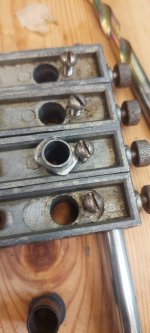
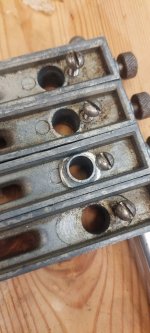
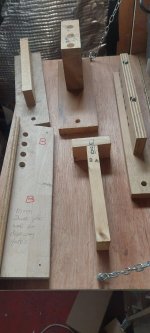
I’ve used dowels for jointing in a number of projects over the years. Usually I’ve made up a simple wooden jig, a couple of bits of stock with holes drilled square are easy to make, easy to register and clamp and generally do the job. Recently I was planning another project and found five previously made jigs, probably more lurking in the corners, none of which were exactly the spacing and offset I wanted. Time to look at an adjustable jig.
simple jigs.jpg


New products from Jessem and Dowelmax are too expensive, I couldn’t justify that for a dowel jig.

Looking online I found a lot of ebay listings for the Record 148. High numbers of listings can be good, like number 4 planes - everybody had one because they do the job well, or multiple listings of shiny unused stuff can be because it promised more than it delivered.

However online comment for the 148 looked promising and I found a complete 148 cheap.
advertising_blurb.jpg

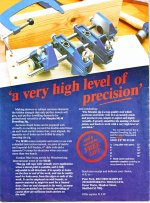
The original Record 148 only came with ¼ and 3/8 bushes as standard. I usually just buy packs of 8 or 10mm dowels, occasionally 6mm for thinner stock. Hammering stock through a plate to produce ¼ and 3/8 dowels for jointing has no appeal, realistically I’ll never use the imperial bushes.

The 3/8 (9.5mm) bushes might drill out to 10mm after annealing, two of the ¼” might drill out to 8mm after annealing.

My query is has anyone successfully annealed the 148 bushes, drilled and re-hardened them with simple kit? I don’t have a kiln to do profiled heating and cooling. The best I’ll manage is heat to red heat with a torch with a slow cool to try to anneal and after drilling an oil or water quench after heating to try to harden again. Does this seem feasible?
 
No idea, but according to the picture you've posted, this kit came with imperial and metric bushes in the box. It could be worth asking the seller if they have some mystery items kicking around that would complete your purchase. Alternatively, have you checked all of the bushes you have, or just two?
 
It might be cheaper to get metric bushes made, for infrequent use no hardening would be necessary.

Bod1
 
I own a 'Dowelmax' metric jig and even if you wanted one, they're no longer available in the UK. If they were, I wouldn't hesitate to buy on but that doesn't help your query - Rob
 
They do indeed come with both imperial and metric bushes; I have both in my kit. Cautious perusal.of "olite" (spelling?) bushes may also reveal a candidate or two.

S.
 
Early 148 sales only came with four bushes (2 off ¼ and 2 off 3/8”). Mine (the documentation is dated 1973) did come with 10 bushes, the imperial ones and 10mm, 8mm and 6mm.

But I have extra bush holders (which all came with ¼” bushes) so I need additional metric bushes.

I have longer rods, 3/8” silver steel bought originally as longer rods for a Record 405 before I measured more carefully and discovered that the 405 (and 55, and presumably the 45) aren’t 3/8, they’re 25/64” rods. Stanley using unusual sizes, whatever next, odd thread sizes.:ROFLMAO:

I didn’t bother annealing and decided to try a carbide drill. It went better than I expected.

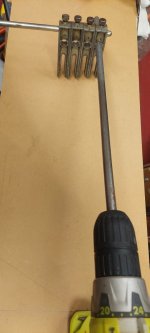
I’d looked at prices of carbide drills from RDG and Rennie but the price for a single drill was more than I paid for my collection of 148 pieces so I tried some cheap Lidl masonry drills.

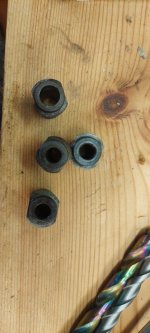
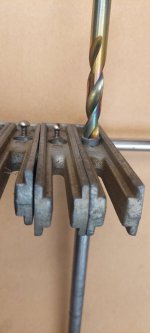
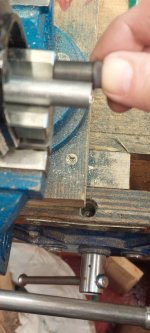
Apart from my drill press being covered in oily swarf it went well. I drilled 4 off ¼” bushes to 8mm and 2 off 3/8” to 10mm.

One ¼” drilled out to 8mm, three others awaiting their fate.

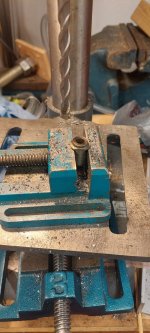
20250405_184047.jpg

A cheapo drill press, Titan brand from Screwfix. A DP vice which came with an old Black & Decker drill stand at least 40 years ago.

20250405_184201.jpg

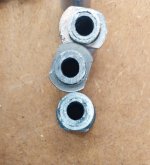
The one on the right at the bottom of the pic is a Record 10mm bush, the other two are the 3/8” ones I drilled out with the 10mm Masonry drill. The 8mm drill was easier than the 10mm. The 8mm bush had thicker remaining sides and I could crank down hard on the vice to hold it. I was scared of distorting the thin walled 3/8” bush in the vice so it was a fine line between not holding it firmly enough with the whole thing spinning and cranking down too hard and crushing it.
20250405_193207.jpg

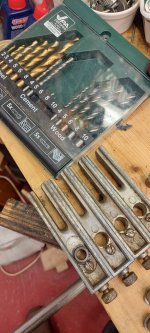
The drill set bought as an impulse buy in Lidl because it was very cheap which donated the Masonry drills.
20250405_193214.jpg


So that’s 8mm sorted, I need another 2 off 10mm but the more difficult problem will be 6mm, unfortunately smaller than any of the original imperial bushes so drilling out isn’t an answer.
 
Turns out it’s cheap and easy to make mild steel metric bushes from common hardware.

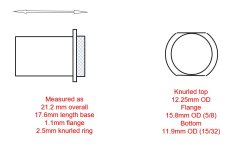
dimensions.JPG

I’d noted down the dimensions of the bush, because I thought I might have to turn some bushes. I wasn’t looking forward to that, my small vintage metal lathe won’t pass 5/8” stock through the spindle so there would have been a lot of waste.
Looking at the dimensions of the bush the shaft diameter at 11.9mm made me think. I had a length of mild steel pipe (from B&Q) with nominal dimensions 12mm OD and thickness 1mm.

A quick fitting at one of the bush holders showed the pipe was indeed slightly oversize, the ID which from the specs would be 10mm was undersize when tried with a 10mm drill bit.
As a quick proof of concept I chucked a length of pipe into a hand drill and held some 80 grit paper to the end until I had a sliding fit in the bush holder.

Then ran a 10mm drill down into the pipe to get the right ID.
20250405_230504.jpg


After drilling the inside I checked again in the bush holder to make sure the internal drilling hadn’t distorted it.
20250405_231209.jpgPic2

For a flange my first thought was an M12 washer but the ones I had were very large in diameter and too thick. An M10 washer was still too large in diameter but the thickness was OK. The M10 washer used on the first one required a bit of trimming to get the flange to a suitable size so for subsequent bushes I used M8 washers drilled out to a 12 or 10mm central hole.

After cutting the pipe to length the washer was fixed in place at the right height with epoxy. Silver soldering would be stronger but the biggest test the epoxy will ever face will be me cutting the flange down to the correct size.
20250406_111416.jpg

The longest part of the process is waiting for epoxy to cure properly. The first attempt fitted well enough to encourage me to make more.
20250406_215943.jpg20250406_215503.jpg

Looking at the B&Q site I could see they do cheap steel pipe in 10mm OD, 1mm thickness and 8mm OD, 1mm thickness. I could repeat the process but sleeving three thicknesses of pipe inside one another. Take a 12mm pipe and fit to the bush holder, sleeve a 10mm pipe inside it after drilling the interior to 8mm and then the 8mm pipe inside that to give me a slightly undersize 6mm bush which can be drilled to exact size.

Not hardenable of course but I’ve drilled many dowels using wooden guides so it should stand up for a while and it would be easy and cheap to make replacements.

Turns out a 6 or 8mm bush is easier to fix the flange than a 10mm and stronger.

20250406_220555.jpg
I dimensioned a bit of 12mm OD pipe as before but cut it down in length to only the section underneath the flange. A bit of 10mm pipe inside this and then a 10mm hole M8 washer provides the flange and seats on top of the 12mm pipe. This would make an easy 8mm bush. I added another bit of 8mm OD pipe inside to give me a 6mm bush, pressed the three bits and washer together in a vice with a little epoxy. All that’s required is to square off the sides of the washer.

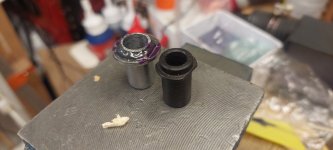
Bits for a further three 6mm bushes, prototype 6mm with a Record bush at top.
20250407_120039.jpg
20250408_191336.jpgThe top two 6mm bushes show the 10mm pipe with the 8mm pipe inside, the bottom upside down one shows the three pipes, 12,10 and 8mm inside one another.


20250408_191247.jpg
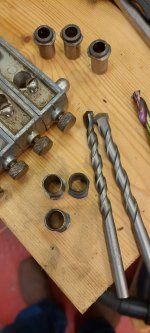
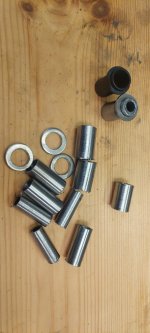
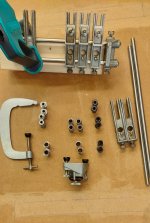
Not bad for a couple of evening’s work, the original six Record metric bushes on the right supplemented by six drilled out imperial ones (middle) and six home made mild steel ones(left).

I’m not a fan of the record G clamp, I find it awkward to hold the jig firmly in position with one hand and manipulate the g-clamp with the other. If I’m in a situation where I don’t have a spare bush holder then I’d make up a wood spacer the same size to let me use a one handed clamp.
 
Brilliant! A neat adaptation, at minimal cost so you can continue with currently available sizes. I hope anyone else with the same issue finds this thread.
 
Back
Top