• Hi all and welcome to TheWoodHaven2 brought into the 21st Century, kicking and screaming! We all have Alasdair to thank for the vast bulk of the heavy lifting to get us here, no more so than me because he's taken away a huge burden of responsibility from my shoulders and brought us to this new shiny home, with all your previous content (hopefully) still intact! Please peruse and feed back. There is still plenty to do, like changing the colour scheme, adding the banner graphic, tweaking the odd setting here and there so I have added a new thread in the 'Technical Issues, Bugs and Feature Requests' forum for you to add any issues you find, any missing settings or just anything you'd like to see added/removed from the feature set that Xenforo offers. We will get to everything over the coming weeks so please be patient, but add anything at all to the thread I mention above and we promise to get to them over the next few days/weeks/months. In the meantime, please enjoy!

Repair split in chisel handle

Just4fun

Sapling
Joined
Nov 26, 2020
Messages
274
Reaction score
24
Location
Finland
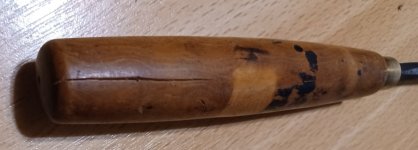
One of my chisels has developed a split in the handle. It looks like the handle has just dried out, although that is odd after decades with no problem. I think the handle is made of boxwood but I am no expert. The chisel is marked "Stormont". I don't recall how I came by it but it is a decent chisel so I don't want the handle to deteriorate further if I can avoid it. My question is how to treat it? My first thought is to just rub some wood glue into the split, but is there a better option?

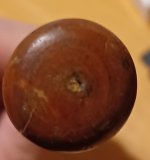
Here are photos of the split and the end of the chisel:
ChiselHandleSplit.jpgChiselHandleEnd.jpg
 
I'd agree that that's boxwood and that Stormont made decent chisels. I don't think the crack will affect the strength much, but it can feel unpleasant.
So yes, I'd say apply some glue, or glue mixed with sawdust or your preferred brand of filler/stopping and sand down when set.
 
Yes to Boxwood, and yes it’s strange that it’s split now after so many years, I suspect that it’s dried out even more than previously and it’s possible that the crack would close up again if the handle was in a damper environment, one test would be to check wooden handled hammers and axes etc that have been in the same room to see if they are loose.
Ian
 
Another thing you could try is to stand the handle in a jar or washed out can filled with linseed oil for a few days. It's possible that the wood would absorb enough oil to close up the crack. Even if it doesn't, you'll be no worse off.
 
Well, good luck with the repair, but I'd be preparing to make a replacement handle.
 
Clamp it up first to see if the crack will close up.

They usualy crack it hit with a hammer rather than a softer mallet.

Pete
 
One of my chisels has developed a split in the handle. It looks like the handle has just dried out, although that is odd after decades with no problem. I think the handle is made of boxwood but I am no expert. The chisel is marked "Stormont". I don't recall how I came by it but it is a decent chisel so I don't want the handle to deteriorate further if I can avoid it. My question is how to treat it? My first thought is to just rub some wood glue into the split, but is there a better option?

Here are photos of the split and the end of the chisel:
View attachment 28500View attachment 28499

Yes, certainly Boxwood.

I have found that many of my better UK chisels (e.g. Marples) are handled with boxwood made from smaller pieces of timber, perhaps branches (so to speak), the pith included, and they tend towards cracking. I cannot be sure if yours has the pith from the photograph. Something to consider.

As to the repair, I usually use tinted epoxy in this setting, then re-mount the handle on the lathe to clean it up a bit, although you could approach it by hand. Glue and sawdust is an option, but may not be as durable, especially if a mallet is used, and IMO is not as aesthetically pleasing.

If remounting on the lathe, the difficulty comes when you attempt to get the handle running true to its axis, especially if attempted between two centers. If you fail to remount it on the lathe properly, you may ruin the handle in the attempt to remove the epoxy and refinish the handle.

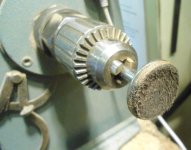
My method is to mount the tang hole in a larger live center, and mount the opposite end on a leather-faced drive "center".
Turning at slow speed, with the handle set relatively loosely, you can adjust the handle until it runs true, then tighten it as much as feasible without cracking the ferrule end.
I apply the back of a gouge to the handle gently to nudge it into concentricity, levering with the tool rest. In doing this, you must stop immediately when it runs true. If you go past concentricity, the handle will turn wildly or be ejected from the centers.
All machinists are familiar with this concept from the use of edge-finders.

See below:
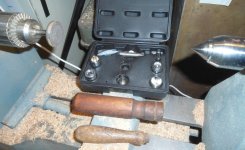
01 BOTH dsc06326.jpg

01 LEATHER PAD dsc06327.jpg

The leather pad is made from an engine tappet to which leather had been affixed with contact cement.
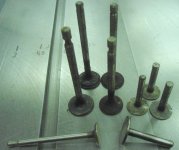
01 ENGINE VALVE TAPPETS dsc06322.jpg

The handle below is the one on top in the first photograph. I also use an extended live center to mount the ferrule.
You can, in this manner, fit the ferrule as you are tuning the work at hand:
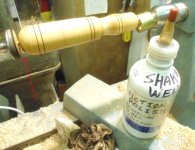
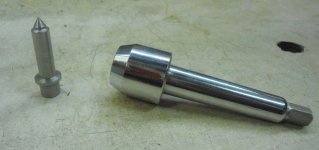
01 FINISH dsc06357.jpg

0001 EXT x FERRULES dsc05686.jpg

I have turned a few handles using this method to affix the ferrule snugly.
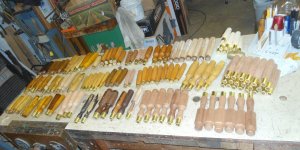
01 group 01 dsc05464.jpg
 
BentonToolThat is a very thorough and thoughtful answer. Thank you for that. Clearly you know what you are doing and my little issue would not take you long to fix. I don't have a lathe and have no skill - or even experience - in turning so that is not a good solution for me. What I have done is just to fill the gap with wood glue. I did that 2 or 3 times, lightly sanding after each application. The end result is clearly visible but the chisel is usable and has not deteriorated further so far. If it does fail at some point I will have to think again but for now it is OK. My tools are for use, not to look pretty, so I can live with that.
 
BentonToolThat is a very thorough and thoughtful answer. Thank you for that. Clearly you know what you are doing and my little issue would not take you long to fix. I don't have a lathe and have no skill - or even experience - in turning so that is not a good solution for me. What I have done is just to fill the gap with wood glue. I did that 2 or 3 times, lightly sanding after each application. The end result is clearly visible but the chisel is usable and has not deteriorated further so far. If it does fail at some point I will have to think again but for now it is OK. My tools are for use, not to look pretty, so I can live with that.
Hello J4F,
I am sure your repair will serve you well. After all, the split is really not that bad.
They do not bother me much... and, my repairs are always visible! :LOL:
So, don't feel badly, after all, it is just a tool handle.

That reminds me of a quote from Christopher Schwarz on the topic of workbenches.
When some were obsessing over the aesthetics of their workbenches, he said:
"After all, it is a workbench, not an alter"... :ROFLMAO:

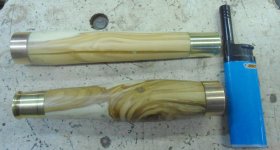
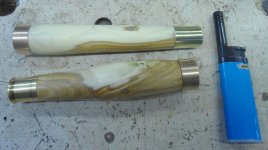
Below are some of my more recent repairs on two handles made with small-diameter Honeysuckle.
It had the pith and honeysuckle tends to split wildly anyway. Filled with tinted epoxy (top handle).
The lower one also had a smaller split (on the right end).

I find honeysuckle to be attractive, and works like boxwood. Very similar grain. Quite dense.
It is difficult to find in large sizes.

Good luck & best wishes from the Colonies...
001 HS p Epoxy dsc05750.jpg

001 HS p Epoxy dsc05746.jpg
 
Back
Top