• Hi all and welcome to TheWoodHaven2 brought into the 21st Century, kicking and screaming! We all have Alasdair to thank for the vast bulk of the heavy lifting to get us here, no more so than me because he's taken away a huge burden of responsibility from my shoulders and brought us to this new shiny home, with all your previous content (hopefully) still intact! Please peruse and feed back. There is still plenty to do, like changing the colour scheme, adding the banner graphic, tweaking the odd setting here and there so I have added a new thread in the 'Technical Issues, Bugs and Feature Requests' forum for you to add any issues you find, any missing settings or just anything you'd like to see added/removed from the feature set that Xenforo offers. We will get to everything over the coming weeks so please be patient, but add anything at all to the thread I mention above and we promise to get to them over the next few days/weeks/months. In the meantime, please enjoy!

Replacement for old glass

Artiglio

New Shoots
Joined
Jan 12, 2021
Messages
240
Reaction score
42
Location
East kent
Good day all

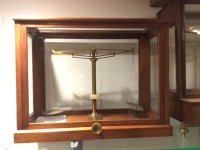
I’ve developed an interest in Oertling balances, recently picked up one at auction and it’s missing a glass panel in the cabinet. They were made a in 1890 and so the glass is not the perfect float of today. It’d look better with a replacement that is similar to the original, lots of 2mm float glass available, but my googlefu is failing me in finding antique/vintage type glass ( there must surely be someone that has such a thing)

Any help appreciated.
 
Don’t know if you still can, but greenhouse glass was of such a poor quality that people used it for old windows.
Unfortunately, horticultural glass is all but perfect these days. I'm mixing it in with ordinary float glass in my leaded lights, and frankly can't tell the difference.
 
Cheers gents, using some of your words and terms in my searches have thrown up some much better results. Seems that ideally i need cylinder glass, but unfortunately that is just not an economical expenditure for such an inexpensive item. A suggestion elsewhere was just to wait for / find a really tatty similar example and strip it for spares.
So seems a bit of patience is order of the day, probably get a bit of greehouse glass for now to keep the dust out, in meantime i can tinker with the pan supports and tidy it up.
image.jpg
 
I suggest you scout around your area for someone having big Victorian sash windows replaced. Our originals are definitely not float glass - you can see the ripples - but as far as I can see, the people doing replacements have no interest in salvaging the glass or listing it for sale online.
 
Do you have cause to be travelling Leicester way?
Theres a chap who supplies horticultural glass I've previously used.
As Andy says an old sash would be a good alternative.
Cheers Andy
 
I thought that old glass was difficult to cut? Only here say not tried myself.
Pretty sure that the key to success is getting it properly clean. Going straight at an old window might be a recipe for problems.

Apparently gentle heat softens old putty, to release the glass from the sash.
 
I'm with AndyT on this - possibly an old sash from a reclamation/architectural salvage place... with two caveats: firstly I think balance covers were thinner glass than windows, and secondly, glass remains liquid throughout its life, meaning sashes become thicker at the bottom and thinner (and under tension) at the top as they age. You have to be very gentle with old ones:

I fell foul of this around 1979 when I changed a cord on a large Georgian sash, for my Clifton (Bristol) landlady's kitchen. The job went well, but at the end, whilst tidying up I lightly touched the sash with the toe of my rubber-soled shoe (was on the ladder), just under the top rail.

I didn't kick it, or even tap it - there was no sound, but a big crack, running mostly horizontal. And this was after I had shown off the re-corded sash running nicely. I was mortified, and then had to learn glazing to fix it (and with new glass!).
 
Scientific American wrote about the liquidity of glass.

Yes, in theory, it remains a liquid, but:

As the glass cools, the time it needs to demonstrate liquid behavior (the "viscous relaxation time") increases and eventually reaches extremes. At the so-called glass transition temperature, the relaxation time is on the order of a few minutes. On a short timescale, the "liquid" glass will appear solid, but after a short while, it can be seen to be slowly flowing, like incredibly thick syrup. At still lower temperatures, the relaxation time reaches values that are truly geologic, i.e., many millions of years. Window glass at room temperature has a nearly incalculable relaxation time, approaching the age of the universe itself. For all practical observations, this glass is a solid. But its solidity is in the eye of the beholder.
 
The glass I unintentionally broke was probably made around 1820-1830 (Georgian?).

I have since owned a mid-Victorian property (1860-70), where we replaced all the glass in the lower sashes of the ground floor with laminated (for security - also slightly improved the μ value). The sashes themselves were good enough to re-use, mostly.

The old glass was obviously thinner at the top, but not by much. I can't say by how much as I was more interested in removing it at the
the time...
 
As ever, thanks for the additional suggestions, would glass in old sashes have been as thin as 2mm? Not that it would matter if it were say 3mm. There is a reclamation yard mear me , but they are ansurdly expensive, however i’ll keep an eye on marketplace etc and keep them peeled when i’m out and about.
 
As ever, thanks for the additional suggestions, would glass in old sashes have been as thin as 2mm? Not that it would matter if it were say 3mm. There is a reclamation yard mear me , but they are ansurdly expensive, however i’ll keep an eye on marketplace etc and keep them peeled when i’m out and about.
Yes, in my experience old sheet glass is likely to be the sort of thickness you want. It wasn't sold by thickness but by the weight of a square foot. Apparently 15 ounces and 21 ounces were the commonest, but I really think you need to find some and then experiment.

Another potential source of thin glass that could be easier is to look in charity shops for unwanted picture frames. You might find something old and suitably imperfect and you wouldn't have the challenge of freeing the glass from putty.
 
I have replaced sash window panes a few times on my own properties and I would heartily concur that glass from old sash windows are the way to go. I’ve tried horticultural glass, but it was too, well, horticultural. That is to say too many imperfections.

The biggest panes I’ve dealt with are about 360 by 560 (3 across and 2 down for a single sash), and cut easily, even with a little wheeled cutter, and then snapped over a small thin piece of wood – I used a few of those long bamboo skewers, end to end.

The problem is getting hold of sashes with the glass intact. Builders seem to take a great deal of pleasure in smashing them. I was lucky enough to meet a householder replacing the windows of one of the basements in Drummond Place, carefully carrying them intact to a skip. In exchange for a bit of help in carrying them he let me have them – straight into the back of the Landy, and I think I have enough Georgian glass to see me out. Unless I take up indoor cricket I suppose.

If you look at the panes there is a sort of orientation to them, presumably because of the method of manufacture the ripples are more prevalent in one direction. Oh, and they are c. 2mm (or imperial equivalent).

AndyT is right, heat on putty is an easier way of removing it than a hacking knife or old chisel. But of course, heat and glass don’t mix. I experimented with heat shields, which work, although the learning curve is steep.
 
Back
Top