• Hi all and welcome to TheWoodHaven2 brought into the 21st Century, kicking and screaming! We all have Alasdair to thank for the vast bulk of the heavy lifting to get us here, no more so than me because he's taken away a huge burden of responsibility from my shoulders and brought us to this new shiny home, with all your previous content (hopefully) still intact! Please peruse and feed back. There is still plenty to do, like changing the colour scheme, adding the banner graphic, tweaking the odd setting here and there so I have added a new thread in the 'Technical Issues, Bugs and Feature Requests' forum for you to add any issues you find, any missing settings or just anything you'd like to see added/removed from the feature set that Xenforo offers. We will get to everything over the coming weeks so please be patient, but add anything at all to the thread I mention above and we promise to get to them over the next few days/weeks/months. In the meantime, please enjoy!

Retirement Project--New Interior Trim

The fuming was a fail. The ammonia I was using was old and I believe most of it had evaporated over the last few decades. I just thought my handling precautions were good so I couldn't smell the ammonia. :) So now on to stain, then I'll get to soaking the slats and assembly.

As for building a forming jig, my second set of results shows this isn't going to be necessary. Keeping the long slats wet should be good enough for them, while heating the short slats in a pot and pulling them out one by one as I use them seems to work fine too.
 
After my experiments with fuming, I decided to go with stain. I bought a small can of "red oak" stain and stained all the slats. The color is a nice dark brown, but nothing like the red oak I use as actual wood. And of course, after I stained the wood I found some oak stain that I could have used instead and not bought new. Oh well.

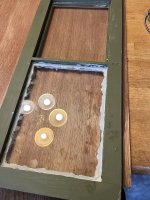
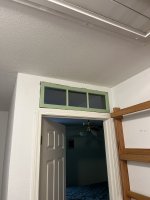
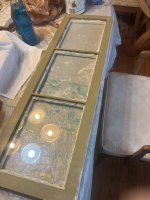
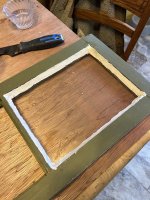
To give the the stain a couple of days to dry fully, I turned to putting glass in the sashes that I'd built last winter. I hadn't cut any glass since I was in junior high school back in the 70's, so this was all new. I got some from the local hardware store, cut into 8" wide X 32" long strips, with enough glass if _everything_ went perfectly. After a few Youtube videos I decided I was qualified, so off I went. I dug out my grandfather's glass cutter and a nice Starrett combination square. The first pane cut to length and then width perfectly. I checked for a good fit then rolled out some glazing putty and made a bed for the glass inside the first sash opening. The glass pressed into place nicely.
IMG_018514.JPGIMG_018515.JPG IMG_018516.JPG
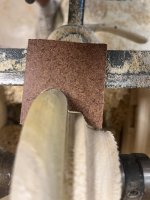
Next up was adding the glazing pins and then filling in the outside putty. I had trouble smoothing this uniformly since my putty knife tended to tear it rather than smoothing it. The second and third panes went in easily too after I cut them. The glass wasn't perfectly cut in all positions, but I was able to sand back the edges a little on my belt sander. (Note that I was sanding the glass holding the glass vertically on the belt sander table, minimizing the chance of breakage.) Once the glass and putty steps were complete, I put the sash back in the transom opening. The putty needs a week to dry enough to paint.
IMG_018517.JPGIMG_018519.JPG
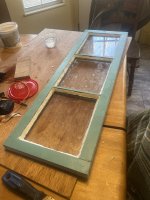
After the green room window, I moved onto the blue room transom window. This went almost as smoothly, until I pressed slightly wrong on the last pane and cracked it. I cut another and put it in without incident, but the stage had been set. It was no longer My Day.
IMG_018521.JPG

Moving on to the third (yellow) sash), my run of bad luck (or bad technique) continued and I cracked 3 more pieces while only getting one more successfully installed. At this time I was out of glass and decided to let it wait to get more.
IMG_018522.JPG
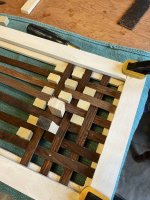
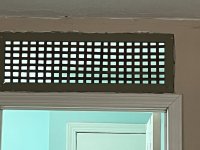
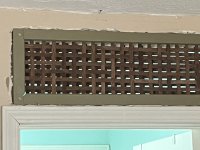
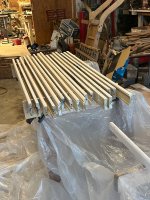
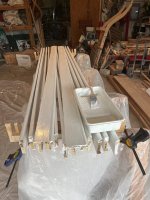
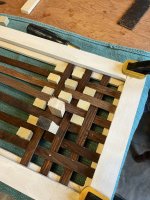
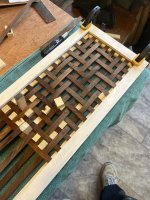
My luck having turned bad again, I moved back to the lattice work on the bathroom transom. Here I took the trouble to soak all the slats in water for a couple of days, then put the vertical slats' pot onto my gas stove and waited for the water to boil. The water would back the slats more flexible, and the hot water for the vertical slats even more so. I brought the whole pot of boiled slats over to the kitchen table to start the assembly. Calculations showed that openings of 1/2" x 3/4" would fill the sash opening nicely. I planed down some poplar and cut it off to make 1/2 x 3/4" spaceers. I also made a diagram to show how the weave would be done. To keep from breaking even the more flexible slats, I made the weave sets of two up and two down which kept it from bending too fast and breaking.
IMG_018531.JPG IMG_018532.JPG IMG_018533.JPG

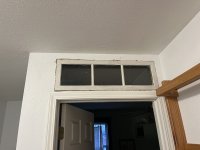
Here's my daugter holding it up over the bathroom door.
IMG_018536.JPG
For the second grill, I need to plane the slot out with the plow plane and then can get started. After that I'll paint them. Right now I haven't finalized my paint color source so these will wait a bit. Also, I haven't cut holes in the walls for them.

Lisa came over on New Years Day and helped finish cutting the glass after I bought a new piece. So the first three sashes are done and I have one pane cut for the fourth (new) sash. The next step will be to finalize the hall and bedroom trim and wall color choices, cut the transom holes and fit the sashed, paint the new sashes, and then start on the bedroom in earnest by removing the existing trim and painting the walls.

Kirk
 
A little more detail on the lattice:
IMG_018531.JPG,
I pulled the long slats out of the water (they were soaking in a piece of pipe) and roughly lined them up in the slot of one end of the sash. I then added the spacing blocks to get the proper spacing and slid in the first vertical slat from the far end, with the weave matching my weaving chart. The slat slid into place with only a little pressure. I then added another row of spacing blocks and slid in the next slat after adjusting the weave. I repeated this for the rest of the lattice, then cut the long slats to length and added the second stile to the end.
IMG_018533.JPG
The friction on each slat is strong enough that none of them want to move.

Kirk
 
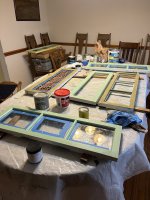
All six sashes (3 old, 3 new) are now painted. The old ones are glazed and in place just waiting for the hallway trim, while the new ones are waiting for me to cut holes in the walls and start on the hall and bedroom trim.
IMG_6254.jpeg IMG_6255.jpeg
I’m temporarily setting this aside because I have a number of small projects I need to knock out in the next 2-3 weeks.
 
Last edited:
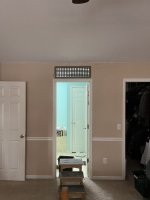
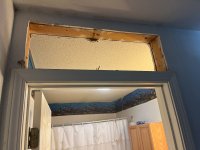
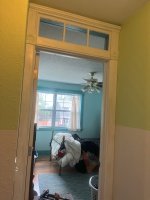
Lisa and I cut the transom hole above the door to my bathroom this morning and then fit the lattice sash.

IMG_6385.jpegIMG_6387.jpeg

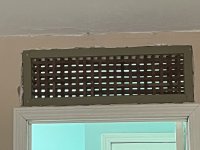
This looked like the holes were too large. We speculated on how to adjust things, then I decided to take the hallway bath sash and insert it into the hole from the other side.
IMG_6388.jpegIMG_6389.jpeg
This gave a much more dense pattern with an interesting interference effect when viewed from different angles.
IMG_6390.jpeg
I think I’ll keep these two sashes here, and make a new one for the hall bathroom. In that sash I’m leaning toward using a single thick piece of wood and using the scroll saw to cut out a Craftsman style or Art Noveau pattern. For this, I may glue up two pieces of poplar at angle to reduce the chance of short grain failure.
 
So is this mounted on top of the double header Kirk? I haven’t got my head around the different ways of doing walls over here yet.
No. This is an interior non-load-bearing wall. There were a couple of vertical 2x4 stubs in there but only one or two thicknesses of 2x4 between the door and the transom, and the same above the transom.
 
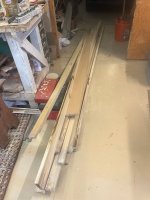
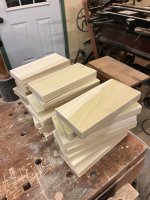
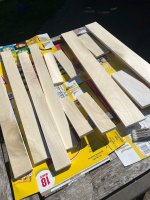
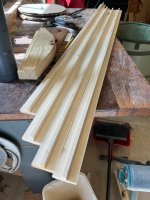
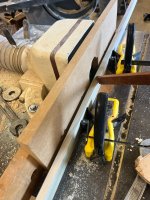
Wagon wheels and other stuff out of the way, I restarted on this in late March. First up was ripping and planing a bunch of blanks to be run through my friend's molder, and using the offcuts to make small pieces like plinth block blanks.
IMG_018943.JPG
IMG_018971.JPG
IMG_018970.JPG
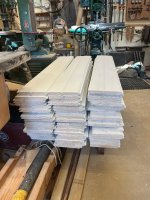
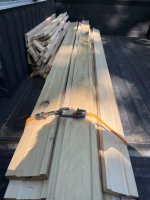
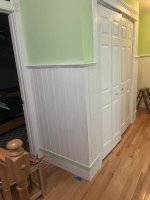
Next I took delivery on a stack of beadboard which I'll use for hallway wainscotting. These pieces were 16' long and 7-1/2" wide. Fifteen pieces cost almost $1000. I cut them all down to 4' lengths.
IMG_018973.JPGIMG_018978.JPGIMG_018979.JPG

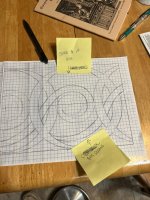
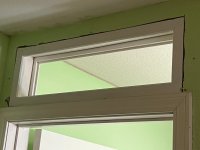
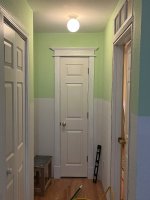
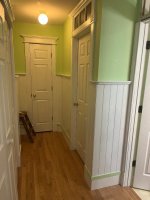
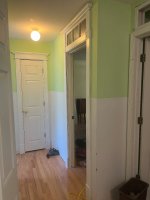
Next up was painting the hallway. When we decided on doing the wainscotting, we flipped from white walls/colored trim to colored walls/white trim. Then I had to backtrack. I needed to cut holes over the hallway bathroom and master bedroom doors for transoms. This time I used my jigsaw instead of just a hammer and cut them much more neatly. The bedroom will get glass like the other bedrooms, but the bathroom will carved and pierced ventilation panels (two panels, one each facing in and out). Lisa is designing those in the style of Louis Sullivan, and I'll do the carving in white oak. The diagram below is the rough layout, with lots of additional foliage to come.
IMG_018997.JPGIMG_018991.JPG
Another sidestep happened when new Carter guides arrived for my small bandsaw and I just had to install them immediately. I'm sure you understand.
IMG_019004.JPG
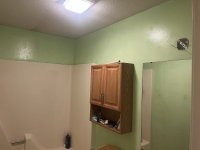
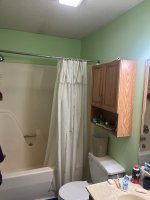
On to painting! Well, not yet. Cutting the transom hole in the bathroom wall showed me how messed up the wallpaper strip there was, so I decided to strip and repaint it. That became an all-day side quest last weekend, including adding a new light over the mirror:
IMG_019008.JPGIMG_019014.JPGIMG_019017.JPG
I did decline to go further and strip the popcorn off the ceiling or fix the peeling drywall tape. Gotta stay on target!
The hallway looks a little funny right now with new paint and old trim, but that will be changing soon.

More in the next post!

Kirk
 

Attachments

  • IMG_019011.JPG
    IMG_019011.JPG
    187 KB · Views: 6
Must have to admit that Louis Sullivan is new to me, Chicago Architect with a penchant for flora with intertwining branches, I do like that design Lisa has done, reminds me a bit of Celtic patterns which I’ve always liked.
 
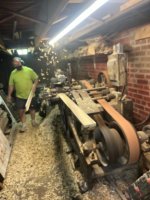
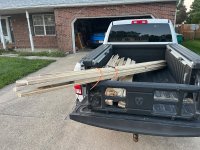
OK, back to it. Last Tuesday my friend Eric was available so I loaded up my truck with trim blanks and headed over to his house where we started by digging around to find the right molding knives. We were going to run four different profiles plus one more for back relief. It took about 7 hours of milling to do 450 or so lineal feet (plus back relief on about half of it). We were very deep in shavings by the end, and my truck went home a lot lighter.
IMG_019024.JPG IMG_019025.JPG IMG_019027.JPG
Wednesday I got the remaining transom sashes repainted as well as painting the sash stops for the newest transoms. I also ran the millwork through my planer (thicknesser) on Wednesday to remove the feed marks from the molder where necessary. Thursday I installed the sash stops, which went pretty well except for brad nailer getting a very bent nail jammed in it.
IMG_019032.JPG IMG_019041.JPG
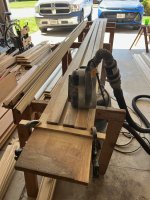
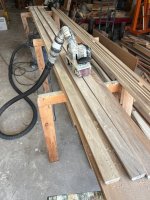
I also spent a couple of hours on Thursday just sanding. And sanding. And sanding. This was just to remove machine marks from the visible surfaces and all will be painted with 2-3 coats, so I only used 120 grit paper. Even with the shop vac hooked up there was plenty of dust. (I don't have a big enough table to sand 10' boards on so I dropped an oak 1x12 across 4 trestles and sanded on that. It works quite well.) By the end of the day I was a good 40% done on the sanding
IMG_019037.JPG IMG_019038.JPG

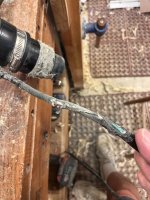
Friday morning I got sanding again, but after about half an hour I messed up and accidentally set the sander down on the cord before the belt stopped. Instantly the cord was pulled in by the belt and it took some minor disassembly to free it. The sander is fine but I need to cut out a bad spot and resolder the wires. (Yes, I did this once before as you can see by the tape.)
IMG_019044.JPG
This Porter-Cable sander has been a workhorse, but I can tell at least one bearing is starting to go again. I've tried to pull bearings on this type of sander before and broke that one, so when this one started squealing a few years ago I took it in for service. IIRC, that was $80 on a then $180 tool (pre-pandemic prices). I also haven't been satisfied with the dust handling on this one. So I went shopping and paid $360 for a new Makita. I started using it today and am quite satisfied--it's quieter and sucks up the dust much, much better. I will repair the P-C as a backup, but the Makita is the new daily driver.

Kirk
 
Last edited:
it’s a sash sticker, which is a molder optimized for making window sash. He’s got it set up for one cutting head though there is provision for a second and there are some other features such as a boring provision I think for making holes for sash pulleys. The specific model is a Hall & Brown #190, probably built between 1920 and 1930.
 
For as space constrained as Eric appears I'm surprised he doesn't look for a smaller footprint 4 head, unless he really utilizes the outboard drop bed capacity.
 
For as space constrained as Eric appears I'm surprised he doesn't look for a smaller footprint 4 head, unless he really utilizes the outboard drop bed capacity.
Eric has three locations for his machines--his basement plus this walled in porch, a three car garage, and an old hardware store about 90 miles north that he's currently restoring. He's already moved 35,000 lbs of machinery to the hardware store, which has given him much more operating room at his house. He and his daughter run a business doing Victorian era house restorations. Here's one house he worked on. He did the lion's share of the wood restoration, trim, and window work on this house:
Artz House, St Louis
 
After all the sanding, I started painting. Everything got at least a coat of primer and a coat semi-gloss latex. Primer of course went on all sides, but fortunately the regular paint only got put on surfaces that will be visible since it was $60/gallon. I primed with a roller, but didn't really care for the finish quality so I gave all the visible surfaces a quick going over with a card scraper to smooth them out and to take off any drips. I put the latex on with a brush. To enable me to paint the edges faster I built a couple of jigs to hold the wide pieces on edge.
IMG_019048.JPG IMG_019073.JPG
It took about a week to paint everything. Most of those days were pretty windy so I didn't miss riding my bike much, but by the end of it I was really antsy to get some miles. Gotta have balance.
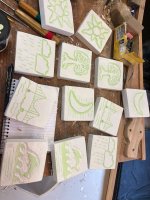
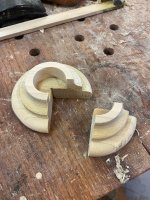
Once everything was painted, it was time to do some detail work before starting to rip out the old trim. All the rooms with transoms will have carved blocks to match the blocks I did on the three bedrooms. Since the hall color is green and white, that's what I painted them. Very simple incised carving, nothing special, but it does personalize the space.
IMG_019089.JPG
After that it was time to put glass in the master bedroom transom. This time I didn't cut it myself, I had the woman at the hardware store do it since I broke too many pieces last time.
IMG_019079.JPG
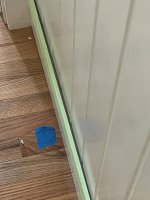
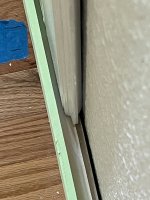
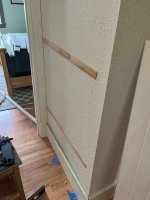
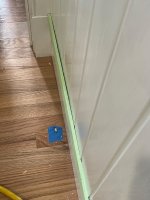
Finally, this morning I started ripping out trim and putting on new.
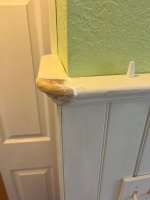
I wasn't terribly happy with the first door's trim, the walls were very uneven and I wound up with a lot of gaps. But as the saying goes, caulk to fit and paint to match. It'll look fine later.
IMG_019092.JPG
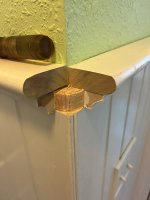
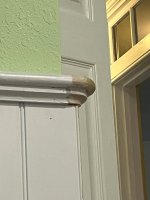
The linen closet went much better though the returns on the ogee, cove, and bead were a little touchy. Again, the nail holes and a few gaps will be caulked before a final coat of paint. Baseboards and wainscotting will come after all seven doors are done.
IMG_019094.JPG
Tomorrow (Saturday), bike riding and trim on a couple more doors.

Kirk
 
To my English eyes those gaps under American doors always look pretty bad, but I do understand that it has to be there for the blown air heating and cooling.
That green is reminiscent of Civil Service Green used in the uk before the war, so a pretty good colour for your late Victorian revamp.
 
The gap is there because of the difference in thickness between current oak floor and the previous carpet. I’d never noticed it, but I’m probably going to repaint the door and could add a filler strip at that time.
 
The gap is there because of the difference in thickness between current oak floor and the previous carpet. I’d never noticed it, but I’m probably going to repaint the door and could add a filler strip at that time.

If you have forced air, and no return in the room you need to keep the gap.
 
Back
Top