Boringgeoff
Seedling
- Joined
- Nov 22, 2021
- Messages
- 45
- Reaction score
- 26
Hi all,
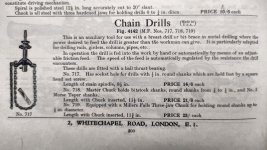
I just picked up this chain drill, branded "Robert Scaife. Maker - Colne." This is the first British made chain drill I've seen, all my others are made in USA. For those of you whose education was sadly lacking I'll explain the workings of this tool. The chuck end will hold a 1/2inch shank drill bit which is locked in by the grub screw visible in the lower left of the chuck. The tapered tang on the other end of the tool is gripped in the chuck of a brace or a breast drill. The chain is wrapped around the workpiece and tightened by turning the knurled hand wheel. Now the operator can start cranking the brace or drill to start the drilling process. This is where the simplicity of this tool comes to life, the main-shaft through the tool transmits the rotary action from the brace to the bit without affecting the tension on the chain, but tightening the thumb screw sticking out at right-angles from the hand wheel changes the situation. The hole that locates the thumbscrew goes right the way through the hand wheel and has at its bottom a brass friction plug, therefore tightening the thumbscrew presses the plug against the main-shaft which exerts friction on the shaft causing the chain holder to turn and tighten the chain. The degree of friction can be raised or lowered to suit the speed of drilling and the amount of effort required to crank the brace or drill.
Graces Guide tells us that Robert Scaife was in business in 1906 -07, 1922 and 1950. A mining drill manufacturer, that's all I've got, if anyone can add to this I'll be very appreciative.
Cheers,
Geoff.
I just picked up this chain drill, branded "Robert Scaife. Maker - Colne." This is the first British made chain drill I've seen, all my others are made in USA. For those of you whose education was sadly lacking I'll explain the workings of this tool. The chuck end will hold a 1/2inch shank drill bit which is locked in by the grub screw visible in the lower left of the chuck. The tapered tang on the other end of the tool is gripped in the chuck of a brace or a breast drill. The chain is wrapped around the workpiece and tightened by turning the knurled hand wheel. Now the operator can start cranking the brace or drill to start the drilling process. This is where the simplicity of this tool comes to life, the main-shaft through the tool transmits the rotary action from the brace to the bit without affecting the tension on the chain, but tightening the thumb screw sticking out at right-angles from the hand wheel changes the situation. The hole that locates the thumbscrew goes right the way through the hand wheel and has at its bottom a brass friction plug, therefore tightening the thumbscrew presses the plug against the main-shaft which exerts friction on the shaft causing the chain holder to turn and tighten the chain. The degree of friction can be raised or lowered to suit the speed of drilling and the amount of effort required to crank the brace or drill.
Graces Guide tells us that Robert Scaife was in business in 1906 -07, 1922 and 1950. A mining drill manufacturer, that's all I've got, if anyone can add to this I'll be very appreciative.
Cheers,
Geoff.