• Hi all and welcome to TheWoodHaven2 brought into the 21st Century, kicking and screaming! We all have Alasdair to thank for the vast bulk of the heavy lifting to get us here, no more so than me because he's taken away a huge burden of responsibility from my shoulders and brought us to this new shiny home, with all your previous content (hopefully) still intact! Please peruse and feed back. There is still plenty to do, like changing the colour scheme, adding the banner graphic, tweaking the odd setting here and there so I have added a new thread in the 'Technical Issues, Bugs and Feature Requests' forum for you to add any issues you find, any missing settings or just anything you'd like to see added/removed from the feature set that Xenforo offers. We will get to everything over the coming weeks so please be patient, but add anything at all to the thread I mention above and we promise to get to them over the next few days/weeks/months. In the meantime, please enjoy!

Router skates

Windows

Old Oak
Joined
Jan 25, 2022
Messages
1,380
Reaction score
395
Location
Cumbria & West Kent
I’m in the process of making router skates for levelling & thicknessing with my Makita router.
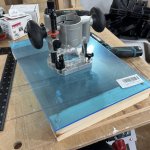
IMG_4101.jpeg
This is the first attempt, but the Perspex is only 5 mm and it flexes too much. I have a 6 mm sheet that seems much stiffer, so I’m going to try that. This was mainly for practice in drilling the Perspex which I hadn’t done before.

I used various drill bits;
5 mm for screw holes
12 mm for locator holes
30 mm for central hole for the router bit

At 5 mm thick for the base, the original screws that attach the base to the body of the router do still work, but I’ve got longer ones so used them (M4 countersunk machine screws). I got two varieties (black & silver) of M4 from the same random Amzn supplier - only the black have the correct thread.

The “skates” are just bits of 2x2 attached with countersunk 3.5x30 screws from the top.

The acrylic sheets are A3 size and cost me £19 for the 6 mm.
 
Last edited:
Can I suggest that you use roundhead screws rather than countersunk? And if they cannot be proud, counterbore them. There is musch less chance that you will crack the perspex. And yes that does mean using something thicker than 5mm. TBH I don't think that perspex is a suitable choice of material at all.
Really sorry to rain on your parade.
You could try twinwall polycarbonate, I'm not sure if that would be stiffer. It might be, given it is essentially a torsion box. Worth a try, I'd say.

S
 
Just a thought...it would still function the same way if you put two more strips of wood on top of the perspex, connecting the corners to make a rectangle. You'd need to glue or screw them onto the perspex. That would stiffen the whole thing up a bit.

Presumably the blue colour is just a protective peel-off sheeting to prevent scratches while working on the plastic.
 
I wouldn't agree with Steve on the suitability of Perspex as long as it's cast and not extruded type. 6 or 8mm should be more than rigid enough for that size. Polycarbonate while being far stronger, almost unbreakable also flexes more than acrylic and unless you went to 10 or 12mm wouldn't be rigid enough.

Acrylic, from my experience in the industry is more forgiving than polycarb as well. If done correctly it's simple enough to cut, drill and even tap with care and personally I'd go with countersunk not roundhead screws though I can see why they were suggested.
The holes should be slightly oversize to allow for expansion and the countersunk of the screw holds better as long as not overtightened. Any concerns and you can add a touch of silicone under the heads or cut some thin rubber washers. Drilled holes should be away from the edges, very sharp bits drilled slowly to prevent heat build up and careful on break through. The edges of the holes can be stress relieved, we used to sell an ICI liquid but I can't remember the name. Minor crazing is undesireable but not fatal.

Perspex templates and jigs were extensively used in fabrication businesses and that's where a lot of my sales ended up. I still make loads of stuff from the scrap stock now dwindling as it's the best part of 40 years since I was in it. (I did have quite a lot ;) ) E.G. I have an enclosure for my laser cutter with transluscent orange 3mm Plexiglass screwed down fairly tight. A sizeable hinged piece and front panel for safe viewing. Used in a cold workshop with the laser burning wood it hasn't flackered in 2 1/2 years despite being moved and chucked frompillar to post.

It doesn't matter these days which brand you buy as unless you need the best clarity they're as strong as each other. You'll pay a premium for Perspex make and Plexiglas won't be far behind.

EDIT

I've remembered it was the same stuff we used to glue accurately machined edges which needed an almost invisible glue line. we appied via a glass syringe in minute quantity and you had to wear a mask. Smelled like choroform so probably on the banned list now.

Just as an aside it's best not to use any alcohol based cleaner like isopropyl as it can attack the material and cause stress cracks.
 
Last edited:
Just a thought...it would still function the same way if you put two more strips of wood on top of the perspex, connecting the corners to make a rectangle. You'd need to glue or screw them onto the perspex. That would stiffen the whole thing up a bit.

Presumably the blue colour is just a protective peel-off sheeting to prevent scratches while working on the plastic.
Good suggestion about the stiffeners. I will probably do that. I’d considered that one piece running across the middle behind the router would probably do it. The blue is just the scratch protection. It doesn’t get in the way while drilling, so I’ll pull it off once I’m done messing around.
 
This stuff is no name acrylic. I’m just used to calling it perspex. Annoyingly autocorrect makes it Perspex so it looks like I’m being official about it. Couldn’t tell you if cast or extruded - my guess whichever is cheaper/more common - but it drills easily enough.

My 5 mm corner holes are 20 mm in from the edges so hope that’s enough. And the 5 mm holes are holding either M4 or 3.5 mm screws so hope that’s oversized enough.

I have been drilling slowly. I do everything slowly. 😜
 
This stuff is no name acrylic. I’m just used to calling it perspex. Annoyingly autocorrect makes it Perspex so it looks like I’m being official about it. Couldn’t tell you if cast or extruded - my guess whichever is cheaper/more common - but it drills easily enough.

My 5 mm corner holes are 20 mm in from the edges so hope that’s enough. And the 5 mm holes are holding either M4 or 3.5 mm screws so hope that’s oversized enough.

I have been drilling slowly. I do everything slowly. 😜
Hole distance is fine, the minimum recommended used to be twice the material thickness but I always thought that was a bit too close though I have taken chances and drilled closer without incident. The lads used specially ground drills at work but mine are just normal jobbers and are fine.

The type should be marked on the protective covering but can't be relied on however it's easy to spot on new material by removing the protection and squinting along the surface. Exruded is obvious as you can see the extrusion lines and the surface is slightly wavy and not perfect. It absorbes moisture more easily and moves a bit more. Cast is pressed between sheets of glass and the surface is usually perfect with excellent clarity right through the sheet and it's more stable. but more expensive of course.

There are other Acrylic derivative so you can't always be sure of what you're getting unless a premium brand but for your purpose it won't matter much. If it does the job it's good enough and Andy's suggestion to stiffen what you have would be the way to go initially.

Perspex as a description is just like Hoover for vacuum cleaners and only the distributors and manufacturers would be irritated. We were as main distributors but that was when it was made by ICI and cheap stuff from overseas just coming on to the market and passit it off as the same quality.

I know what you mean about doing everything slowly. :ROFLMAO:
 
Last edited:
Just to reinforce the 'go slow' message... When I was at school I had a Saturday job in a plastic moulding factory. One odd job they took on was making display boards for fishing tackle. A sheet of perspex about A3 size was filled with holes, spaced on a grid, probably about 30mm centres. One of the toolmakers had made up a guide board, fitted with hard steel bushes. My job was to stand at a pillar drill, drilling all those thousands of holes, one by one.

If I went too fast, the drill bit would heat up, melt the plastic and weld itself in, ruining the bit and the board. That didn't please the boss but he didn't take me off the job. 😟

I have done some tedious jobs since, but I think that one was the most brain numbing of all! 😀
 
Turns out 6 mm is also too flexible with skates right at the edges. I moved the skates in a bit and it looks solid enough, but haven’t tested yet so I’ll find out tomorrow.
 
Last time I did it, I simply used two pieces of "L" shaped aluminium angle for the supports and extended the 10mm fence rail supports (with cheap bar stock, to allow the router to slide in the other axis. It worked surprisingly well, except that I was a bit 'greedy' with the width of the board, so there was a little too much sag. But it was good enough to finish with handplanes.
 
When I was at school I had a Saturday job in a plastic moulding factory. ...😟

...I have done some tedious jobs since, but I think that one was the most brain numbing of all! 😀
My first job was at the Russell Hobbs factor in Blythe Bridge, putting the pins into handles of electric kettles. Th pins were put in a jig, the bakelite handle (or whatever it was made of) laid over them. Then the guard came down and a big thump of a hammer riveted them in place. Then they went to tables of two workers, all of them women, who soldered them and sealed them with silicone. 800 per day every day for 6 weeks. 40p per hour.
That was mind-numbing too, with the extra spice of me being a callow youth in a group of about 20 women. Daniel in the lino's ring comes to mind, I was Spoil.
Sorry, didn't mean to hijack...
S
 
Turns out 6 mm is also too flexible with skates right at the edges. I moved the skates in a bit and it looks solid enough, but haven’t tested yet so I’ll find out tomorrow.
I'm more than a little surprised at that. It looks like the base of a trim router you have fitted or is it a full size? I had my Makita (RTO702) fitted to a 3mm A4 size sheet a couple of years ago and it was steady enough though I wasn't using it as a thicknesser. No timber or supports to stiffen it however.

Maybe gluing the 6 and 3 mm sheets together could be an option.
 
It’s the plunge base of the DRT50 Makita trim router. It wasn’t flexing under the weight of the router, but it didn’t take much pressure to flex it about a mm while handling it when the skates were at the edge. I can’t see any flex during normal handling with the skates moved closer to the centre though.
 
Used the skates to flatten and thickness a piece of wood for a threshold. Works OK. Not the fastest for removing wood, but definitely does the job. With 9” between the skates, it leaves a pretty good surface. Can still cause a deflection if you shove down too hard, but you have to be trying.
 
Back
Top