
We’d never get the furniture in!If modifying the stairs is not an option then remove the problem and fit a lift, an S2 would go in there.

We’d never get the furniture in!If modifying the stairs is not an option then remove the problem and fit a lift, an S2 would go in there.
I was going to ask the same. Is it plumbed in like that, can’t quite see if the tails go anywhere or if it’s decommissioned and just sitting there?What on earth is going on with that radiator
No it’s fully functional. The tails are lost against the background which is the top of the wall of the room below. It has to be said that the construction of the house is very weird. For example, in one of the ground floor rooms when we ripped up the manky carpet, right in the middle is a massive slab inset into the floor and measures about 2m square. No idea as to what or why. I asked the previous owner who said he didn’t know although I take that with a pinch of salt.I was going to ask the same. Is it plumbed in like that, can’t quite see if the tails go anywhere or if it’s decommissioned and just sitting there?

It just looks wrong, with that style of air vent it looks like it’s been hung the wrong way round. The top of the radiator is above the window sill which looks odd. The TRV is almost at floor board level & tucked under the radiator so inaccessible & not an ideal position for its effective working.You mean it’s a bit big for the space?

Could the slab be capping off a well?No it’s fully functional. The tails are lost against the background which is the top of the wall of the room below. It has to be said that the construction of the house is very weird. For example, in one of the ground floor rooms when we ripped up the manky carpet, right in the middle is a massive slab inset into the floor and measures about 2m square. No idea as to what or why. I asked the previous owner who said he didn’t know although I take that with a pinch of salt.
Returning to those stairs ….You know when rats leave a trail over time on the wall that they hug as they scuttle along? Well me and SWMBO joke that because we both hug that wall as we traverse the turn……….

A capped off mine shaft or some sort of cellar as they used such spaces for food storage before we had refridgeration.I asked the previous owner who said he didn’t know although I take that with a pinch of salt.
It’s Italian! Say no moreIt just looks wrong, with that style of air vent it looks like it’s been hung the wrong way round. The top of the radiator is above the window sill which looks odd. The TRV is almost at floor board level & tucked under the radiator so inaccessible & not an ideal position for its effective working.
It just looked like it’s been made to fit rather than bought to suite the space

Maybe it's covering an old dug well.No it’s fully functional. The tails are lost against the background which is the top of the wall of the room below. It has to be said that the construction of the house is very weird. For example, in one of the ground floor rooms when we ripped up the manky carpet, right in the middle is a massive slab inset into the floor and measures about 2m square. No idea as to what or why. I asked the previous owner who said he didn’t know although I take that with a pinch of salt.
Returning to those stairs ….You know when rats leave a trail over time on the wall that they hug as they scuttle along? Well me and SWMBO joke that because we both hug that wall as we traverse the turn……….


Sure will !Good job. I do not think that I have ever seen a door of that style before, looks good.
The next one will be easier.

Why do people put a hinge in the middle, in theory it is not doing a lot because the bottom hinge is in compression whilst the top hing is in tension, having the third hinge above the mid point takes some of the load off that top hinge, you have two in tension.Middle hinge needs packing out a little.

As I understand it, having three hinges significantly reduces the chance of twist or warp. It also makes the door more “robust”.Why do people put a hinge in the middle, in theory it is not doing a lot because the bottom hinge is in compression whilst the top hing is in tension, having the third hinge above the mid point takes some of the load off that top hinge, you have two in tension.
Not needed Ian as the floor is being overlaid by naff laminate. The first room being that bedroom.Well you’ve redeemed yourself Roger, hasn’t taken you long to build that, but suggest a door threshold maybe?

Why do people put a hinge in the middle, in theory it is not doing a lot because the bottom hinge is in compression whilst the top hing is in tension, having the third hinge above the mid point takes some of the load off that top hinge, you have two in tension.


Yes that’s still an important part of measuring for me, just the other day I used a rod to check for blinds fitting.Reading this thread made m wonder how many woodworkers still use rods and templates when making things such as doors and windows. I seem to remember You Tubers like Ollie Bradshaw and Robin Clevett, after sketching out the design on paper, using rods to determine measurements and then making a full-size drawing of the finished doors on a large sheet of mdf or similar. That way all the final measurements were taken off the full-size drawing and the manufactured components assembled on the drawing. I’m pretty sure I used this method some 20 years ago when making a large louvred shutter for our daughter’s house in France.
Brill description as always Richard, those long thin lats are never chopped up in my workshop and I also have lots of slats from blinds, painted white wood and wonderfully straight. Never thought to use spring cramps to hold two together like that though, I’ve always just marked the end of one onto the other till I could wrap tape around them. Filed away!Rods are still good practice in many circumstances, even though digital drafting can lead directly to machining wood using CNC technology frequently limiting the requirement for rods. But even now, there are many oddball shaped and sized things where rods have the edge over digital technology, or work well in conjunction with the digital stuff.
How to make and use rods for doors, windows, etc is still taught to joinery apprentices and learners, along with furniture students, especially if I have anything to do with the teaching, ha ha. A few examples of rods and the end products they lead to below from my own work. True, none of these are doors or windows, but the development of them, their purpose and use of the rods are essentially the same. Slainte.
One example of taking measurements, below.
View attachment 39444
Rods developed from measurements taken as above, see below.
View attachment 39445
View attachment 39446
Below. One of the rods from immediately above in use setting out the length of a carcase end panel.
View attachment 39447
End products made using rods, below.
View attachment 39448
View attachment 39449
View attachment 39451
 Until now I'd not heard of this... not being 'in the trade'. It's an excellent idea and definitely beats trying to get such long measures with a tape
  . Thanks for mentioning 'rods' and for sharing the details

When I lived in the US I learnt that what Americans called a story stick is what I know as a rod. As far as I could tell they were essentially one and the same, along the same lines a rabbet (USA) and rebate (British), but then over at UKWorkshop maybe some years back now there were contributors (actually, maybe only one forceful participant?) that came up with distinctions, even in British English, between a rod and a story stick.Are these rods just the same as a story stick, can be something fancy with adjustable markers or just a length of ply with details marked to locate anything from available space to position of pipes to avoid and electrical backboxes.
Richard just beat me to it. That just about sums it up, how much info you want to record is up to the individual, personally I just started to do it without being shown, but if you want something to fit between two other things it’s unbeatable.Are these rods just the same as a story stick, can be something fancy with adjustable markers or just a length of ply with details marked to locate anything from available space to position of pipes to avoid and electrical backboxes.
Surely not Jacob by any chance ?When I lived in the US I learnt that what Americans called a story stick is what I know as a rod. As far as I could tell they were essentially one and the same, along the same lines a rabbet (USA) and rebate (British), but then over at UKWorkshop maybe some years back now there were contributors (actually, maybe only one forceful participant?) that came up with distinctions, even in British English, between a rod and a story stick.
For the life of me I can't recall what the supposed distinction was, and I don't think I can get the energy up to care either, ha ha. So, for me, rod/story stick = same thing. Slainte.
Actually Roger, I was wrong, because there wasn't a forceful contributor, so I apologise for the potential mischaracterisation. However, it was Jacob who suggested a possible difference between rod, story stick and story pole but he wasn't at all dogmatic about it. It all came out in a thread by someone called ScottyT who described a bridge build he was working on. Slainte.Surely not Jacob by any chance ?
The trick with the spring clamps is you can simply hold the two laths together with your hands lengthening and shortening them whilst moving the laths around in the space until you find the shortest dimension. At that point the clamps are applied and the end of each lath is marked on to its partner and those marks positively identified for future use. After that you can go around picking up salient references in the space by marking the information on the laths.Brill description as always Richard, those long thin lats are never chopped up in my workshop and I also have lots of slats from blinds, painted white wood and wonderfully straight. Never thought to use spring cramps to hold two together like that though, I’ve always just marked the end of one onto the other till I could wrap tape around them. Filed away!
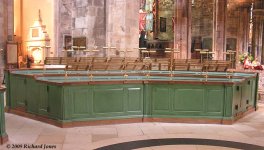
If I remember correctly the main materials used for the construction were Douglas fir and birch(?) plywood for panels, seating and other bits plus a bit of show oak and brass hardware. It was forty plus years ago I had a role in the construction of these choir stalls, and I left that company for a new job before they were finished, so I could have some memory lapses. But, given the materials used it doesn't surprise me they were mostly painted with some polish on the oak bits, so perhaps green is not such an odd choice.those stalls are very nice, and pretty unusual being green aren’t they? I’ve only ever seen them au natural.
