• Hi all and welcome to TheWoodHaven2 brought into the 21st Century, kicking and screaming! We all have Alasdair to thank for the vast bulk of the heavy lifting to get us here, no more so than me because he's taken away a huge burden of responsibility from my shoulders and brought us to this new shiny home, with all your previous content (hopefully) still intact! Please peruse and feed back. There is still plenty to do, like changing the colour scheme, adding the banner graphic, tweaking the odd setting here and there so I have added a new thread in the 'Technical Issues, Bugs and Feature Requests' forum for you to add any issues you find, any missing settings or just anything you'd like to see added/removed from the feature set that Xenforo offers. We will get to everything over the coming weeks so please be patient, but add anything at all to the thread I mention above and we promise to get to them over the next few days/weeks/months. In the meantime, please enjoy!

Sometimes collectors can work in your favour.

Andy Kev.

Nordic Pine
Joined
Jan 4, 2021
Messages
705
Reaction score
52
At the moment there's a thread in the hand tools section about the prices of second hand tools increasing. I recently and amazingly, to my profit, found out there's a similar thing going on in the world of film cameras. I thought it worth telling the story firstly because most of us rarely come out of a simple commercial transaction ahead of the game and secondly, to give a heads up for people who might have cameras which are worth a bob or two.

I've always had an interest in photography but am no expert and certainly not ambitious, my goal being to simply be able to competently take a photo of anything which catches my eye.

When the digital boom started to seriously hit the camera market, a lot of people sold off tip top film cameras and for a while they were to be had at knock down prices. The upshot of this was that I picked up a couple of Leica M4s, an M2, an M6 and a pair of Contax G2s. (Not bad for somebody who's not fanatical about photography but these things, especially the Leicas are the definition of mechanical as opposed to electronic excellence.)

Anyway, about three weeks ago I realised that I just had too many cameras for a bloke who doesn't take too many photos, so off I went to a specialised Leica store hoping to get €3,000 - 4,000 for five bodies and a couple of Contax lenses. There was only one camera I coveted and that was the Leica Monochrome, which to a lot of people will sound like a daft camera because it is a digital device which only takes black and white images. It also costs €8,300 which in my eyes makes it even dafter. So the idea was to leave the shop being able to buy a new washing machine. I did ask, out of idle curiosity, if they would do a part exchange on a Monochrome but there was no way that I was going to fork out €4,000 or so for one.

Two of the shop staff checked the cameras out thoroughly (this took a good quarter of an hour) and then the bloke came up to me and asked, "How much were you thinking of asking for these?" (You already have my estimate of what I thought I might get.) I said, "Look, I'm not interested in haggling as if we were in a Middle Eastern bazaar: you have a limit above which you won't go and I have one below which I won't go, so just make me a sensible offer and I can say yes or no".

He said, "Would €7,000 be OK?"

I do not know how I managed to retain a poker face but I did and then managed to say, "So if I were interested in the Monochrome, that would be €1,300 then?"

I left the shop in a state of shock, clutching my new black and white camera. I hadn't been following the second hand market at all but here are two examples of how prices have rocketed over the past five or so years. My Leica M2 cost me €400. I saw the same model in a comparable condition in a shop on Saturday for €1,450. The lens which I have on it cost me €300 and there doesn't seem to be one on offer anywhere for less than €1,000.

The bottom line: if you have an old Leica M camera and it works and is otherwise in reasonable condition, you might be able get enough for it to get a handful of decent planes. Conversely, if you have a Leica R, you will get hardly anything at all.

The other thing that occurred to me is that the dealer is probably laughing too because I guess he will do a 100% mark up when he sells all my gear and obviously the Monochrome will have cost him miles less than the retail price.

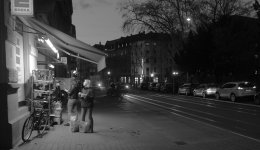
PS Here's a pic I took with the Monochrome. (I know it's nothing special but I wanted to show that the camera works.)
Edeka Seck LdStr 16.03.22.jpg
 
Fully agree. Being a bit obsessive at times I did a similar thing years ago and bought up a few Leica rangefinders and quite a bit of good Leica glass from the upgrade fraternity. Also a couple of Leica microscopes. The binoculars were never cheap but they are excellent.

I've got one microscope left to sell (these are sought after in the Koi fraternity) and I started selling off the cameras and glass this year. I might shift most of my Canon L glass as well as I no longer use them within the business.

The camera market is fickle. I still thing a full frame small camera is unbeatable as a carry around when visiting gardens or on holiday, but mobile phone cameras are so good now, and the digital interpolation is getting more and more credible.
 
Interesting that you mention mobile phones. I'll hazard a prediction for the short term future of photography: most happy snappers will use their mobiles and nothing else. This may mean that far fewer "consumer" cameras will be made. The pros and those with an interest will always have a "proper" camera. It's also worth remembering that film is enjoying a bit of a revival and I reckon that that will stabilise at a certain level and will maintain the demand for old high end film cameras.

FWIW I like to use a camera because it makes me slow down and properly address the business of taking a photo. That probably means taking no more than 5 - 15 secs longer than someone who is just going point and shoot but it can mean a big difference to the results.

I'm now down to three cameras: an M2 for B&W film, an M6 for colour slide (the least used one) and the Monochrome for most of the time.

BTW for years I've been toying with the idea of buying a microscope (I did biology at university) but have so far resisted going down that particular rabbit hole!
 
Whenever I think of taking pictures, I think in terms of tone and shading for B&W never think the end result will be printed in colour. B&W seem to be more natural in a photo rather than full colour. I am not an old fuddy and grew up with colour film but always bought Isopon 64
 
droogs":36f4cchg said:
Whenever I think of taking pictures, I think in terms of tone and shading for B&W never think the end result will be printed in colour. B&W seem to be more natural in a photo rather than full colour. I am not an old fuddy and grew up with colour film but always bought Isopon 64
I think that B&W is for structure and colour is best for landscapes. Obviously there are people who can do brilliant B&W landscapes but I'm not one of them. It's a purely subjective thing that I am increasingly tending to B&W. It's probably because I enjoy the exercise of seeking out structure.
 
Phil Pascoe":2irwfs5p said:
I've not tried photography with Isopon. :shock:
I just looked up Isopon.

I am surprised, Phil, that a man of your talents can't take a photo with it. :D
 
Andy Kev.":efobf8wo said:
.....
FWIW I like to use a camera because it makes me slow down and properly address the business of taking a photo. That probably means taking no more than 5 - 15 secs longer than someone who is just going point and shoot but it can mean a big difference to the results.
....

You've hit the nail on the head there. When digital cameras first came in, a very well-known photographer got one and found that the artistic quality of his photographs were taking a nosedive. After some thought, he came to the conclusion that, like you say, he was almost snap-happy. So he got his assistant to count the shots as if he was still using a 35mm film. Quality back to normal.

I think that the trouble with mobile cameras is that they are trying top be too clever with these high resolutions and that the content of the image can really mess up the processing algorithms....like this one

 
I see what you mean: any enlargement of that image makes it almost painful on the eye. That has the potential to ruin the aesthetic effect of an otherwise well-conceived photograph.
 
Andy Kev.":37tuq6ri said:
I see what you mean: any enlargement of that image makes it almost painful on the eye. That has the potential to ruin the aesthetic effect of an otherwise well-conceived photograph.

Thanks, Andy.

mmmm... :eusa-think: Actually the reason for taking that photo is because the Eejit up the road had the local contractor out and cut just the spurge down that area. Well, underneath that area are the water and electricity pipes to our property. Now call me paranoid but...he's mental. So we're kind of on guard to hear a JCB digger (OK...I admit....spurge v. digger ...digger wins).

But...

PS sorry to hijack
 
lol I meant Ilford XP2 ISO50 - 400 at iso64 a great film in its time. Don't know what I was daydreaming about with that one
 
RogerS":2qhwofo6 said:
Andy Kev.":2qhwofo6 said:
I see what you mean: any enlargement of that image makes it almost painful on the eye. That has the potential to ruin the aesthetic effect of an otherwise well-conceived photograph.

Thanks, Andy.

mmmm... :eusa-think: Actually the reason for taking that photo is because the Eejit up the road had the local contractor out and cut just the spurge down that area. Well, underneath that area are the water and electricity pipes to our property. Now call me paranoid but...he's mental. So we're kind of on guard to hear a JCB digger (OK...I admit....spurge v. digger ...digger wins).

But...

PS sorry to hijack

It seems to me that there is a degree of elegance in making the case for the defence with a photograph which is easy on the eye and roughly obeys the rule of thirds. :D
 
droogs":2rn1ynfw said:
lol I meant Ilford XP2 ISO50 - 400 at iso64 a great film in its time. Don't know what I was daydreaming about with that one
XP2 is still enjoying its time! As are most of the Ilford films for that matter. My favourite one is SFX because it can also double up as a more or less infrared film.

Incidentally, I used to agonise over development until I discovered stand development. Instead of fannying around with 5 minutes of this and 10 rotations of that, you just put massively dilute developer in the tank with everything at room temperature and let it stand for an hour, with maybe one rotation at 30 mins. Unless your Ansel Adams's grandson, you're going to be happy with the results. You don't even need a stop bath because the dev is so dilute. Just rinse it with water and fix.
 
Andy

Purely as a matter of interest, why did you choose the mono Leica? I know it is a popular camera for enthusiasts, and I have never tried a monochrome only camera. (Nor have I ever processed old school film myself. I know this Leica is digital, just setting out my experience limitation).

The reason why I ask is that modern processing software such as Capture 1 Pro and DXO5 do (I think) a very good job of generating monochrome images from full colour capture files. It can't be the grain effect of old B&W film I suppose as that doesn't really exist with very high quality cameras and lenses, and anyway can be emulated in processing.

What is the advantage of doing the monochrome processing in camera (which is what must be happening really as the lens just transmits light) as opposed to in the computer?

Not criticising your choices - just seeking to fill my knowledge gap. I like B&W images a lot and often do them myself. especially for street pictures and portraits.

Adrian
 
Adrian,

that's quite a big question or at least it means that I have to give it proper consideration.

It starts with my subjective reaction to the Leica M film cameras. The M2 and M4 felt just right, despite being purely mechanical (for the unfamiliar that means zero electronics). The M6, with its exposure meter (necessary for colour slide) is really good but IMO not quite as pleasing.

I like doing landscapes in colour but that sort of photography is the definition of unhurried so I ended up with a 5" x 4" field camera for that (the kind where you have to chuck a blanket over your head). So that was ticked off.

For everything else, I found that colour is generally a distraction when photographing structure e.g. a close up of tree bark which can be made to look very abstract. The thing that sold me on theidea of the monochrome was that it offers the purity of the B&W approach but in a digital format. The sensor also offers ISO of up to 100,000. Given that I really like low light and night photography, this is a blessing because you can ditch the need for a tripod. The dullest street can be made quite atmospheric in a night shot.

There's also the incredible sharpness of the sensor. This is because any given B&W sensor effectively has 4x the number of pixels of the equivalent colour sensor. (It might be 3x. I'm not too hot on tech.) You have to have a pixel for each of the basic colours in a colour sensor, whereas every pixel counts on its own in B&W.

If you enlarge the pic in the first post, it does become a bit blurry at the maximum. I presume that's because I've put it on here. In the computer it is pin sharp at the max and that is for a hand held shot at twilight!

The bottom line of all that is that a B&W pic from the monochrome is 4x (or 3x ?) more detailed than that of a conversion from colour. Then there is the matter of software processing. As far as I am aware, you can't do any in-camera processing - I really am trying to use it like an M2 - although I'll check that. I use Affinity Photo software on the DNG digital negatives and just lighten the shadows and darken the highlights (the pic at the top was very dark indeed before I tweaked it) and you can do that just by putting a bit of an "S" into the curve in the computer. Then I save it as a JPEG but retain the DNG.

Therefore I believe there is no processing taking place within the camera unless you count the production of a straight digital negative as processing. Daylight shots tend to be a bit flat. This is not a fault but rather a reflection of the wide tonal range of the monochrome sensor. You just need to play a little bit with shadows and highlights and maybe contrast to make the picture pop. I'm actually the worst bloke on earth to ask about this as I resent time spent at the computer for photography but I am on a learning curve with Affinity Photo, which is free BTW.

The only other thing I've done is to reduce the display time once an image has been taken, just to check the focussing, as again I want to keep the process as film-like as possible.

There is one absolutely wonderful accessory that Leica does for this camera and that is the electronic viewfinder and that means that you get to see the image in B&W while you take the shot. This is of course not necessary for low light shots but what a boon it is in daylight. You can also get an adaptor for Leica R lenses which means you can go to extreme telephoto and look through the viewfinder or on the screen. Obviously you can do that on the current M10 colour camera as well.

There is one other plus: I discovered at the weekend that if you put an infrared filter on your lens, you can take IR shots with the monochrome. I intend to shoot a roll of IR film and mimic the shots with the monochrome to see what differences/similarities there are. You can also use the classic B&W filters (yellow, green, red etc.) with it. https://www.stevehuffphoto.com/2013/06/ ... ierk-topp/

What you might find useful is to borrow one of these along with the viewfinder from a dealer for a day. You'll know instantly if it is for you or not, particularly after you have tweaked an image or two in the computer.

Finally - and this is wholly subjective - this is the first digital camera I have handled which somehow feels like a film camera and more specifically like an M2 or M4.

Andy.
 
This is interesting. I am in a similar situation with my late fathers Leica collection. I too am a photography enthusiast of the old school and still have a darkroom set up, but the price of film is so brutal. I have been thinking of trading his kit in for a Nikon something body which I can use with my nikon lenses (all manual running my old trusty F3hp). Or trade the M6 and my Nikon gear for a Monochrome. Last time I was back in the UK I had a play with the Monochrome and I found it a bulkier than the M6. Is the new version smaller?
 
Digital Leicas up until the M9 were indeed bulkier than the film Ms. With the M10 they got the digital cameras down to the old dimensions and so they sit better in the hand. The current monochrome is the second B&W camera and it too has the slimmer, older measurements. So you shouldn't get the feeling of bulk.

BTW, I would recommend that you choose the Leica dealer you trade with carefully. I went to one of the official Leica Stores. You may want to compare the offers from one or two places. I imagine they would offer you a good deal on part exchange if the Leicas you have got are in good condition.
 
Thanks Andy. I am kicking myself for not thinking of the pixel density on the sensor.

Going down the Leica digital route is not affordable for me much as I would like an M10. I have a lot of Canon L glass and invested in the new (at that time) EOS R5. Had I known the R5C was coming out I might have waited. I got a deal with some special glass though, and this camera suits our needs. I know the R3 is probably better, but it's much too big and obvious. We also still use the EOS 5D III (mirror) a lot as well.

In fact it was this change that prompted me to sell much of my past Leica kit as it was pretty much a direct swap in the end - in fact a small amount of cash my way. I looked hard at the M10 which was about half as much again price wise as the R5 and the (fixed 28mm f1.7 lens) Q2 obviously. The problem is the variable lens Leica's really need modern Leica glass and the price for their fast glass is eye watering. We couldn't see the sense in having two systems as my wife is very used to Canon and she likes her lenses.

Agree re Affinity. I use DXO because I am very lazy and like their presets. :shock:
 
Adrian,

the only thing I would say about the ludicrously expensive Leica glass, is that there is one much cheaper alternative which is as good - for normal mortals at least and that is the ZM series of lenses made by Zeiss.
I also think that a wide range of lenses for M rangefinders is hard to justify. I have an 18 mm, 35 mm (bothZM) and a 75 mm Elmarit which is from the Leica bargain basement range. So each lens is double the focal length of the other.

For the M2 I have second hand 70s era Leica lenses: 35 mm and 90 mm both bought when prices were low. I could easily manage without the 75 and 90 mm lenses.

I suspect that the perfect set of focal lengths would be 18 or 21 mm, 35 mm and 50 mm.

I reckon that one would have to have pretty specific reasons for getting the more expensive Leica lenses (and I include summicrons in that category). Are you sure that the digital Leicas need modern lenses? I get good results with my 35 mm summaron and perfect results with the 35 mm ZM, which is modern but relatively cheap.

If Canon meets your needs though and you've certainly got good gear, it would be hard to justify going down Leicastrasse.
 
I am not knowledgeable enough to know really. However, the glass we actually use is:

high quality macro for plant close ups (my wife uses this a great deal)
wide angle short L zoom for buildings and garden and holidays
longish L 2.8 telephoto for birds and planes
general purpose short (up to 70mm), fastish L (2.8) zoom for walk around
f1.2 L for portraits and brochures (big lens and probably will be sold)

We have more glass than we are prepared to carry about now.
 
I mostly use a 35mm on full frame and 24mm on a crop body.
I have a nice Sigma Art 35mm f1.4 and a Nikon 24mm f1.8.

Obviously theu aren't my only lenses, a Lensbaby Composer Pro and sweet 35mm gets used a lot.

Pete
 
Interesting I might have another look into the monochrome.
Another even more expensive option would be a digital back for my Hasselblad, but if I sell everything I would still be somewhat short because I need to get three lenses serviced. I'm not brave enough to take them apart myself, but the glass is fantastic.
 
AJB Temple":3n1e3u89 said:
I am not knowledgeable enough to know really. However, the glass we actually use is:

high quality macro for plant close ups (my wife uses this a great deal)
wide angle short L zoom for buildings and garden and holidays
longish L 2.8 telephoto for birds and planes
general purpose short (up to 70mm), fastish L (2.8) zoom for walk around
f1.2 L for portraits and brochures (big lens and probably will be sold)

We have more glass than we are prepared to carry about now.
That sounds like a balanced collection of lenses. I would have thought that the average macro lens would be able to double up as a portrait lens, if it is around 90 mm.
 
MJ80":3rcidzev said:
Interesting I might have another look into the monochrome.
Another even more expensive option would be a digital back for my Hasselblad, but if I sell everything I would still be somewhat short because I need to get three lenses serviced. I'm not brave enough to take them apart myself, but the glass is fantastic.
I think that the drawback with the Hasselblad is that they are a bit clunky for everyday photography. Give the monochrome a go. As I said above, you might be able to rent one for a day.
 
Its way clunky, I have the grip handle and prism finder, but its really much happier on the tripod.
On curious lenses there is the tri Elmar in Lecia collection, its almost genius, but it sacrifices too much speed.
I'm loving this thread, love film cameras and photography, I never managed to make the transition to digital properly. Its nice to see interest in analog gaining ground, but there has been so much lost or diluted in terms of films, chemicals and papers.
 
Yes, the macro would do the job, but the f1.2L is frankly in a different league for composition and sharpness.


We have a couple of very long lenses as well as we went through a period of trying to do bird photography. However, that was a lesson learned as they are bulky, weight a lot and it is hard to acquire the target and get a super sharp picture. We couldn't really afford the pro end gear which is much faster, but several thousand per lens, mostly primes.

I also have a few small primes, including the basic and L versions of the 50mm and 35mm. Big difference between the consumer grade and L grade on these.

But....with Covid we don't travel much, and I don't employ anyone to do business brochures any more, so most of what we do now is our own garden and some videography. We actually bought the new camera in anticipation of another Japan trip, but that is materially postponed due to Covid. Japan is not really open. Last time we went we lugged a roller bag full of lenses around, and took a lot of pictures of Japanese gardens and architecture and food markets. I wanted top quality this time, but much lighter and the ability to do good video.

The snag with cameras is that once you have chosen a brand, you are pretty much stuck with it. If we were starting again I probably would not choose Canon. However, as with pianos and tools, the capability of the kit is greater than my ability to exploit it.
 
AJB Temple":jherokd9 said:
The snag with cameras is that once you have chosen a brand, you are pretty much stuck with it. If we were starting again I probably would not choose Canon. However, as with pianos and tools, the capability of the kit is greater than my ability to exploit it.

I think that if I wanted to do colour digital, I would probably choose a Fuji XPro 3 with about three lenses.
 
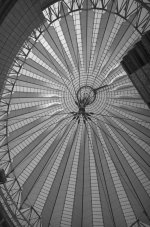
With ref to the idea of B&W photos being well suited to structures, here's one I took last week of the roof of the Sony Centre in Berlin:

Sony Centre 4.jpg
 
Back
Top