• Hi all and welcome to TheWoodHaven2 brought into the 21st Century, kicking and screaming! We all have Alasdair to thank for the vast bulk of the heavy lifting to get us here, no more so than me because he's taken away a huge burden of responsibility from my shoulders and brought us to this new shiny home, with all your previous content (hopefully) still intact! Please peruse and feed back. There is still plenty to do, like changing the colour scheme, adding the banner graphic, tweaking the odd setting here and there so I have added a new thread in the 'Technical Issues, Bugs and Feature Requests' forum for you to add any issues you find, any missing settings or just anything you'd like to see added/removed from the feature set that Xenforo offers. We will get to everything over the coming weeks so please be patient, but add anything at all to the thread I mention above and we promise to get to them over the next few days/weeks/months. In the meantime, please enjoy!

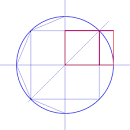
The Golden Ratio

Similarly there is the Silver Ratio which jumps out once you know it is there in traditional Japanese construction. It is 1 : 1.414 (which is the square root of 2).
 
Blackswanwood":2qvaotq3 said:
Similarly there is the Silver Ratio which jumps out once you know it is there in traditional Japanese construction. It is 1 : 1.414 (which is the square root of 2).

The same ratio as a standard piece of paper (A5, A4, A3 etc).
 
many years ago a group of us students were asked to divide a 6 inch line into two pleasing parts and nearly every single one of us was within half an inch of each other, - the golden square.
When I design furniture it has become natural as it does for most people not to have tall thin things or short squat things, where the design allows obviously.
 
As my father is keen to say “If it looks right it generally is”.

Much easier for my tiny brain to use the rule of thirds than 1:1.168. Not exactly the same of course but works for me.
 
I never use any ratio like that. OK, My work may not look good, that is another topic, but my main problem is that we have to work with constraints. For example, consider making a dining table. The height of a table is pretty much fixed by the practicalities of using a table; measure the height of 100 tables and they won't vary by much. Now think that if the height is fixed and you stick to a ratio, the width & length of the table are also fixed. Thus every table ever made will be basically the same size. Sounds ridiculous to me.
 
Blackswanwood":2jmbtym6 said:
Similarly there is the Silver Ratio which jumps out once you know it is there in traditional Japanese construction. It is 1 : 1.414 (which is the square root of 2).

I'm pretty sure that the so-called silver ratio is 1: 1+root2, so 1:2.414. If I'm wrong, I've mis-remembered something from uni 20 odd years ago. If I have remembered correctly........I know nothing about Japanese design, but if they use 1:1.414, which is easily derived geometrically, then that's interesting, but isn't what we call the silver ratio.
 
Yamato Hi 1 to 1.4 Used frequently in temple and pagoda construction.

Yamato Hi means Japanese ratio.
 
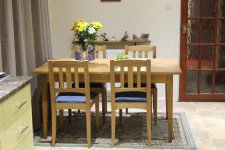
dining table and chairs 002.JPG
Just4fun":22kaa3ie said:
I never use any ratio like that. OK, My work may not look good, that is another topic, but my main problem is that we have to work with constraints. For example, consider making a dining table. The height of a table is pretty much fixed by the practicalities of using a table; measure the height of 100 tables and they won't vary by much. Now think that if the height is fixed and you stick to a ratio, the width & length of the table are also fixed. Thus every table ever made will be basically the same size. Sounds ridiculous to me.

Agreed that the height of a dining table is fixed at about 750mm but when deciding on the dimensions for the top I construct it to the 1:1.62 ratio.
John
 
Looks like there may be different opinions on what constitutes the silver ratio then …. however the author in this architectural publication views it as being seen in Japanese architecture and being 1 : 1.414
 
Mike G":f5jts5ii said:
...I know nothing about Japanese design, but if they use 1:1.414, which is easily derived geometrically, then that's interesting, but isn't what we call the silver ratio.

If you google silver ratio the first image gives one to the square root of two ........... 1 - 1.414.
 
Phil Pascoe":drf1jz6w said:
....If you google silver ratio the first image gives one to the square root of two ........... 1 - 1.414.

From Wikipedia:

This defines the silver ratio as an irrational mathematical constant, whose value of one plus the square root of 2 is approximately 2.4142135623
 
Yep. So, gold and silver are but a hair's breadth apart.
 
Blackswanwood":2f84z5kg said:
Looks like there may be different opinions on what constitutes the silver ratio then …. however the author in this architectural publication views it as being seen in Japanese architecture and being 1 : 1.414

https://architects.zone/golden-and-silv ... hitecture/

Reposted as I seem to have omitted the link in the original!
 
I think it's just semantics. We all know what they are, they're just being described differently. (I tell a lie - I hadn't heard of silver ratio. :lol: )
 
Thew height of a dining table is set like that so you can get it through a standard doorway. )29 1/2" through a 30" dfoorway). Or possibly vice versa. DAMHIK what happens if you decide to mess about with it...
S
 
No, Steve, it's all about the height at which seated people can use them comfortably. So, their height relates to chair height. Chair height, in its turn, relates to the length of our legs below the knees. Both chairs and tables have remained at roughly the current heights for centuries.

As for the table-through-a-doorway challenge........I reckon it would be perfectly possibly to thread a normal height dining table through a doorway only 12" wide, if the end of the table didn't overhang by much.
 
That's making a lot of assumptions about clearance around the doorway itself. I can testify from personal experience that clearance matters.

As to the height of a table remaining unchanged for centuries - you are right, it has. The trouble is that people haven't. So when you make atable bit higher than normal - not much, just half an inch or so - it looks grat in the workshop and then you can't get it onto the dining room because other walls are in the way.

I do know what I'm talking about here :(
 
The whole standard heights thing is daft when we make our own stuff. I am tall, but not crazy tall (6ft 2) and normal height kitchen worktops are uncomfortably low for me for chopping (even on a thick board), knife sharpening and such like. So I made all of ours just over 2" higher than standard in the new kitchen.

We once had a 500 year old farmhouse in Surrey called Mare Pond. All of the doorways were ludicrously low and so were most of beams. It looked very beautiful but I sold it pretty fast because it was awful for tall people to live in. I reckon men must have been at least a few inches shorter on average a few hundred years ago. Many tables are knee bangers for me if they have any kind of apron arrangement. Awful.
 
From googling just now out of ignorance and curiosity, in UK medieval men were 68" on average, so 5' 8" and this went down to 5' 5" in 17th and 18th century and is now a tad over 5' 10" they say.

In the Netherlands, where I used to live once upon a time, I frequently felt pretty short at my height and lots of Dutch women were 5' 10" ish. My wife's cousin is 2 metres tall and that is a pain with modern houses and furniture.
 
AJB Temple":2c4ahyjm said:
2 metres tall and that is a pain with modern houses and furniture.

Definitely. I'm 1.98 metres tall (6'6") and my other half is 1.88 metres tall (6'1"). It's a pain with a lot more things than just modern houses and furniture. Our worktops are raised up quite a bit (I can't remember by how much), which helps a lot, but that doesn't help with clothes, hotel rooms (footboards on beds), tents, sleeping bags, plane journeys, safety clothing (like lab coats, overalls, motorcycle gear or whatever) and the list goes on and on an on...
 
Back
Top