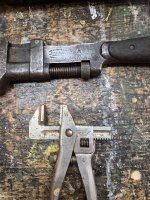
Ok, Scott, you've hooked me in!
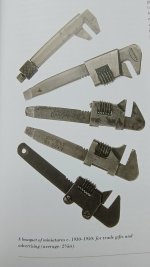
The first two tools give us a good example of how it's often easier to find out about American tools than British ones. The crucial thing is that over your way, patent markings generally give a nice clear date. And over the last thirty years or so, there have been enough dedicated old tool collectors to build the wonderful
DATAMP database - the Directory of American Machinery and Tool Patents. It contains over 85,000 patents, (including over 6,000 not from the US). Each entry shows what it was, who invented it, and when. There are links to the original drawings and claims. Often, there are photos of tools as manufactured.
So, if we want to know more about the Starret pliers, we note the date - Jan 3, 1911 - and enter that in the search box. We get this: - click through for more info.
US patent 980,361 Expansion Pliers was issued to Laroy S. Starrett of Athol, MA. It was granted on 01/03/1911. This pliers was item #240 in Starrett's #21 catalog.{br}Starrett Expansion Pliers with worm and rack adjustable jaw allows for parallel jaw faces thr
www.datamp.org
A useful comment says there's more in the Starret catalog no 21. Now, the ever-useful International Tool Catalogue Library has plenty of Starret material but not catalog 21. Never mind, it's in no 22, with a complete description of its advantages:
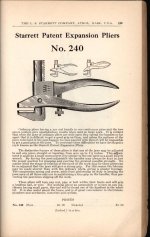
So we can see it was invented in 1909, patented in 1911 and in production around 1917.
It looks a useful tool - I'd happily pay $3 for one, or even $3.50 for a shiny one!
The other tool in your first photo is similarly clearly marked, so it's easy to see the patent, here
US patent D33,468 Design for a Wrench Member was issued to Amos Shepard of Plantsville, CT. It was granted on 10/30/1900. The patent describes a handle end for a monkey wrench bar. The patent relates to the PERFECT HANDLE family of tools. This patent and William S. Ward's
www.datamp.org
and note that the patent isn't for the design of a whole monkey wrench, but for the way that the handle could be made as a one-piece forging, with wooden scales on either side. HD Smith seem to have been the originators of the "Perfect Handle" design, which was clearly robust and was popular on both sides of the Atlantic until the arrival of plastics in the second half of the 20th century.
Here's a catalogue listing for it, from the 1914 catalog of Crerar, Adams & Co., of Chicago, IL - again from the ITCL, with some other Perfect Handle tools:
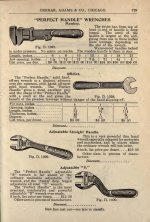
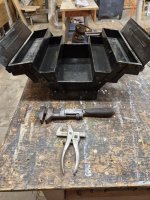
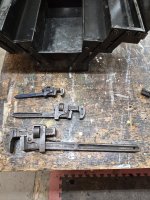
That monkey wrench would be useful for gripping and turning nuts and bolts, but anyone working on the sort of steel pipe that is still used for large scale heating etc in commercial or industrial buildings will need to be able to grip various sizes of pipe and tighten it into threaded iron fittings. They need an adjustable tool which tightens up as it's pushed, to hold the pipe firmly. That's what's in your second picture.
It's interesting to see that although there were so many American companies making these, your three all came from Sheffield.
I don't know enough about these to date them, but I can say that the trademark "Record" was registered in 1909 and that they expanded production of hand tools, including tools for pipe fitters, between the two world wars, though the designs show continued into the 1990s when the group went through a confusing sequence of changes of ownership.
This is from a 1991 catalogue:
100 p., illus., 29.7 cm, trade catalog
archive.org
I expect most people would call this sort of tool a "Stillson" and it's interesting to see that Record did that themselves in that listing.
But it's not hard to discover that Mr Stillson was the inventor, back in 1869, with a couple of later improvements
If I drag a few of my own tools out and look closely at them, here's what looks like an old Stillson, with wood on its handle, alongside a newer Record equivalent
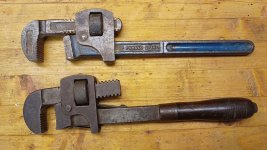
and a close-up of the markings shows this
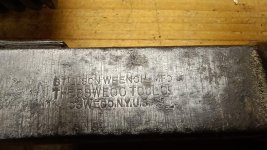
That wasn't immediately intelligible to me, not having a detailed knowledge of places in New York State, but it turns out to be the Oswego Tool Company, from Oswego, who describe themselves as "Stillson Wrench Manufacturers."
I guess that's careful wording - they're not saying that they are the Stillson company. Wikipedia makes it clear that the name was licensed to several companies before the rights expired.
And just to round off this thread (without rounding off any recalcitrant nuts!) here's my similar selection.
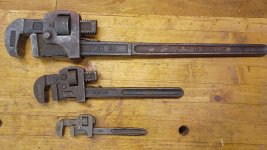
A 24" from
Chatwin (a long-standing Birmingham maker) which I can barely lift, a practical 14" Record and a cheap nasty 8" knock-off with a head that's already been bent.
Not the sort of thing I need often, but they have all come in useful enough to be worth keeping.




 )
)