• Hi all and welcome to TheWoodHaven2 brought into the 21st Century, kicking and screaming! We all have Alasdair to thank for the vast bulk of the heavy lifting to get us here, no more so than me because he's taken away a huge burden of responsibility from my shoulders and brought us to this new shiny home, with all your previous content (hopefully) still intact! Please peruse and feed back. There is still plenty to do, like changing the colour scheme, adding the banner graphic, tweaking the odd setting here and there so I have added a new thread in the 'Technical Issues, Bugs and Feature Requests' forum for you to add any issues you find, any missing settings or just anything you'd like to see added/removed from the feature set that Xenforo offers. We will get to everything over the coming weeks so please be patient, but add anything at all to the thread I mention above and we promise to get to them over the next few days/weeks/months. In the meantime, please enjoy!

Wellington & Manawatu Railway.

Vann

New Shoots
Joined
Aug 30, 2020
Messages
246
Reaction score
49
Location
Petone, New Zealand
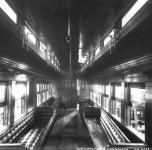
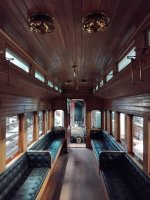
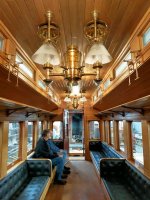
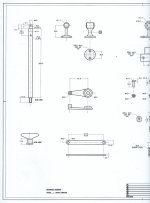
I mentioned in another thread that I'm involved in a project to restore some old railway carriages. There seems to be some interest, so rather than continue to hijack that thread, I've started this one.

I'm 70 years old and worked for New Zealand Railways (through numerous name changes to the current KiwiRail) for 49 years. I intially did an apprenticeship as a railway coachbuilder, and still think of myself primarily as a coachbuilder.

Around 2000 a mate got me involved in a project to restore an old railway carriage and I beavered along until 2008 when, as a result of family commitments and frustrations with the guy running the project, I walked away.

Come the late 2010s I was persuaded to come back and assist on occasions. My nemisis had moved on, as had most of the rest of the small team, and my kids had grown up. My involvement grew and the guy currently leading the team, now in his eighties, was looking to hand over the lead. I have resisted, and still don't hold any title, but the writing is on the wall (much to my wife's disgust). My retirement in 2021 didn't help my cause.

People asked "What will you do with your spare time when you're retired?". All I can say is "What spare time?".

Cheers, Vann.
 
You’re not the only one around here working on heritage railway restorations projects.

I hope that we can get to see a little of what you do.
 
Some background:
During the 1870s New Zealand Government Railways was constructing a railway line out of the capital, Wellington, through the Hutt Valley to the Wairarapa, and hence towards Napier, Palmerston North, and other points north.

Construction also began on a second railway north, this time through the Manawatu. However hard times meant the government had to cut back big projects, and this second route was abandoned in 1880 so finances could be concentrated on the Wairarapa route. Any rail buffs reading this may know that the route to the Wairarapa involved crossing the Rimutaka Range via a route with 1:14 grades, run by Fell locomotives. But I digress.

A number of Wellington businessmen got together and formed the Wellington & Manawatu Railway Company in order to take over the abandoned works - which consisted of about 1 mile of laid track and about 7 miles of embankment winding a torturous route through Wellington's northern suburbs.

They ordered five locomotives from Manning Wardle & Co. in England, followed by a further three locomotives from Nasmyth Wilson & Co. However carriages were ordered from Gilbert Car Co. in the USA.

The railway opened in 1885 and ran between Wellington (where it had an interchange with the government line) for 81 miles to Longburn on the government's Foxton branch (where there was another interchange).

The Wellington & Manawatu Railway was the only successful private railway company in New Zealand - excluding a few short industrial lines built for single commodities, such as coal or forestry.

In 1995 the Gilbert Car Co. went bust, with the last carriages from that source being commissioned here in New Zealand the following year. By then the company had 27 carriages, with 25 built by Gilbert, and two by New Zealand Government Railways - all 43' 4" long over headstocks.

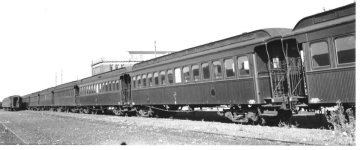
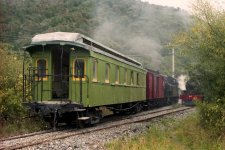
The company then switched to another American supplier, Jackson & Sharp. Eight 43' 4" Jackson & Sharp carriages entered service on the railway, four in 1898 and four in 1902. Shortly after, the WMR ordered another 7 carriages from Jackson & Sharp, these being six 50' carriages and a 55' restaurant car. These carriages, when they entered service in 1903 and 1904, were longer than anything the government railway had.

About the same time the company, worried about the risk of fire, decided to replace the timber Belmont Viaduct with a steel structure. This left them with a number of large kauri beams. The company then turned to building their own carriages to the same pattern as the Jackson & Sharp 50 footers, utilising these beams.

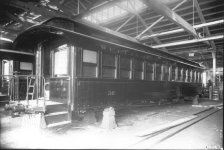
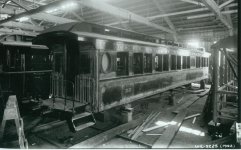
A batch of six 50' carriages - #42 to #47 - was built at the company workshops in Thorndon, Wellington, during 1904. A second batch of six - #48 to #53 - was built in 1906 and 1907.

In late 1907 the government gave the company 12 months notice that it was going to acquire the railway. The North Island Main Trunk line (between Wellington and Auckland) was nearing completion, and the Remutaka incline, with it's six Fell engines, was an inefficient bottleneck.

In December 1908 the government took over 53 passenger carriages, numerous 4-wheel and bogie wagons, and 20 locomotives.

Cheers, Vann.
 
More background.
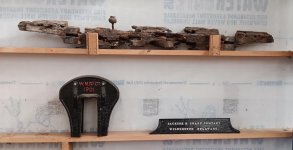
In the year after it acquired the WMR, the NZGR (New Zealand Government Railways) absorbed the carriages into it's fleet. The first modifications included the removal of electric lights (powered by batteries in the guards van), and their replacement with gas lighting (NZGR didn't introduce electric light until 1926). Just before WW1 the distinctive American Woods Safety Gates were removed.

Electric lighting was never re-installed in these carriages. They continued with gas lighting to the end of their service. When I started my apprenticeship at the Otahuhu Railway Workshops in 1973, there were still four carriages on the Auckland suburban fleet with gas lighting.

The WMR carriages initially remained in the Wellington region. In the mid-1930s the torturous route through Wellingtons suburbs (and over the Belmont Viaduct) was replaced with two tunnels (the second and longer tunnel being over 4km long) and the line was electrified (1500v DC) as far as Paekakariki (27 miles). There remained a further five short tunnels, and in some the clearances were tight. The WMR carriages being also taller than goverment carriages, were soon banned from the route after one came in contact wire the overhead wire and caught fire.

The carriages mostly ended up in Auckland, and were eventually withdrawn from normal passenger service around 1940-41. However they lived on to about 1947-48 restricted to the Otahuhu Workshops train (which conveyed railwaymen to the workshops in the morning, and back into Auckland in the afternoon) of up to twelve carriages.

From 1950 a number of the surviving carrages were converted to works vehicles. If, for example, a station needed resignalling, a works vehicle kitted out as a workshop might be shunted into the siding for use by signal maintainers until the job was completed, and then moved to the next worksite. In remote locations some even had bunks and cooking facilities.

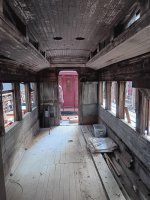
Their interiors had long been stripped of seats, luggage racks and even toilets (being of the "long drop" variety, they were unsuitable for stationary use).

By the early 1960s the few remaining ex-WMR carriages were withdrawn and scrapped or sold.

Cheers, Vann.
 
The New Zealand Railway & Locomotive Society.
The society had its origins in 1944 and by the 1960s had small branches around the country.

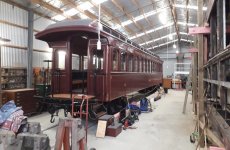
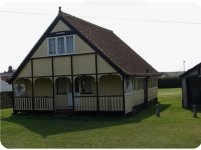
The Hawkes Bay branch bought former WMR carriage #48 (the first of the second batch of locally built carriages) for their clubrooms. It was located at Clive Station, between Napier and Hastings.

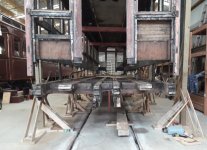
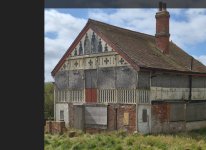
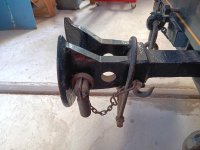
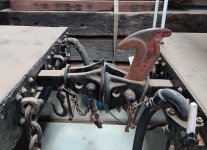
Similarly, the Wanganui Branch of the society bought the former #52 (second to last WMR carriage). I don't know where it was based in the Wanganui district, but the branch eventually closed and the carriage passed into the hands of a group of steam traction engine enthusiasts based near Greatford. Here the bogies and most other underfloor steelwork was removed and scrapped. Later the carriage passed to the Wellington Branch of the society and was moved to Seaview in the Hutt Valley.

The Wellington Branch of the society became the Silver Stream Railway, who run steam and diesel trains, and a railcar, over about 1 km of track at Silverstream further up the Hutt Valley.

Fortuneately, some members of the Silver Stream railway became aware that the NZGRs forestry tramway was using old WMR carriage bogies to haul logs out of the bush. Upon the closure of tramway a group of members went up to the tramway and acquired three bogies for #52, to replace those that had been scrapped.

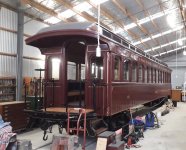
In the late 1990s the Hawkes Bay branch was disbanded, and their carriage, along with a small sum of funds for restoration, was dispatched to Silverstream, where the society owned a small portion of land at the north end of the Silver Stream Railway.

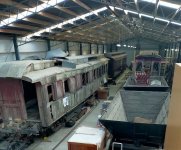
The society's activities consisted of publishing books and magazines on New Zealand Railways, and archiving written material about our railways. There was no preservation arm. However, the society took the plunge and put up a two road shed, to house the carriage and a couple of 4-wheel coal wagons.

It was about that time that I was first approached to participate in the restoration project. While working on #48, we were very aware that just 1km south, on the Silver Stream Railway, carriage #52 was sitting exposed to the elements and slowly deteriorating. We sought permission from the committee, then approach the SSR and they agreed to sell the carriage to our society.

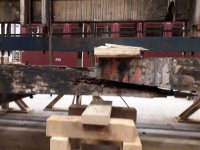
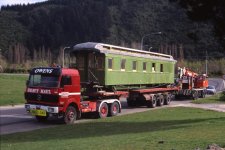
While at Otahuhu Railway Workshops in the 1970s I had often noted an old carriage out the back, it being former WMR carriage #42 (the first carriage of the first batch, and the first carrige built by the WMR). It later was moved to the bush Tramway Club, near Huntly. This carriage too was exposed to the weather. The owner was approached and agreed to part with the carriage. It arrived on site in 2014.

So we now have a shed extension to house the only three remaining carriages of the Wellington & Manawatu Railway - 118 years after it ceased to be.

Cheers, Vann.
 
Back
Top