• Hi all and welcome to TheWoodHaven2 brought into the 21st Century, kicking and screaming! We all have Alasdair to thank for the vast bulk of the heavy lifting to get us here, no more so than me because he's taken away a huge burden of responsibility from my shoulders and brought us to this new shiny home, with all your previous content (hopefully) still intact! Please peruse and feed back. There is still plenty to do, like changing the colour scheme, adding the banner graphic, tweaking the odd setting here and there so I have added a new thread in the 'Technical Issues, Bugs and Feature Requests' forum for you to add any issues you find, any missing settings or just anything you'd like to see added/removed from the feature set that Xenforo offers. We will get to everything over the coming weeks so please be patient, but add anything at all to the thread I mention above and we promise to get to them over the next few days/weeks/months. In the meantime, please enjoy!

Wellingtonia trees

Eric the Viking

Nordic Pine
Joined
Dec 10, 2020
Messages
867
Reaction score
325
Location
In the downstairs shower, trying to fix the leak.
We've just returned from a superb (if pricey) holiday in Alberta and British Columbia.

Whilst on Vancouver Island, we visited Butchart Gardens, about 10 miles north of Victoria (the provincial capital). The place is absurdly pretty, and has a small number of Giant Sequoias (Sequoiadendron giganteum).

They're apparently quite happy, albeit about 500 miles north of their natural range (they peter-out in northern California). I spoke to one of the horticulturalists, who puts their success mostly down to a relatively mild micro-climate. Here are a couple of examples:

Buchart Gardens: a pair of young Sequoiadendron Giganteum background (on the hill), and a Sequoiadendron Giganteum Pendulum (weeping Sequoia) left foreground.
Butchart Gardens: a pair of young Sequoiadendron Giganteum background, and a Sequoiadendron Giganteum Pendulum ("weeping Sequoia") left foreground.

"Wellingtonia" is the common British name for the same species, which was introduced here in the 1850s (the name was already assigned to a different plant altogether and "Sequoiadendron giganteum" wasn't finally settled on until 1939!).

Sequoiadendron Giganteum like the British climate, especially Scotland, although we had a couple in our back garden when I was a child in south-west Surrey, hence my particular interest in them. Ours were probably planted some time in the 1860s, and in 1970 easily 100ft tall. Sadly (more so as I actually climbed the taller of the two!), Google StreetView shows they were both felled, fairly recently.

Anyway, that conversation with the Butchart horticulturalist, and a rather poor article on Forestry England's blog were interesting. I knew fire was an important part of Sequoia propagation, and that the ones in their native range are in difficulties. In contrast, the ones here seem to be fairly common and thriving. I can't find information on how they are propagated, but they must have been!

Has anyone got links with tree nurseries that have grown them? I'd be very interested to know how they do it. We used to get lots of cones from our two trees, but they usually stayed quite green and firmly shut!

E.

*Forest fires apparently prompt the cones to open and release seed, at the same time removing underbrush so young Sequoia can flourish - mature Sequoia have fire-resistant bark and usually a big gap (tens of feet) between the ground and the lowest branches. Human fire management has interrupted these natural processes, meaning the current generation of mature trees in their native California will probably die before any seedlings can reach a safe age (and height!) to replace them.
 
Same here and flew in to Blighty on Tuesday. We also visited Butchart Gardens on Vancouver Island and thence off to tour BC and Alberta. As I understand it, these giant trees now grow better in the UK (and places with similar climates, such as Vancouver Island) than they do in California - Rob
 
We've been to the Butchart Gardens a couple of times and it really is a spectacular place. We loved Canada and were in Vancouver on Canada Day the first trip which was something special to witness, In Whistler on the second but still a great parade. Did you get to the other side of the island Eric? We got as far as Tofino and I really would have liked to drive further up but opted for a week on a ship to Alaska and the Hubbard Glacier instead.
The Grizzly pic used as my avatar was taken near Jasper and a bit too close to my camera for comfort and safety. :oops:
 
The Grizzly pic used as my avatar was taken near Jasper and a bit too close to my camera for comfort and safety
Well, 's funny you should mention that. We'd just done a day trip down the Maligne valley:

baldeagle-nest.JPG
[Disclaimer: these are all a bit rough quality - tweaked and scaled in GIMP from JPEGs - I'm still learning Darktable, to handle CR3 raw files from the new camera, and getting the way-too-clever autofocus system to do my bidding.]

Anyway, this Bald Eagle has two chicks, one in front (facing mom or dad) and the more obvious one to the right. Spirit Lake had a forest fire a few years ago, hence all the dead trees in the background.
[300mm @ f/4.5 with 2x, 'handheld' leaning against a 'no overnight parking' sign, being yelled at (very politely) by the coach driver coz we were late, and next to someone who annoyingly had a decent gimbal and tripod, and a lot more time!].

There was also an Osprey nest with both parents, but I couldn't get a clear shot (metaphorically!).


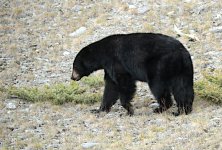
The fire damage was helpful maligne-black-bear1.JPGas it left clearings with only small vegetation.

This guy was only interested in food and completely ignored the coach and passengers...


maligne-mountain-goat.JPG
... and this Maligne Car-Park Goat was totally spaced out on whatever it was licking (something really cool, man) and ignoring the growing queue of cars waiting to get in.

They're very rare, probably because even extraordinarily polite Canadians lose patience sometimes.

As our coach driver put it, "look at those beautiful eyes: you can clearly see nobody's home."


Black bears were out in force that day. This one was in another clearing and we think interested in small berries or flowers on the vegetation (dunno what exacrly):

maligne-black-bear2.JPG

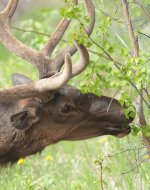
But it turned into a 'wrong lens' day. I needed a 2x converter on most of the above, and it's slow and fiddly to swap out. Thus I was caught out by the stoned goat, and then this guy:

maligne-elk-velvet2.JPGMaligne-elk-velvet1.JPG
It's a young male Elk, with antlers still in velvet. He was literally around 20 feet from the coach window, and I didn't want to miss the moment by stopping to remove the 2x converter. Thus I have several more shots, with the entire set of antlers not in them... D'Oh!

But you mentioned Grizzly bears:

On the way back from the Maligne valley, we'd dropped off all the posh tourists at the Fairmont lodge just outside Jasper (there were many and it is extraordinarily posh). There were about five of us left on the coach including the driver. Literally 300 yards from the start of Jasper's Connaught (i.e. Main) Street, there were a female Grizzly with her probably-two-year-old cub. We got a really good look at them together, for perhaps a minute, and the differences between Grizzlys and Black bears became a lot more obvious. Then they galumphed back in to the scrub and that was that.

Do I have a picture? Nope. I'd packed all the long lens kit away by that time (who expects bears in town in the middle of summer, let alone Grizzlys?). So we just watched and enjoyed (Ruth had her binoculars handy though). Still it was probably our best wildlife-spotting day (if you don't count the humpback whales).
Alberta and British Columbia are truly amazing places
 
@Lons We looked at going up to Tofino when planning the trip, as whale watching boats run from there. But as you probably remember it's a fairly slow and difficult drive up from Victoria and we'd have had to allow time for pickup and drop off of a hire car, so really it needed one or two more overnights. In the end we realised we wouldn't have time (flights have been fully booked in late June for months now, also accommodation, so we really couldn't extend the trip).

We did whale watching from Victoria harbour, which turned out really well - saw a mother and calf humpback showing off close up, sea lions, grey seals, more bald eagles hunting (and getting mobbed by an Oystercatcher), and more seabirds.
R6II1346a.jpg

mum-humpback-breaching.JPG
 
From my office window, I can see what is allegedly the oldest Christmas tree in the UK. A Wellingtonia planted at Wrest Park by the De Grey family in 1856, it's about 30m high. It was dug up and brought inside for Christmas, then re-planted until it got too big. Don't know how they propagated it though !
 
Thanks for your post Eric, very interesting. I've seen them in California, absolutely massive.
There are some very good specimens at Batsford Arboretum near Moreton-in-Marsh as well as many other interesting tree and shrub species from Europe, the Americas and Asia particularly China. and well worth a visit.
 
@Lons We looked at going up to Tofino when planning the trip, as whale watching boats run from there. But as you probably remember it's a fairly slow and difficult drive up from Victoria and we'd have had to allow time for pickup and drop off of a hire car, so really it needed one or two more overnights. In the end we realised we wouldn't have time (flights have been fully booked in late June for months now, also accommodation, so we really couldn't extend the trip).

We did whale watching from Victoria harbour, which turned out really well - saw a mother and calf humpback showing off close up, sea lions, grey seals, more bald eagles hunting (and getting mobbed by an Oystercatcher), and more seabirds.
View attachment 27234

View attachment 27235
Your'e not wrong about the drive from Victoria to Tofino; once you're off the main highway it's a bad, twisting road and we did it the driving rain; I felt like a bit of chewed string at the end of it. The bonus was that we stayed for a couple of nights at the Hotel Zed which is a complete blast from the 70's past. SWIMBO managed to see some wildlife with a couple of outings from Jamie's Whaling Station in Tofino - Rob
 
Thanks for your post Eric, very interesting. I've seen them in California, absolutely massive.
There are some very good specimens at Batsford Arboretum near Moreton-in-Marsh as well as many other interesting tree and shrub species from Europe, the Americas and Asia particularly China. and well worth a visit.
Ditto Westonbirt Arboretum.

I read recently that there are far, far more sequoias in Britain (about half a million) than there are in their native California (about 80,000), although obviously none of the British ones are as big.
 
Ah, Kodachrome!

I still have a couple of unexposed rolls of 25 and, I think 100 professional in the freezer, which I really should have used about 15 years ago. I used to travel with little packets of film canisters wrapped in foil (the pro version was supposed to be kept refrigerated).

You can get close with digital HDR techniques etc. but the original was always the best, and underexposed by 2/3 stop gave amazing, saturated colour. Kodachrome is also supposed to be the most stable film chemistry, archivally.

Weirdly, on our Canada trip, we had meals with two different people who processed film and printed for fashion photographers in the 1970s and 1980s. I was surprised that E3 in half-frame technical cameras was the weapon of choice for many (had never heard of it before, but a predecessor to E6 apparently). I also used professional Ektachrome 160 and 200, which was picky about exposure (no latitude), but way better than the standard stuff (100ft rolls for bulk loading).

Apparently film is making a comeback - there was a girl on our table at dinner on the train in Canada who was travelling with a point-and-shoot film camera. I know of several more people who use it, but I've no idea what modern emulsions are like.
 
S. giganteum can be propagated from seed, cuttings, and micropropagation.

Seed is obviously the most accessible route for amateur growers - they need 2 years to mature, then stratification to germinate.
 
Apparently film is making a comeback - there was a girl on our table at dinner on the train in Canada who was travelling with a point-and-shoot film camera. I know of several more people who use it, but I've no idea what modern emulsions are like.
I took an old Pentax P30 (if I remember correctly) film SLR on holiday a couple of years ago. I really, really enjoyed taking photos with it.

I think for me the power, cleverness and photoshoppability of modern cameras has taken a lot of the joy out of photography for me and I mostly now just take (mainly workshop) photos with the phone. When I'm out and about, I see something beautiful, realise that my camera skills and lack of inclination to use photoshop mean that I'll never get a photo that's as impressive as ones you could find on-line and just decide to enjoy the view without trying to capture it.

When I took the film camera on holiday, it was a pleasure to have to think about every shot that bit more (as I couldn't check the screen to see whether it came out right and then have another go) and I left the camera on "Aperture Priority" and manual focus for most of the time we were away. I think I only took 1 or maybe 2 films worth of photos in a 2 week holiday, but it definitely felt like a more enjoyable bit of photography than the experience I'd have with a modern camera. Even the act of manually winding the film on felt like a real pleasure.

Of course, the photos weren't that impressive compared to what you often see these days, but in many ways that's beside the point. I guess it's a bit like choosing to use hand tools rather than doing everything with a table saw & electric router :) .
 
Your'e not wrong about the drive from Victoria to Tofino; once you're off the main highway it's a bad, twisting road and we did it the driving rain; I felt like a bit of chewed string at the end of it. The bonus was that we stayed for a couple of nights at the Hotel Zed which is a complete blast from the 70's past. SWIMBO managed to see some wildlife with a couple of outings from Jamie's Whaling Station in Tofino - Rob
I didn't think it was that bad tbh Rob though we had crossed over from near Vancouver to Nanaimo rather from Victoria and it was fine weather. We stayed overnight about half way at a fantastic private house with beavers at the bottom of the garden and cougers that came looking for any stray dogs to prey upon. I did drive back from Tofino to Victoria in one go which was tiring but no more so than some of our other trips.

Eric.
We did the whale whatch as well from Victoria on a 12 man inflatable and it was bloody cold and wet, saw loads though the highlight being a small pod of orcas very close toying with a seal to teach 2 calves how to kill. My wife found it a bit upsetting but it was fascinating.
 
I've photographed a few big cats in captivity, but Cougars (AKA 'mountain lions') terrify me. There are a pair at Nashville zoo (of all places!), and they have a stare that just chills. It's entirely obvious they are calculating whether you'd be more suitable for lunch or dinner. I have a similar, 'looking right at you' shot of a Bengal tiger from about 20ft away, and that has a hint of menace, but it's nothing compared to a Cougar.

I saw a superb beaver dam from the Via Rail train down from Jasper to Vancouver. Lake, dam and lodge might've been drawn by an eight-year-old child. They looked 'perfect'. But, being the train'n'all, it was, very sadly, gone in a blink.

Our whale watching was from a large twin-hulled motor boat ("catamaran"), with about 40 tourists on board and around six crew. It wasn't splashy (good for the new camera!), and pretty stable when it wasn't under way (Eagle Wing tours, operating from Fishermen's Wharf). That said, we got out further into the Juan de Fuca strait than the inflatables usually do (apparently. They operate those too).

That said, the Humpbacks we saw were enjoying the presence of a middling-sized freighter, and we didn't see any Orcas at all (didn't bother me particularly). It was rather special, and, I suspect, a bit of a fluke*.

E.

*somebody had to in this thread ;-).
 
That said, the Humpbacks we saw were enjoying the presence of a middling-sized freighter, and we didn't see any Orcas at all (didn't bother me particularly). It was rather special, and, I suspect, a bit of a fluke*.

E.

*somebody had to in this thread ;-).
I was sat just behind one of the crew and they are in constant radio contact with all the other boats out looking for whales and dolphins so maybe less of a fluke than people might think. That's how they found the Orcas and a pod of dolphins which were quite happy to come and investigate the small boat with strange looking things on it pointing cameras at them.

We did a whale trip in OZ as well and they certainly have no fear of people. There were some who jumped in to swim with the dolphins despite warnings from the crew about the possibility of sharks - idiots! We saw a great white later on that trip as well which isn't something I'd want to get close to. o_O
 
Eric, thanks for posting - interesting and another place added to the bucket list! I’ve seen them in California but didn’t realise they grew so far north. truly awesome trees.

Has anyone got links with tree nurseries that have grown them? I'd be very interested to know how they do it. We used to get lots of cones from our two trees, but they usually stayed quite green and firmly shut!

This may be of interest re propagation … if it’s the right episode it covers it being done in California.


Cheers
 
Back
Top