• Hi all and welcome to TheWoodHaven2 brought into the 21st Century, kicking and screaming! We all have Alasdair to thank for the vast bulk of the heavy lifting to get us here, no more so than me because he's taken away a huge burden of responsibility from my shoulders and brought us to this new shiny home, with all your previous content (hopefully) still intact! Please peruse and feed back. There is still plenty to do, like changing the colour scheme, adding the banner graphic, tweaking the odd setting here and there so I have added a new thread in the 'Technical Issues, Bugs and Feature Requests' forum for you to add any issues you find, any missing settings or just anything you'd like to see added/removed from the feature set that Xenforo offers. We will get to everything over the coming weeks so please be patient, but add anything at all to the thread I mention above and we promise to get to them over the next few days/weeks/months. In the meantime, please enjoy!

What should I cut this brass sheet with?

SteveMP

New Shoots
Joined
Jun 18, 2026
Messages
187
Reaction score
229
Name
Steve
LOCATION
San Diego
Want to make a small try square. Picked up this bit of brass sheet in the scrap bin of my local metal store for cheap. Its about 1.13 mm, i think that would be 18 gauge according to google? I have a dremel with cutoff wheels, a hack saw, and an angle geinder with cutoff wheels an other types of grinding wheels . Also have an assortment of files. I do have tin snips but mine tend to “curl” sheet metal as i cut. Best way to cut a parallel strip off this?
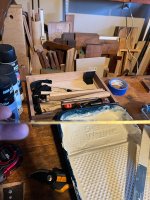
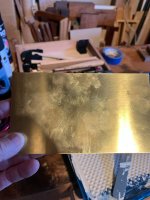
IMG_2260.jpeg
IMG_2259.jpeg
 
Last edited:
There are several ways to do it with limited tools but it's thin so you risk deforming it. Personally for what it is I'd clamp a bit of ply accurately alaong the cut line on both sides and cut it by hand with a hacksaw keeping as many of the teeth in contact with the flat surface as possible. Make it a tadge oversize then use a flat file to finish.
I have in the past successfully snapped thin brass by doing a similar thing but scoring it fairly deeply both sided but it's as quick to use a hacksaw. A jigsaw would certainly work but by hand is more controllable.
 
Last edited:
There are several ways to do it with limited tools but it's thin so you risk deforming it. Personally for what it is I'd clamp a bit of ply accurately alaong the cut line on both sides and cut it by hand with a hacksaw keeping as many of the teeth in contact with the flat surface as possible. Make it a tadge oversize then use a flat file to finish.
Agreed, that's how I'd do it†. Hold the saw at an acute angle to the face of the brass sheet so that the cut, once established, is as long as possible.

† Not strictly true: I'd use my metal cutting circular saw, but if I didn't have that, then it's how I'd do it.
 
Last edited:
Scoring and snapping is probably critically dependent on the grade of brass. Most sheet brass is a fairly malleable type that will bend; bar stock is often a more brittle grade that is more suited to machining or hot work.

I too would use the hacksaw. With a fairly fresh blade if available.
 
Many decades ago as an apprentice I had to mill some square section brass runners and as soon as they were released from the clamps they buckled and warped like Wickes timber.
 
Many decades ago as an apprentice I had to mill some square section brass runners and as soon as they were released from the clamps they buckled and warped like Wickes timber.
Annealing the brass (by heating it to dull red and quenching in water) before (and possibly during, and possibly after) working it can help with that.
 
Wouldn't it be easier to clamp ply across the whole piece (both sides), and then mark and hacksaw through the ply? You could then file with the ply (and thus the line) still intact...although in my workshop I'd be using a mounted belt sander as a linisher for a final finish to the line. Funnily enough I'll be doing something very similar myself in the next little while.
 
As my wife is fond of telling me, "every project is an opportunity to buy a new tool."

I would use my fret saw with a fine blade to rough cut the sheet brass and file or sand to the final dimension. If the cuts exceed the capabilities my fret saw, I would be looking for a used Hegner MultiCut SE scroll saw. There are plenty of SE and 2S saws available here on the secondary market.
 
Metal cutting blade in a jigsaw is my go to then a file to clean up
Hmm, i do have a jig saw but it tends to grab and bounce metal, maybe i need different blades? Mine are called “bi-metal”, i normally jjust use wood blades in the jig saw.
There are several ways to do it with limited tools but it's thin so you risk deforming it. Personally for what it is I'd clamp a bit of ply accurately alaong the cut line on both sides and cut it by hand with a hacksaw keeping as many of the teeth in contact with the flat surface as possible. Make it a tadge oversize then use a flat file to finish.
I have in the past successfully snapped thin brass by doing a similar thing but scoring it fairly deeply both sided but it's as quick to use a hacksaw. A jigsaw would certainly work but by hand is more controllable.
Ok so cutting between 2 pieces of ply as supprts?
Agreed, that's how I'd do it†. Hold the saw at an acute angle to the face of the brass sheet so that the cut, once established, is as long as possible.

† Not strictly true: I'd use my metal cutting circular saw, but if I didn't have that, then it's how I'd do it.
Thats makes sense with the angle. Thats how i have to use my ryoba saw in wood to keep a straight line. I do have a small metal chop saw but only cuts up t 1” bar. And a small 4” circular saw but riggt now is fitted for stone cutting.
Another vote for clamping it to some ply and cutting with a fine tooth hacksaw blade.

Pete
Thanks
Scoring and snapping is probably critically dependent on the grade of brass. Most sheet brass is a fairly malleable type that will bend; bar stock is often a more brittle grade that is more suited to machining or hot work.

I too would use the hacksaw. With a fairly fresh blade if available.
Yeah this feels like it would bend
As my wife is fond of telling me, "every project is an opportunity to buy a new tool."

I would use my fret saw with a fine blade to rough cut the sheet brass and file or sand to the final dimension. If the cuts exceed the capabilities my fret saw, I would be looking for a used Hegner MultiCut SE scroll saw. There are plenty of SE and 2S saws available here on the secondary market.
I don’t actually have a fret saw, it broke. Only have a coping saw with skip tooth blade for dovetails.

Thanks all, think I’ll try the hacksaw. I do have some new unused blades for it. But i forget how many teeth. Do you think it matters how many?
 
Ok so cutting between 2 pieces of ply as supports?

Yes: it'll stiffen up the brass and make it less likely to bend as you cut. As @Mike G says, clamping the wood across the joint and cutting through wood and brass together is probably easiest. In all honesty, that's what I pictured when I agreed with Bob - I obviously didn't read his post carefully enough.

Thanks all, think I’ll try the hacksaw. I do have some new unused blades for it. But i forget how many teeth. Do you think it matters how many?

The usual rule applies of trying to have three teeth in the cut at all times. Cutting at an acute angle makes that much easier as the cut is longer. I'd expect any common hacksaw blade to be fine if you get the angle steep enough, but 32 TPI would be a good option. 32 TPI is 0.8 mm pitch so three tooth gaps is 2.4 mm - thicker than your plate but easily achievable with an acute angle (of 28° or less for your 1.13 mm brass).

On the slim off-chance that you care, the maths to work out that angle was sin⁻¹(1.13 ÷ 2.4)
 
Yes: it'll stiffen up the brass and make it less likely to bend as you cut. As @Mike G says, clamping the wood across the joint and cutting through wood and brass together is probably easiest. In all honesty, that's what I pictured when I agreed with Bob - I obviously didn't read his post carefully enough.


The usual rule applies of trying to have three teeth in the cut at all times. Cutting at an acute angle makes that much easier as the cut is longer. I'd expect any common hacksaw blade to be fine if you get the angle steep enough, but 32 TPI would be a good option. 32 TPI is 0.8 mm pitch so three tooth gaps is 2.4 mm - thicker than your plate but easily achievable with an acute angle (of 28° or less for your 1.13 mm brass).

On the slim off-chance that you care, the maths to work out that angle was sin⁻¹(1.13 ÷ 2.4)
Thanks, makes sense. I’ll have to find what i did with my hack saw blades. I know i bought 2 packs recently but not sure where they are
 
Back
Top