• Hi all and welcome to TheWoodHaven2 brought into the 21st Century, kicking and screaming! We all have Alasdair to thank for the vast bulk of the heavy lifting to get us here, no more so than me because he's taken away a huge burden of responsibility from my shoulders and brought us to this new shiny home, with all your previous content (hopefully) still intact! Please peruse and feed back. There is still plenty to do, like changing the colour scheme, adding the banner graphic, tweaking the odd setting here and there so I have added a new thread in the 'Technical Issues, Bugs and Feature Requests' forum for you to add any issues you find, any missing settings or just anything you'd like to see added/removed from the feature set that Xenforo offers. We will get to everything over the coming weeks so please be patient, but add anything at all to the thread I mention above and we promise to get to them over the next few days/weeks/months. In the meantime, please enjoy!

Where do I start

MY63

Old Oak
Joined
Oct 17, 2018
Messages
1,251
Reaction score
0
Location
North East England
I am now the proud owner of a Hegner Multi cut 1 scroll saw which seems to work fine.
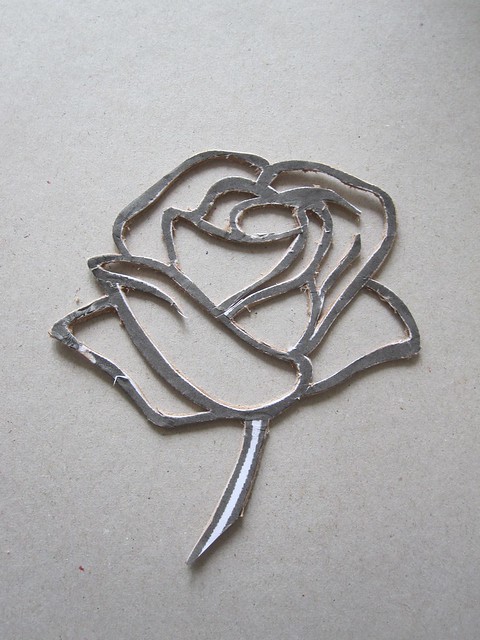
My main use for this saw is to help me cut card which is 1.2 mm thick like this

2019-12-13_07-04-49 by my0771, on Flickr

I have some issues with my hands and currently cut these out with a knife which I find really difficult.
This is my first scroll saw I have seen some good videos on youtube showing how to tension and fit the blades which I am comfortable with. I have also found the oil points.
My next task is to learn the basics of using the saw so if anyone can point me towards videos or books that will help me to learn the basics. A source for practice patterns would also be appreciated.
Thanks
 
Very American, but Steve Good has his followers:

http://scrollsawworkshop.blogspot.com/

In terms of practice patterns, just google clipart and go from those pictures. There are also quite a few free patterns on the web if you do not mind what you make and just want cutting experience. Lettering using MS Word or PowerPoint is also good practice. Jigsaw patterns can also be a source of good practice patterns for flowing but small turns.

You are looking to cut some very fine lettering from your image and it will take time to be able to do this reliably. The hardest part will be to get a smooth flow to your lines. For the beginner, this is usually because they try to adjust too quickly the line of the cut i.e. the blade starts to drift off line and there is an immediate reaction to get back on the line as quickly as possible. If you can drift back to the line instead it will avoid the jaggedness that can result from sharp deviations.

The other thing that will take practice is sharp turns or corners. When these are internal you can come at them from both sides to make the 'point' sharp. When they are external, it is far better to do a loop, going past the point into the scrap, turning a full circle and then coming at the other side of the point from the opposite direction.

As with anything - practice makes perfect, and it can take a lot of practice to be good. Don't be disheartened if your first attempts are not exactly as you would want - it can take a while to get into the groove with a scroll saw and I find it is one of those things that I have to do constantly to remain good at it.

final thing - blades are key. Get the right size and tooth pattern for what you are wanting to cut and don't be afraid to replace them often. I use Flying Dutchman blades from the US. Although I haven't tried then, Pegasus blades are now sold by Axminster I believe and seem to get good reviews. You will not be able to get decent blades in a DIY shed such as B&Q etc.

If you do not get a good edge, or get feathering on your cardboard, either sandwich it between two other pieces of card and take the middle one for your work; or if it is going under leather and does not matter wrap the card in sellotape front and back. This will also help lubricate the blade and will hopefully give you a smoother cut.

Failing all that, sell the Hegner and get a laser cutter ;)
 
I have never tried cutting cardboard but I suspect that as it is so light weight and flexible it might be a struggle to keep it down flat on the table.

Dont be afraid of it. Jump in and try different blades and see how it goes.
 
Thanks StevieB for such a comprehensive reply I have indeed found I did indeed try to correct a wandering blade too quickly. I think I have been trying to work too quickly my next efforts will be more relaxed.
I think I will try learning with wood.
AndyP it is not card in the sense you are used to I should call it by its proper name grey board which is used by artists and modelers. It is a little firmer than card board but does indeed flap around I am going to try cutting two or three together holding it together with tape.
 
Good advice from the contributors to this thread already.

You may find there is some vibration from your saw. Hegners are heavy and very good quality so this shouldn't be much of a problem but you can minimise it by adding mass to your saw. My advice is to bolt it to your workbench. For goodness sake, don't use rubber pads or anti-vibration matting; it's counter-intuitive but this will actually exacerbate any vibration problem.

Looking at the card you have been cutting, I suspect your saw is operating too fast. I presume you own the single speed version of the Multicut 1, so there won't be much you can do about that. If you do have variable speed, try slowing it. One of the big mistakes newcomers to scrolling make is to use their scroll saw at full speed for every project. With experience you will learn that slower speeds often help you cut faster (more efficient saw dust ejection) and prolong blade life (blades are very thin and overheat quickly, losing their cutting edge). If you are not limited to a maximum thickness of 1.2 mm for your card, I suggest you try something thicker. Your Multicut 1 should easily be able to cope with material up to an inch thick, I should imagine. Once you get the hang of cutting accurately you should be able to sandwich several boards of 1.2 mm card together and get quite a production line going.

Rather than move straight into cutting wooden boards, I suggest you cut plywood instead; it has no grain which can divert a blade from its path. Try to use good quality Baltic birch plywood if you can find some. Another option is to cut MDF. A lot of people hate the idea of cutting MDF because of the dust it produces, so some form of face mask is advisable.

Insofar as patterns go, why not search the internet for stained glass patterns? They are usually very easy to adapt for the scroll saw. Also, keep your eyes open for books by the late Patrick Spielman. There are loads on Amazon and don't cost much but I wouldn't go overboard buying books. As you grow more experienced you will want to follow your own path, not paths others have trodden.

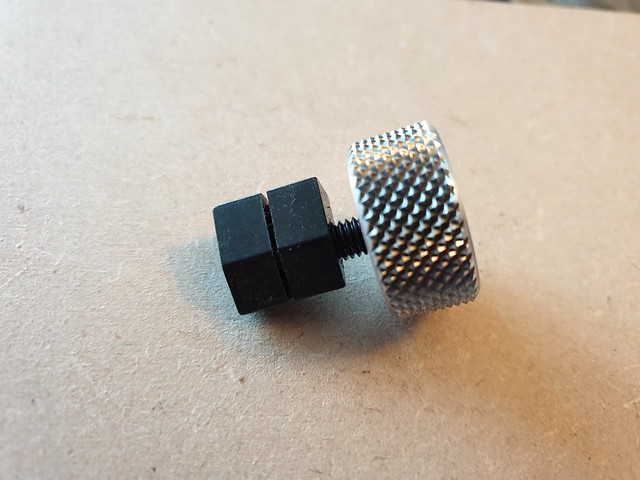
Finally, I suggest you ask Santa for one of these if you don't already have one. It saves so much time releasing the blade from the top clamp of a Hegner.
 
Gill":111zqwuv said:
Good advice from the contributors to this thread already.

Definitely yes.


Gill":111zqwuv said:
Finally, I suggest you ask Santa for one of these if you don't already have one. It saves so much time releasing the blade from the top clamp of a Hegner.

I looked at this some years ago when i needed other spares, but they did not ship to RSA and it became a logistics problem buying. Having a look now, the price is GBP20 (diff must be tax) and they do deliver to RSA.
Not sure what delivery cost would be.
 
Thanks Gill
I have learned lots already from others and I really appreciate all of the advice.
The saw does create some vibrations and as soon as I have built some benches I will consider bolting it to them.
I do have some thin ply and lots of MDF.
By the way I did mention the quick release thingy to Santa's representative and was reminded that they had already provided the saw :) (I ordered one anyway).
I think adding three pieces of card together and putting tape on the outer ones may help that way the middle one will be intact.
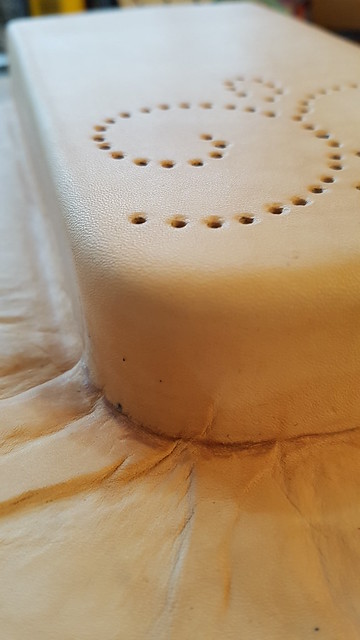
I don't have permission to share the inside of the current project but this is what I am doing, the gray board cut out is encased in the leather outer cover second picture.

IMG_0485_1 by my0771, on Flickr

IMG_0502_1 by my0771, on Flickr
 
That does look impressive. :)

A quick and dirty method of reducing saw vibration is to make sure the saw is firmly clamped to the surface it is operating upon, then add weights. As an example, you could clamp your saw to a workmate-type bench and suspend a bag of sand beneath it.
 
Thanks guys the notebook cover was part of a four part set I made for my sons teachers when he left high school.

IMG_0540_1 by my0771, on Flickr

I was wondering if the best way to use the scroll saw is sitting or standing.
 
MY63":1g83mj6f said:
I was wondering if the best way to use the scroll saw is sitting or standing.

There is no right way. What's important is that you are comfortable, are able to see the pattern line clearly, and don't apply pressure to the blade. Let the saw do the work.

I feel inspired to try some of those notebooks myself.
 
Thanks for your help Gill I am not an expert with notebook covers but have made a few if I can help just let me know.
 
How do you get the leather to form and stretch round the pattern, Michael ?
 
Hi Roger
Veg tanned leather is quite easy to work with especially if you soak it in cold water I usually wait until the bubbles stop coming out and it stops fizzing.
Once it is wet I use wooden moulds to shape and form the leather it is amazing the shapes that can be made I have seen masks made for theatrical productions.
It can also be carved.

20180413_183426 by my0771, on Flickr

DSC_1971[1] by my0771, on Flickr
 
How fascinating. Thank you for sharing, Michael. :text-bravo:
 
Michael, that looks very smart! :eusa-clap: :eusa-clap:

Do you glue the leather over the cut-out?
I have only seen this done once before with heavy duty tin foil glued over a pattern.
 
Phil":2m85tg09 said:
Michael, that looks very smart! :eusa-clap: :eusa-clap:

Do you glue the leather over the cut-out?
I have only seen this done once before with heavy duty tin foil glued over a pattern.

Thanks Phil
Yes the cut out is under there mounted on a piece of gray board I used contact cement on the board only then pressed the suede into it. PVA glue would soak into the suede.
 
One of those clamps will be enough. Of course, you could always ask Santa for another and then use it as an excuse to invest in an additional Hegner. Can't have too many Hegners...

Phil, $4.95 is remarkably good value! :o
 
Gill":if5gtrdf said:
One of those clamps will be enough. Of course, you could always ask Santa for another and then use it as an excuse to invest in an additional Hegner. Can't have too many Hegners...

Phil, $4.95 is remarkably good value! :o

Agree with you.

Even out of UK, excl. VAT the price is still expensive.
Hegner takes the Euro + 50% = GBP, then UK add another 50%.
I suppose with brexit the price will go up even more :cry:
 
Back
Top