

Reading the comments on coloured wires in Bob's excellent thread took me way, way back to the late 60's and early '70's to my days at the BBC.
The mainstay of our cameras was the EMI 2001 and the camera cable that connected it back to the camera control unit was called a G101 cable. Armoured, it had, as the name suggests, 101 cables in it. These ranged from some video cables to single core white cables that fortunately had small ident clips on them to let you know which was connected to which pin in the connector plug. It's the large cable at the bottom of this photo


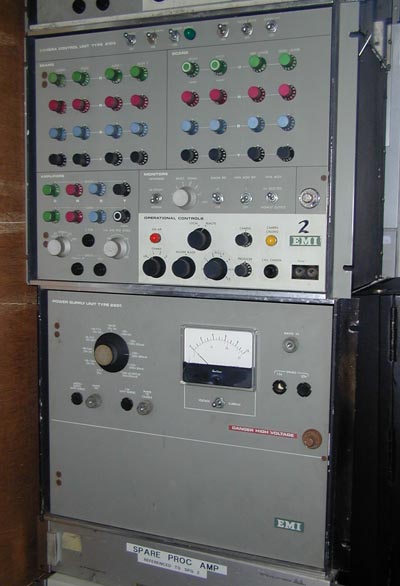
The CCU (camera control unit) and power supply. I spent a lot of time lining these up every day and also during the day/night.
Why was it important to know which white wire went to which pin? Well, some of those wires carried 600v dc down to feed the camera tubes and 600v dc doesn't really like damp or water. And on Outside Broadcasts, we used to get rather a lot of that. These camera cable runs had a maximum run of 2000 ft and although we'd wrap the joints in plastic to try and keep the water out, inevitably some might creep in and then the 600v dc would arc over. Eventually, even the socket on the actual camera might arc over and so need replacing.
So take closer look at that camera picture and imagine having to re-route, fix and solder 101 wires ......
Yours truly wrote the Acme Guide to replacing the socket and we reckoned to do one in a day, all being well.
The mainstay of our cameras was the EMI 2001 and the camera cable that connected it back to the camera control unit was called a G101 cable. Armoured, it had, as the name suggests, 101 cables in it. These ranged from some video cables to single core white cables that fortunately had small ident clips on them to let you know which was connected to which pin in the connector plug. It's the large cable at the bottom of this photo
The CCU (camera control unit) and power supply. I spent a lot of time lining these up every day and also during the day/night.
Why was it important to know which white wire went to which pin? Well, some of those wires carried 600v dc down to feed the camera tubes and 600v dc doesn't really like damp or water. And on Outside Broadcasts, we used to get rather a lot of that. These camera cable runs had a maximum run of 2000 ft and although we'd wrap the joints in plastic to try and keep the water out, inevitably some might creep in and then the 600v dc would arc over. Eventually, even the socket on the actual camera might arc over and so need replacing.
So take closer look at that camera picture and imagine having to re-route, fix and solder 101 wires ......
Yours truly wrote the Acme Guide to replacing the socket and we reckoned to do one in a day, all being well.
 bscene-drinkingcheers: