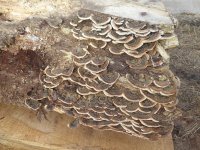
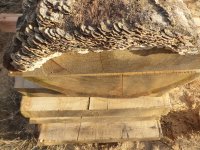
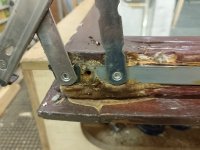
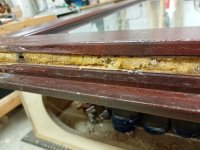
I can't tell you what the fungal species is but if, as you say, the sapwood and the heartwood are dry then the infestation is likely to be confined to the bark which must be wetter. You've got rid of the bark (and the sapwood) so the problem should be resolved, and stays that way as long as the material remains dry in storage, i.e., below about 25% MC.
25% MC isn't considered dry from the point of view of people using the wood for internal structures, e.g., dining tables, chairs, internal joinery products, etc, but it's a reasonable MC for many an artefact destined for external use, e.g., sculptures, gazebos, and the like, if a bit wetter than ideal for park benches, picnic tables, and so on.
Anyway, that all being what it is, from a timber technology angle and in the timber/lumber seasoning industry there's that magical phrase of drying wood below the 'dry rot safe' point of 20% MC. Dry rot is the only fungus that can get going and thrive in wood that's at that low an MC. Every other fungal species needs a higher water content in the wood to thrive. How wet the wood needs to be for each fungal species to live happily varies, but whatever it is it's generally significantly more than 20% MC.
I only include all the above blather because you said in your first post that there is a gap in your knowledge regarding fungi and wood, so thought I might be able to say something at least half useful, ha, ha. Slainte.