• Hi all and welcome to TheWoodHaven2 brought into the 21st Century, kicking and screaming! We all have Alasdair to thank for the vast bulk of the heavy lifting to get us here, no more so than me because he's taken away a huge burden of responsibility from my shoulders and brought us to this new shiny home, with all your previous content (hopefully) still intact! Please peruse and feed back. There is still plenty to do, like changing the colour scheme, adding the banner graphic, tweaking the odd setting here and there so I have added a new thread in the 'Technical Issues, Bugs and Feature Requests' forum for you to add any issues you find, any missing settings or just anything you'd like to see added/removed from the feature set that Xenforo offers. We will get to everything over the coming weeks so please be patient, but add anything at all to the thread I mention above and we promise to get to them over the next few days/weeks/months. In the meantime, please enjoy!

Wood fungi

Don McDermott

New Shoots
Joined
Nov 16, 2024
Messages
114
Reaction score
147
Name
Don McDermott
LOCATION
Bourne End
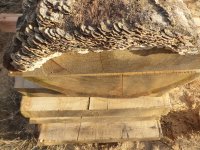
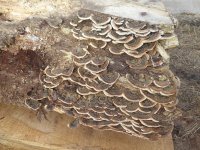
These mushroom sort of things were on some of the oak I bought for my trading wherry build, does anyone know what they are and if there is any cause for concern? I confess there is a gap in my timber knowledge concerning fungi. The sapwood below the bark was very dry and brittle, easy to break off, but the actual heartwood oak seemed okay. Thanks in advance.
 

Attachments

  • P1010082.JPG
    P1010082.JPG
    373.1 KB · Views: 19
  • P1010086.JPG
    P1010086.JPG
    357.2 KB · Views: 19
I agree with Andy, either Turkey Tail or false Turkey Tail. It is basically a white rot fungus that degrades lignin (a structural element) from deciduous wood. Get rid of the fungus pronto. If the wood itself appears sound then I would use it.
 
Thank you both. I have gotten rid of the fungus and most of the sapwood.
 
These mushroom sort of things were on some of the oak I bought for my trading wherry build, does anyone know what they are and if there is any cause for concern? I confess there is a gap in my timber knowledge concerning fungi. The sapwood below the bark was very dry and brittle, easy to break off, but the actual heartwood oak seemed okay. Thanks in advance.
I can't tell you what the fungal species is but if, as you say, the sapwood and the heartwood are dry then the infestation is likely to be confined to the bark which must be wetter. You've got rid of the bark (and the sapwood) so the problem should be resolved, and stays that way as long as the material remains dry in storage, i.e., below about 25% MC.

25% MC isn't considered dry from the point of view of people using the wood for internal structures, e.g., dining tables, chairs, internal joinery products, etc, but it's a reasonable MC for many an artefact destined for external use, e.g., sculptures, gazebos, and the like, if a bit wetter than ideal for park benches, picnic tables, and so on.

Anyway, that all being what it is, from a timber technology angle and in the timber/lumber seasoning industry there's that magical phrase of drying wood below the 'dry rot safe' point of 20% MC. Dry rot is the only fungus that can get going and thrive in wood that's at that low an MC. Every other fungal species needs a higher water content in the wood to thrive. How wet the wood needs to be for each fungal species to live happily varies, but whatever it is it's generally significantly more than 20% MC.

I only include all the above blather because you said in your first post that there is a gap in your knowledge regarding fungi and wood, so thought I might be able to say something at least half useful, ha, ha. Slainte.
 
I can't tell you what the fungal species is but if, as you say, the sapwood and the heartwood are dry then the infestation is likely to be confined to the bark which must be wetter. You've got rid of the bark (and the sapwood) so the problem should be resolved, and stays that way as long as the material remains dry in storage, i.e., below about 25% MC.

25% MC isn't considered dry from the point of view of people using the wood for internal structures, e.g., dining tables, chairs, internal joinery products, etc, but it's a reasonable MC for many an artefact destined for external use, e.g., sculptures, gazebos, and the like, if a bit wetter than ideal for park benches, picnic tables, and so on.

Anyway, that all being what it is, from a timber technology angle and in the timber/lumber seasoning industry there's that magical phrase of drying wood below the 'dry rot safe' point of 20% MC. Dry rot is the only fungus that can get going and thrive in wood that's at that low an MC. Every other fungal species needs a higher water content in the wood to thrive. How wet the wood needs to be for each fungal species to live happily varies, but whatever it is it's generally significantly more than 20% MC.

I only include all the above blather because you said in your first post that there is a gap in your knowledge regarding fungi and wood, so thought I might be able to say something at least half useful, ha, ha. Slainte.
Thank you! I don't have a moisture tester, but the oak has been stacked outside, under cover, all summer. Considering how dry it's been, I would imagine the moisture content has dropped considerably. I might need to improve the cover though, as some ends do get wet if it's rainy and windy.
 
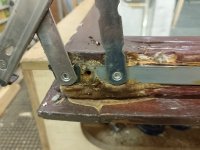
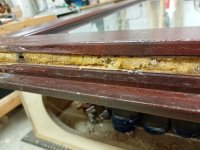
I came across what I presume is some kind of fungus a few days ago on a sash I was replacing for a customer. The sash was hardwood, I presume Sapele or Utile and only about 10 years old, there was no structure left in the timber at all.

fungus 1.jpg

What surprised me was how it had spread in the cavity between the friction hinge and sash......horrible stuff

fungus 2.jpg
 
Thank you! I don't have a moisture tester, but the oak has been stacked outside, under cover, all summer. Considering how dry it's been, I would imagine the moisture content has dropped considerably. I might need to improve the cover though, as some ends do get wet if it's rainy and windy.
Don, moisture meters are cheap, useful, and revealing. I suggest you invest. Also, you may not know that Richard is a leading expert on all aspects of wood, having written probably the defining book on such matters a few years ago. We're lucky to have his input here.
 
Don, moisture meters are cheap, useful, and revealing. I suggest you invest. Also, you may not know that Richard is a leading expert on all aspects of wood, having written probably the defining book on such matters a few years ago. We're lucky to have his input here.
Mike, you are quite right. I will first check whether we have one at the boatyard I'm based at, but if not, it would be useful to own one.

I did not know that about Richard - we are indeed fortunate! Might I inquire what the name of the book is, it sounds like something which if I haven't read, I probably should!
 
Don, moisture meters are cheap, useful, and revealing. I suggest you invest. Also, you may not know that Richard is a leading expert on all aspects of wood, having written probably the defining book on such matters a few years ago. We're lucky to have his input here.
Many thanks, Mike for the flattering commendation of me and by implication to my book Cut & Dried.

Thanks also toAJB T for providing the link to where the book can be bought.

I'm always pleased when someone other than me promotes my book because that's something I don't do myself because I won't shill my own work in forums. So thanks again to both of you, and I hope Don maybe gets something useful out of the book if he buys it. Slainte.
 
Looks like old sapwood decay rather than anything active. I’d cut back to clean, firm wood and bin the crumbly stuff. Once you’re into solid heartwood, you should be fine.
 
I had similar moisture issues at home, and getting a full inspection through rcrmold.com helped me figure out exactly where the leaks were hiding. They checked the bathrooms and kitchen with moisture tools and sent samples to a lab, which made it easier to plan next steps. The price was reasonable, too, so it didn’t feel like a huge gamble.
 
I had similar moisture issues at home, and getting a full inspection through rcrmold.com helped me figure out exactly where the leaks were hiding. They checked the bathrooms and kitchen with moisture tools and sent samples to a lab, which made it easier to plan next steps. The price was reasonable, too, so it didn’t feel like a huge gamble.
Think I’ve missed saying welcome, sorry. Would you mind putting your name and approximate location on your badge pls? We’ve got people from all corners of the globe, which is brill and it can be very useful sometimes.
Ian
 
Back
Top