• Hi all and welcome to TheWoodHaven2 brought into the 21st Century, kicking and screaming! We all have Alasdair to thank for the vast bulk of the heavy lifting to get us here, no more so than me because he's taken away a huge burden of responsibility from my shoulders and brought us to this new shiny home, with all your previous content (hopefully) still intact! Please peruse and feed back. There is still plenty to do, like changing the colour scheme, adding the banner graphic, tweaking the odd setting here and there so I have added a new thread in the 'Technical Issues, Bugs and Feature Requests' forum for you to add any issues you find, any missing settings or just anything you'd like to see added/removed from the feature set that Xenforo offers. We will get to everything over the coming weeks so please be patient, but add anything at all to the thread I mention above and we promise to get to them over the next few days/weeks/months. In the meantime, please enjoy!

Wood identification help needed – 1989 Japanese electric guitar body (Alder or Basswood)

Pabloguitarjazz

Seedling
Joined
May 20, 2026
Messages
4
Reaction score
1
Name
Paweł
LOCATION
Poland
Hello everyone,

I would like to kindly ask for help identifying the wood species used in my electric guitar body.

The guitar is a Japanese Fender Stratocaster ST62 made in 1989 at the Fujigen factory in Japan. Historically, these guitars were produced mainly using TWO TYPES of wood: ALDER and BASSWOOD. Unfortunately, because the guitar is nearly 40 years old and some electronic parts were replaced over the years, it is difficult to determine the exact original specification and therefore the exact body wood.

On guitar forums I received many contradictory opinions, so I decided to ask people who specialize in wood itself rather than guitars.

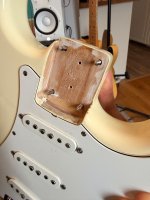
The attached photos show the “neck pocket,” which is one of the few places on this type of guitar where unfinished raw wood can be seen clearly. After comparing many examples online, I personally began to suspect that the body may be alder rather than basswood.

My reasoning is mainly based on:
- the darker salmon/pinkish coloration that developed with age,
- visible darker grain/fiber lines in some areas,
- and the overall structure of the wood.
- I also tried the fingernail hardness test using a lot of force directly on the raw wood, and it did not leave even the smallest mark or scratch at all — absolutely zero trace.

From what I have learned so far, older basswood often tends to remain much paler, cream/yellowish, softer-looking, and visually more uniform, while alder can develop warmer reddish or salmon tones over time. At the same time, I also understand that some examples of both woods can appear visually very similar, especially after decades of aging.

This is a wonderful old instrument and I am simply trying to learn as much truth about it as possible. I would be extremely grateful for any opinions from people experienced in wood identification, restoration, woodworking, or wood science.

thank you very much for your time 🙏

IMG_1219.JPG
IMG_1290.PNG
Thank you very much for your time and help. IMG_1296.PNG
 

Attachments

  • IMG_1220.JPG
    IMG_1220.JPG
    426.8 KB · Views: 3
  • IMG_1182.JPG
    IMG_1182.JPG
    307.7 KB · Views: 3
  • IMG_1218.JPG
    IMG_1218.JPG
    262.4 KB · Views: 3
  • IMG_1219.JPG
    IMG_1219.JPG
    383.9 KB · Views: 3
Hello and welcome, I came across my first bit of Basswood a couple of years ago over here in the us, so my experience is very limited but after what you said about its hardness and looking at the pics I wouldn’t say it was Basswood.
I have no doubt that someone with more knowledge will be along in the morning.
Ian
 
As I understand it, Basswood is the American name for Lime. I've got quite a few bits of Lime and have handled quite a few more as my father is into wood carving. As Ian has said, that looks nothing like it.

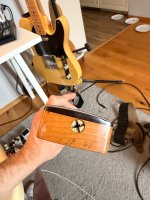
The only bit of alder I've ever used was for this box. That had a lot of spalting on it so is perhaps not an ideal candidate for comparison. However, if that wood is definitely either alder or lime/basswood then I would say alder is a much more likely contender.
 
This is always difficult. I used to collect (and play) guitars - but mainly US and Custom (Gibson, Fender, PRS and various hand made etc). I've traded a few earlyish Japanese made strats and teles, and done a re-fret on a couple. Basswood dings and marks very easily so as yours is resistant that pretty much rules it out. J guitars from the main copiers used basswood a lot for solid colour finishes, ash or swamp ash sometimes, and from what I remember alder for things like clearcoat and sunburst finishes. The neck pocket on yours is roughly finished which is odd and I am wondering if someone has roughly scraped the neck pocket at some time to re-set the neck. My guess is that the body is actually made of ash or what they called swamp ash sometimes, or "Sen" in Japan, which is ash.

Presumably the neck is maple?
 
This is always difficult. I used to collect (and play) guitars - but mainly US and Custom (Gibson, Fender, PRS and various hand made etc). I've traded a few earlyish Japanese made strats and teles, and done a re-fret on a couple. Basswood dings and marks very easily so as yours is resistant that pretty much rules it out. J guitars from the main copiers used basswood a lot for solid colour finishes, ash or swamp ash sometimes, and from what I remember alder for things like clearcoat and sunburst finishes. The neck pocket on yours is roughly finished which is odd and I am wondering if someone has roughly scraped the neck pocket at some time to re-set the neck. My guess is that the body is actually made of ash or what they called swamp ash sometimes, or "Sen" in Japan, which is ash.

Presumably the neck is maple?
Interestingly, according to the catalogs, the model that my guitar most closely resembles was apparently sometimes available with a Sen wood body as well. However, I have not come across a single example with a Sen wood body in any of the archived guitar listings I have found so far.

yes, neck is maple

By the way, when it comes to these Japanese catalogs, stamps, and markings from the late '80s and early '90s, it has been a real nightmare to research. There seems to be very little consistency, and it is extremely difficult to draw any firm conclusions from the stamps alone. Specifications, materials, markings, and hardware appear to be mixed in all sorts of ways. Every time I think I have found a solid clue, I come across photos of another original guitar that completely contradict the theory.

That is why I have decided to rely more on the opinions of people who have real experience with wood itself. For reference, the guitar weighs 3.64 kg, and the body is in astonishing condition for its age (PHOTOS⬇️). There is literally not a single dent anywhere on the body. It honestly looks as if it spent almost 40 years in its case. At the same time, I know it was played at least to some extent because it had a refret in the past.

So, based on what you see, would you say alder is more likely than basswood? And do you think there is any chance it could even be Sen wood?

Thank you very much for your time and for sharing your knowledge!

IMG_1417.JPG
IMG_1418.JPG
 
Welcome. I have a 1982 Japanese Squier Strat. The body neck pocket has the serial number of the instrument, so I am a little surprised that a serial number is not shown on yours.

I have only used English Alder on one instrument and I'll post that here, so we can all compare.


IMG_7038.JPGIMG_7039.JPG
 
I am a little surprised that a serial number is not shown on yours.
Thank you very much for your reply. Your alder appears lighter in the photo, although I suppose that may also be related to the age of the wood. The wood in my guitar is much darker, but it is also 37 years old. From the information I have found during my research, alder can develop a more pinkish or salmon-like color over time.

As for the serial number, I was also surprised that it is not on the neck plate. On my guitar, all the markings and stamps are on the neck heel, while there are no markings in the neck pocket itself. However, I have come across a few examples online of similar guitars that also had no markings in the neck pocket.

Thank you
 

Attachments

  • IMG_1210.jpeg
    IMG_1210.jpeg
    336.6 KB · Views: 1
  • IMG_1212.jpeg
    IMG_1212.jpeg
    342.6 KB · Views: 1
yes - the hardware etc was always very variable with Fender Japan instruments. They were of course very much made to a price to compete with the many Asian copies flooding the market at the time, so they used what they could get I guess. Not unusual to see pick up and machine head upgrades and a lot I've come across have been re-necked.

Do you think the body has been re-finished? To have had a re-fret requires significant wear and that usually shows on the body, especially with a gigged guitar where the backs are usually marked. I did wonder about that finish when I first saw the neck pocket. The neck looks quite dark for maple. Might just be the picture. I only really like the maple fingerboard strats, so all three of mine are that.
 
yes - the hardware etc was always very variable with Fender Japan instruments. They were of course very much made to a price to compete with the many Asian copies flooding the market at the time, so they used what they could get I guess. Not unusual to see pick up and machine head upgrades and a lot I've come across have been re-necked.

Do you think the body has been re-finished? To have had a re-fret requires significant wear and that usually shows on the body, especially with a gigged guitar where the backs are usually marked. I did wonder about that finish when I first saw the neck pocket. The neck looks quite dark for maple. Might just be the picture. I only really like the maple fingerboard strats, so all three of mine are that.
I don't think the body has been refinished, although unfortunately I can't be 100% certain about that. 😅

As for the dark color of the neck, I believe that is most likely due to the tinted finish. Fender Japan used a fairly dark amber tint on many of the '62 reissue necks to recreate the look of original 1960s instruments.
 
Back
Top