Hi all, I am in the process of moving up my skill levels onto making my own windows and doors, I have done similar with outbuildings and other small projects but now I want to move up into realms of better-quality finishes and woods. I do not have a large workshop so therefore thinking of a combi machine and looking on eBay I have come across a Record Maxi 26 but I cannot find any other information for this machine on the net other than discontinued so before I commit I am asking has anyone any experience of this machine? do you think it may be a little overkill for my needs and should I just get a decent table saw and routing table and improve my bandsaw.

-
Hi all and welcome to TheWoodHaven2 brought into the 21st Century, kicking and screaming! We all have Alasdair to thank for the vast bulk of the heavy lifting to get us here, no more so than me because he's taken away a huge burden of responsibility from my shoulders and brought us to this new shiny home, with all your previous content (hopefully) still intact! Please peruse and feed back. There is still plenty to do, like changing the colour scheme, adding the banner graphic, tweaking the odd setting here and there so I have added a new thread in the 'Technical Issues, Bugs and Feature Requests' forum for you to add any issues you find, any missing settings or just anything you'd like to see added/removed from the feature set that Xenforo offers. We will get to everything over the coming weeks so please be patient, but add anything at all to the thread I mention above and we promise to get to them over the next few days/weeks/months. In the meantime, please enjoy!
You are using an out of date browser. It may not display this or other websites correctly.
You should upgrade or use an alternative browser.
You should upgrade or use an alternative browser.
Combination machine a wise move?
- Thread starter tony.w
- Start date

Hi and welcome to the forum.
I have no experience of the Maxi 26 but a quick Google suggests it's a bit of a curate's egg. And spares are like rocking horse ****. I'd try and get a more modern machine like a Hammer C3-31.
You mention windows and doors and then a list of separate machines to a combi. The one machine you don't mention but really essential for windows and doors IMO is a spindle moulder. Be warned ...the moulder is only the start of your outlay as the tooling needed can soon add up. And if you do get a spindle moulder then please, please get some training!
Planning your workflow is also critical with a combi as swapping between functions can be tiresome when you realise you need to rip another piece of wood and the spindle moulder is all set up.
I have no experience of the Maxi 26 but a quick Google suggests it's a bit of a curate's egg. And spares are like rocking horse ****. I'd try and get a more modern machine like a Hammer C3-31.
You mention windows and doors and then a list of separate machines to a combi. The one machine you don't mention but really essential for windows and doors IMO is a spindle moulder. Be warned ...the moulder is only the start of your outlay as the tooling needed can soon add up. And if you do get a spindle moulder then please, please get some training!
Planning your workflow is also critical with a combi as swapping between functions can be tiresome when you realise you need to rip another piece of wood and the spindle moulder is all set up.

Pete Maddex
Old Oak
I have a Kity Bestcombi 2000 its o/k As Rodger says you need to plan out your actions but apart from that its fine
Pete
Pete
SamQ aka Ah! Q!
Old Oak
I had an ancient one. Saw, planer, RAS, morticer. Weighed a quarter ton. Irritating in that you had to dismantle settings for the saw to use the planer, then again to get the RAS...and access? You needed 8'-10' each end on the long axis. Unless you are setting up in a barn, forget combos.
What Rodger posted is spot on.
No experience with Record combos, But have used Felder which have great repeatability, but as with all combos they are pain to break down from one function to the next.
If at all possible go separates is my 2 cents worth
No experience with Record combos, But have used Felder which have great repeatability, but as with all combos they are pain to break down from one function to the next.
If at all possible go separates is my 2 cents worth

Mike
Sapling
Hi all, I am in the process of moving up my skill levels onto making my own windows and doors, I have done similar with outbuildings and other small projects but now I want to move up into realms of better-quality finishes and woods. I do not have a large workshop so therefore thinking of a combi machine and looking on eBay I have come across a Record Maxi 26 but I cannot find any other information for this machine on the net other than discontinued so before I commit I am asking has anyone any experience of this machine? do you think it may be a little overkill for my needs and should I just get a decent table saw and routing table and improve my bandsaw.
I likely have less recent woodworking experience than anyone on this forum, but I have learned painful lessons by buying poor quality equipment without doing much research. My previous experience was building houses during my teens. All of that is behind me now (I hope).
One important lesson I learned is don't buy anything if I can't find useful information about it on the Internet. Also never use "better quality" and "Record Power" in the same sentence unless the context is contradiction. I still have a Record Power bandsaw and I put more time and money into making it what I think it should be than if I bought nearly anything else. I am content with it now, but at the first stutter, I'll thrash it worse than Basil Fawlty's car and then buy a Laguna 14BX.
When I fitted out my shop, I initially thought I wanted a combination machine, such as the Hammer C3-31 or SCM CU 300c. Unfortunately, the size, location, and layout of my shop restricts the length of material I can feed through the machine in a fixed location. The other important factor was the smallest physical size that the machine could be dismantled in order to be safely moved down the basement stairs.
While the central fixed location of the sliding saw was fine, it would not work for the spindle moulder and P/T because I would be limited to about two meters of material through the machine. This rules out any attempt to make doors, skirting, or crown moulding. If my shop was four meters wider, the SCM combination machine might have been more attractive if it could be moved into my shop. I like the Hammer product line, but Felder/Hammer in Germany appear to make it as difficult as possible for hobbyists to buy their machines, while SCM is the opposite.
As a result, the only combination machine I have is the SCM FS30G P/T, and I am very happy with it. My mobile machines are the bandsaw, router table, and spindle moulder. I can reposition each to take advantage of the shop doorway, connect to the large dust/chip extraction, and allow me to feed three-meter long material past the blade or cutters.
The spindle moulder will never replace my router table, as each does a great job as long as you recognize the strengths and limitations of each. I've made dozens of raised panel kitchen cabinet doors and drawer faces with the router table, but would never consider using it for the components of a passageway door. Likewise, I would not bother setting up the spindle moulder for projects best suited for the smaller router bits. Cutter blocks and cutters for the spindle moulder can be eye-watering expensive, especially when I buy unique Whitehill products and pay the extra fees and duty. For everything else, I buy Guhdo products because they are available locally and are used in the professional shops.
With one exception, all of my power tools are new because I want the manufacturer's warranty. I bought a used Elektra Beckum TF904 spindle moulder from a shop about two hours north of me. The owner bought a former brewery and converted it to a manufacturing shop for the entire EB product line. He does a ground up rebuild of each machine and gives a two-year warranty on the machines. I had to wait nearly a year for my machine to be available because there were five customers in the queue ahead of me, but it was worth the wait. My TF904 was the largest 3-phase bi-directional tilt arbor machine I could find that would fit down the stairs, and it looks like it just left the factory. With the infeed and outfeed table extensions, sliding deck, and crosscut table, the total cost was about the same as a new single phase non-tilting arbor machine, with no accessories, made in China or Taiwan. He didn't have any power feeders available at the time, so I bought a Robland feeder from another vendor.
I'd confirm much of the above regarding layouts and inconvenience.
There's to my mind no reliable substitute for sitting down and laying out a large scale drawing (paper is in many respects better than CAD unless you are very used to it) of your workshop, dust system drops, power points, walkways, tracks along which to move a vacuum, heating etc. Then make paper cut outs to scale for your machines, yourself and everything that moves. Also work out the max length of board you think you will want to process (much less than 2.5m can be problematical) and make scale paper version of whatever you decide.
Then 'work' the machines, juggling it about until it the problems are solved - taking account of doors, windows etc and the lines along which you will want to feed material - they often don't need to be very wide unless you are handling sheets of plywood.
A track saw used outside on trestles and foam board can get around the problem of the space required for a saw big enough to break down sheet material.
Buy nothing until you know what you want/can fit.
I started with a Robland combo which was an OK machine. Its major layout problem was the fact that the tables used by the saw and planer outfeed were not in the same plane. (about 3mm off - possibly a manufacturing error)
I then went for separate Hammer machines - carefully fitted in using the above method. My space is workable but quite tight - lots of walking around stuff.
One option that seems to work well to save some space without going full combo is the (ideally sliding because a slider is very good for tenoning etc) table saw and spindle moulder combo.
+1 on the need to go for decent quality. The Hammer stuff is OK and after a lot of tuning and reworking to resolve faults (e.g. badly out of flat planer tables) is accurate - but I think given the choice again I'd go for better quality used stuff. I've got fabulous value from a 24in Agazzani bandsaw bought used for very little more than the cost of a just about useful new saw. No experience of it, but SCM looks promising...
There's to my mind no reliable substitute for sitting down and laying out a large scale drawing (paper is in many respects better than CAD unless you are very used to it) of your workshop, dust system drops, power points, walkways, tracks along which to move a vacuum, heating etc. Then make paper cut outs to scale for your machines, yourself and everything that moves. Also work out the max length of board you think you will want to process (much less than 2.5m can be problematical) and make scale paper version of whatever you decide.
Then 'work' the machines, juggling it about until it the problems are solved - taking account of doors, windows etc and the lines along which you will want to feed material - they often don't need to be very wide unless you are handling sheets of plywood.
A track saw used outside on trestles and foam board can get around the problem of the space required for a saw big enough to break down sheet material.
Buy nothing until you know what you want/can fit.
I started with a Robland combo which was an OK machine. Its major layout problem was the fact that the tables used by the saw and planer outfeed were not in the same plane. (about 3mm off - possibly a manufacturing error)
I then went for separate Hammer machines - carefully fitted in using the above method. My space is workable but quite tight - lots of walking around stuff.
One option that seems to work well to save some space without going full combo is the (ideally sliding because a slider is very good for tenoning etc) table saw and spindle moulder combo.
+1 on the need to go for decent quality. The Hammer stuff is OK and after a lot of tuning and reworking to resolve faults (e.g. badly out of flat planer tables) is accurate - but I think given the choice again I'd go for better quality used stuff. I've got fabulous value from a 24in Agazzani bandsaw bought used for very little more than the cost of a just about useful new saw. No experience of it, but SCM looks promising...
Last edited:

Trevanion
Old Oak
In my opinion, combination machines give you the worst of all worlds. They are generally very clunky to use, very inefficient, and can actually eat up more space than separate machines because they can't be laid out any other way than the way they are. I'm also not very fond of combined planer thicknesser machines as they are much more uncomfortable to operate compared to separate surface planer and thicknessing machines.
There are so many ways to skin a cat, and also produce joinery, that they couldn't all feasibly be listed.
The style of the windows and doors you want to produce will somewhat dictate the direction you need to take regarding equipment. If you want to make a plain square flush casement window with no mouldings or glazing bars you only need a small bench saw and a bit of ingenuity as you can quite easily produce tenons, run the rebates, cut grooves, and produce the head and cill extensions on one and be quite efficient at it. If you don't want to spend any more you can quite easily cut the mortices by hand with a chisel and mallet, though a morticer does make light work of it.
Of course, a more elaborate window such as a sliding boxed sash window with mouldings and glazing bars will require more equipment to be efficient.
There are so many ways to skin a cat, and also produce joinery, that they couldn't all feasibly be listed.
The style of the windows and doors you want to produce will somewhat dictate the direction you need to take regarding equipment. If you want to make a plain square flush casement window with no mouldings or glazing bars you only need a small bench saw and a bit of ingenuity as you can quite easily produce tenons, run the rebates, cut grooves, and produce the head and cill extensions on one and be quite efficient at it. If you don't want to spend any more you can quite easily cut the mortices by hand with a chisel and mallet, though a morticer does make light work of it.
Of course, a more elaborate window such as a sliding boxed sash window with mouldings and glazing bars will require more equipment to be efficient.
Cabinetman
Sequoia
- Joined
- Oct 11, 2020
- Messages
- 5,530
- Reaction score
- 1,231
- Location
- Lincolnshire Wolds + Massachusetts
- Name
- Ian
Well I’ve had good quality separates and now I’m retired I have an SCM Minimax 26g which as has been said does take up quite a lot of space with its arms, it doesn’t particularly bother me that I have to plan because of changing from one function to another, the main problem with this machine and most complain about is its fence, but I have made a new wooden one for the table saw which is way better!
As Ian said the slider for use with the spindle is brill for tenons, the planer thicknesser is good ( 10”) but not quite as good as my old 12” Minimax, it just hasn’t got the mass. Slight hobby feel to it.
Making doors and windows on a router table as opposed to a spindle is a no brainier I’m afraid, spindle every time. I’ve never missed not having a power feed btw.
Ian
As Ian said the slider for use with the spindle is brill for tenons, the planer thicknesser is good ( 10”) but not quite as good as my old 12” Minimax, it just hasn’t got the mass. Slight hobby feel to it.
Making doors and windows on a router table as opposed to a spindle is a no brainier I’m afraid, spindle every time. I’ve never missed not having a power feed btw.
Ian
'Efficient' is surely only more important to a full-time professional.?In my opinion, combination machines give you the worst of all worlds. They are generally very clunky to use, very inefficient, and can actually eat up more space than separate machines because they can't be laid out any other way than the way they are. I'm also not very fond of combined planer thicknesser machines as they are much more uncomfortable to operate compared to separate surface planer and thicknessing machines.
There are so many ways to skin a cat, and also produce joinery, that they couldn't all feasibly be listed.
The style of the windows and doors you want to produce will somewhat dictate the direction you need to take regarding equipment. If you want to make a plain square flush casement window with no mouldings or glazing bars you only need a small bench saw and a bit of ingenuity as you can quite easily produce tenons, run the rebates, cut grooves, and produce the head and cill extensions on one and be quite efficient at it. If you don't want to spend any more you can quite easily cut the mortices by hand with a chisel and mallet, though a morticer does make light work of it.
Of course, a more elaborate window such as a sliding boxed sash window with mouldings and glazing bars will require more equipment to be efficient.
Trevanion
Old Oak
'Efficient' is surely only more important to a full-time professional.?
Yes, but having efficiency also reduces overall frustration in a job as well which is of benefit to anyone. Efficiency isn't necessarily about being fast, it's just not having to deal with a load of unnecessary stuff that slows the job down. For example, having to constantly move bits about to use certain parts of the combination machine. You do some ripping on your combination machine and then you need to use the spindle moulder so you take the rip fence off and fit the spindle fence, raise up the spindle out of the table, set it up, move dust extraction pipes around and make the cut, then realise you need to rip more because you're short or a piece got mangled somehow, undo everything you just did and set up for ripping again, then re-set again for spindle moulding... you get the idea.
Combination Machines trade efficiency for versatility, you can get a lot done with one but you're going to have a harder time working than if you were using separate machines in a well-laid-out workshop.
Cabinetman
Sequoia
- Joined
- Oct 11, 2020
- Messages
- 5,530
- Reaction score
- 1,231
- Location
- Lincolnshire Wolds + Massachusetts
- Name
- Ian
Unfortunately you’re correct. But even though I’ve always agreed and said a machine that does more than thing doesn’t do either very well, I have bitten the bullet and bought one lol.Yes, but having efficiency also reduces overall frustration in a job as well which is of benefit to anyone. Efficiency isn't necessarily about being fast, it's just not having to deal with a load of unnecessary stuff that slows the job down. For example, having to constantly move bits about to use certain parts of the combination machine. You do some ripping on your combination machine and then you need to use the spindle moulder so you take the rip fence off and fit the spindle fence, raise up the spindle out of the table, set it up, move dust extraction pipes around and make the cut, then realise you need to rip more because you're short or a piece got mangled somehow, undo everything you just did and set up for ripping again, then re-set again for spindle moulding... you get the idea.
Combination Machines trade efficiency for versatility, you can get a lot done with one but you're going to have a harder time working than if you were using separate machines in a well-laid-out workshop.
Ian
Yup. And if you are space constrained then separates are going to be a challenge. Yes, you can put them on wheeled bases but then you're forever moving them in and out, trailing wires etc etc.Unfortunately you’re correct. But even though I’ve always agreed and said a machine that does more than thing doesn’t do either very well, I have bitten the bullet and bought one lol.
Ian
I did my apprenticeship in a shop where we had everything and the space to optimise them and could leave them set up until the job was complete. So it was with trepidation that I bought a (single) combination machine (Saw, Spindle, Planer Thicknesser). The lesson you learn quickly is to plan your workflow carefully and make a spare part for everything. Not all combination machines are created equally, some allow to be reset for another operation but still allows a fence to be placed back exactly where it was. Another consideration was I wanted a slider on the saw. Once you want a slider then a combination machine does not take up much more space whereas separates would and need to be out the way of the slider (a big area 5mx3m to the left of the saw blade). It came with the bonus of being a tenoner for the spindle.
I still think if you have the space then separates are perfect, but if like me you are short of space then a combination machine is a good option. It is better than separates on wheels in my view as you have to have somewhere to put the machines whilst not using them, whereas I use the space for material storage and workflow.
In a one man shop a slider is the equivalent of an extra pair of hands. I can breakdown a sheet of ply or large lumber on my own whereas before I had to go get Mrs PAC1 to assist. Now track saws are a thing, then the plywood issue could be dealt with but large lumber cannot.
I still think if you have the space then separates are perfect, but if like me you are short of space then a combination machine is a good option. It is better than separates on wheels in my view as you have to have somewhere to put the machines whilst not using them, whereas I use the space for material storage and workflow.
In a one man shop a slider is the equivalent of an extra pair of hands. I can breakdown a sheet of ply or large lumber on my own whereas before I had to go get Mrs PAC1 to assist. Now track saws are a thing, then the plywood issue could be dealt with but large lumber cannot.
Some observations about putting machines on wheels.
It's not unusual (especially on US forums where many work in garages) to see woodworkers routinely talk of putting their machines on wheel sets.
This probably is best avoided.
I did some measuring to find out what the possibilities were when fine tuning the set up of a Hammer A3 410 planer thicknesser - this after hand scraping accurately flat the tables which were way off with humps and hollows as delivered.
Planer thicknessers are probably worst case because the knives need to be set accurately at perhaps 0.05mm above the outfeed table across the width of the table, because the tables need to be accurately flat and in the same plane, and because the essentially H section chassis (sides and the floor linking them) has minimal twisting resistance.
Watching the dial gauge while raising and lowering one corner a little on an adjustable levelling foot saw this setting vary over multiples of the required knife height. This movement was taking the tables out of plane too.
Depending on the layout of the chassis a table saw or spindle moulder may not be quite so badly affected, but the reality is that even a carefully laid concrete floor is in these terms far from flat and machine chassis are essentially flexible. (cast iron planer tables are highly flexible too which means that the hinges and supports need careful setting up so that they don't twist when locked down, but that's another story)
This reality feeds back into the above matter of sorting out a working workshop layout which defines machine locations and sticking to it.
It might sound OTT, but it makes sense run a felt tip marker around each machine foot to mark the floor so that in the event of its having to be temporarily moved it can be put back exactly where it was without needing to set it up again...
It's not unusual (especially on US forums where many work in garages) to see woodworkers routinely talk of putting their machines on wheel sets.
This probably is best avoided.
I did some measuring to find out what the possibilities were when fine tuning the set up of a Hammer A3 410 planer thicknesser - this after hand scraping accurately flat the tables which were way off with humps and hollows as delivered.
Planer thicknessers are probably worst case because the knives need to be set accurately at perhaps 0.05mm above the outfeed table across the width of the table, because the tables need to be accurately flat and in the same plane, and because the essentially H section chassis (sides and the floor linking them) has minimal twisting resistance.
Watching the dial gauge while raising and lowering one corner a little on an adjustable levelling foot saw this setting vary over multiples of the required knife height. This movement was taking the tables out of plane too.
Depending on the layout of the chassis a table saw or spindle moulder may not be quite so badly affected, but the reality is that even a carefully laid concrete floor is in these terms far from flat and machine chassis are essentially flexible. (cast iron planer tables are highly flexible too which means that the hinges and supports need careful setting up so that they don't twist when locked down, but that's another story)
This reality feeds back into the above matter of sorting out a working workshop layout which defines machine locations and sticking to it.
It might sound OTT, but it makes sense run a felt tip marker around each machine foot to mark the floor so that in the event of its having to be temporarily moved it can be put back exactly where it was without needing to set it up again...
Yojevol
Seedling
Is this wood you're working with Vaj?Some observations about putting machines on wheels.
It's not unusual (especially on US forums where many work in garages) to see woodworkers routinely talk of putting their machines on wheel sets.
This probably is best avoided.
I did some measuring to find out what the possibilities were when fine tuning the set up of a Hammer A3 410 planer thicknesser - this after hand scraping accurately flat the tables which were way off with humps and hollows as delivered.
Planer thicknessers are probably worst case because the knives need to be set accurately at perhaps 0.05mm above the outfeed table across the width of the table, because the tables need to be accurately flat and in the same plane, and because the essentially H section chassis (sides and the floor linking them) has minimal twisting resistance.
Watching the dial gauge while raising and lowering one corner a little on an adjustable levelling foot saw this setting vary over multiples of the required knife height. This movement was taking the tables out of plane too.
Depending on the layout of the chassis a table saw or spindle moulder may not be quite so badly affected, but the reality is that even a carefully laid concrete floor is in these terms far from flat and machine chassis are essentially flexible. (cast iron planer tables are highly flexible too which means that the hinges and supports need careful setting up so that they don't twist when locked down, but that's another story)
This reality feeds back into the above matter of sorting out a working workshop layout which defines machine locations and sticking to it.
It might sound OTT, but it makes sense run a felt tip marker around each machine foot to mark the floor so that in the event of its having to be temporarily moved it can be put back exactly where it was without needing to set it up again...
Not to be rude Brian but that is the classic response of some when tolerances are mentioned in the context of woodworking or woodworking machinery.
This from hard earned personal experience is however the reality if you want a machine to perform accurately - or for that matter want your joints (whether hand or machine cut) to fit properly and keep everything in correct alignment.
The woodworking life becomes frustrating and complicated if stock is not milled or or by some other means consistently and accurately made square and parallel.
Table flatness for example on planers (jointers in US speak) is critical - a hump of only several thou in the wrong place can leave the thing incapable of jointing straight. It may not be far off at certain points on the table or for certain lengths of stock, but way off in other cases.
A low knife height will see the stock blocked or pushed up by the edge of the outfeed table. Too high and the stock is free to dip or even chatter.
The effects of simple table misalignments are pretty predictable.
The above is not necessarily the language and terminology that many woodworkers are used to but very high levels of precision have always been necessary in fine woodworking.
Those working to a high standard are getting there somehow - even if (as is the case for all of us no matter what vernacular we are used to) it's via a less explicitly stated mix of experience, method, judgement and (yes!) luck.
Crude work is another matter...
This from hard earned personal experience is however the reality if you want a machine to perform accurately - or for that matter want your joints (whether hand or machine cut) to fit properly and keep everything in correct alignment.
The woodworking life becomes frustrating and complicated if stock is not milled or or by some other means consistently and accurately made square and parallel.
Table flatness for example on planers (jointers in US speak) is critical - a hump of only several thou in the wrong place can leave the thing incapable of jointing straight. It may not be far off at certain points on the table or for certain lengths of stock, but way off in other cases.
A low knife height will see the stock blocked or pushed up by the edge of the outfeed table. Too high and the stock is free to dip or even chatter.
The effects of simple table misalignments are pretty predictable.
The above is not necessarily the language and terminology that many woodworkers are used to but very high levels of precision have always been necessary in fine woodworking.
Those working to a high standard are getting there somehow - even if (as is the case for all of us no matter what vernacular we are used to) it's via a less explicitly stated mix of experience, method, judgement and (yes!) luck.
Crude work is another matter...
Last edited:
Yojevol
Seedling
The point is that after you have finished machining, wood can move, expand, contract in all sorts of unpredictable ways. What's more, the act of machining can unlock inbuilt stresses which actually initiate movement.Not to be rude Brian but that is the classic response of some when tolerances are mentioned in the context of woodworking or woodworking machinery.
This is however from hard earned personal experience is the reality if you want a machine to perform accurately - or for that matter want your joints (whether hand or machine cut) to fit properly and keep everything in correct alignment.
The woodworking life becomes frustrating and complicated if stock is not milled accurately square and parallel.
Table flatness on planers (jointers in US speak) is critical - a hump of several thou in the wrong place can leave the thing incapable of jointing straight. It may not be far off at certain points on the table or for certain lengths of stock, but way off in other cases.
It's perhaps not the language and terminology that woodworkers are used to but very high levels of precision have always been necessary in fine woodworking. Crude work is another matter...
I understand that the satisfaction we get from working in wood varies from one person to the next. Personally I get satisfaction from producing the end product and if there are challenges on the way, so much the better. So far I have been satisfied with the precision of my machines 'as found' be they new or secondhand. I've done some tinkering and fettling but only to improve operation, eg, dust collection efficiency, or ergonomics, not the basics of machine capability.
Brian


TomTrees
Sapling
- Joined
- Aug 19, 2014
- Messages
- 380
- Reaction score
- 98
I can well imagine how much difference the floor makes, specifically for a PT, that is, a rather heavy machine compared...
as I've had to make changes to my tablesaw mobile base design, to accomodate captured feet.
I've had to have my saw in this exact position, (which took a lot of trial & error, I might add)
It's a big PITA for the time being,
as been working on making an overhead guard, but more so of late going to build a router table extension wing...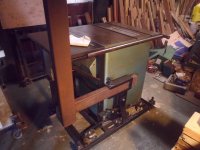
Being in a tight spot, I wish to utilize both tablesaw/bandsaw beds, (having either for outfeed)
and being not very tall, both machines preferably as low as possible.
Long story short, when I'm finished working on this machine, and it comes time to use it,
I'll likely be having to adjust the wing, aswell as the floor,
as the fence will not pass if it isn't flush, which it ain't now.
This doesn't just upset my wacky design of choosing to have a freestanding wing or crown guard,
but also changes the accuracy of the saw, as when the blade is tilted to 45 degrees, there is a noticeable
skewing of the blade when the saw is rocking from each corner compared.
I'll be documenting to see how much I can eliminate this fairly soon, as I've been avoiding it like the plague, lol.
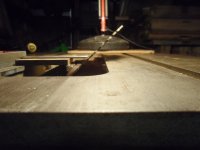
p.s. I must mention I've not detected this by eye (not laid down a straight edge or laser)
even when I suspected it wasn't great, nothing obvious to me anywhere on the floor where it will sit particularly badly,
where is most places I might add.
All the best
Tom
as I've had to make changes to my tablesaw mobile base design, to accomodate captured feet.
I've had to have my saw in this exact position, (which took a lot of trial & error, I might add)
It's a big PITA for the time being,
as been working on making an overhead guard, but more so of late going to build a router table extension wing...
Being in a tight spot, I wish to utilize both tablesaw/bandsaw beds, (having either for outfeed)
and being not very tall, both machines preferably as low as possible.
Long story short, when I'm finished working on this machine, and it comes time to use it,
I'll likely be having to adjust the wing, aswell as the floor,
as the fence will not pass if it isn't flush, which it ain't now.
This doesn't just upset my wacky design of choosing to have a freestanding wing or crown guard,
but also changes the accuracy of the saw, as when the blade is tilted to 45 degrees, there is a noticeable
skewing of the blade when the saw is rocking from each corner compared.
I'll be documenting to see how much I can eliminate this fairly soon, as I've been avoiding it like the plague, lol.
p.s. I must mention I've not detected this by eye (not laid down a straight edge or laser)
even when I suspected it wasn't great, nothing obvious to me anywhere on the floor where it will sit particularly badly,
where is most places I might add.
All the best
Tom
Hi Tom. I guess that for some a machine is something you use, for others dialling in and improving them is enjoyable too.
Some thoughts.
If for space reasons you have to have a wheeled base you could possibly having decided where the saw will live mark the locations on the floor that the wheels need to return to when its in use - having in that location levelled the saw on the base.
Fully threaded coach bolts with the rounded heads pointing down make cheap and very practical levelling feet. (and stops) Or a length of threaded rod with an acorn nut lock nutted at one end.
I for similar space reasons also went to a fair amount of trouble to set the tables of all of my machines at the same height. It also means I can use the same set of four modified Ikea solid wood kitchen trollies (also equipped with cheap pressed metal adjustable furniture levellers) combined as an assembly table, or separately as infeed and outfeed tables for any machine I like. The devil in the detail is that there's often some work in fine tuning the height of everything because they get moved around.
An overhead mounted guard I suspect is the plan for a saw - it's on my list too. Riving knife mounted guards are sometimes a PIA. e.g. they have to be removed for submerged cuts, and the guard sometimes fouls the work. It's not much fun working with the guard off and the dust being thrown in your face...
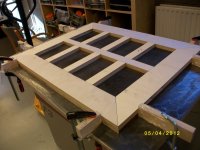
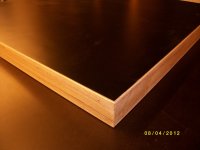
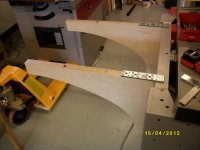
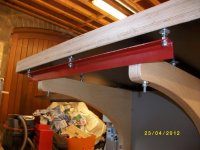
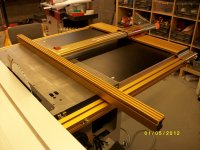
You may want to retain the ability to move your extension wing for the saw about, but it's possible to build a cantilevered one too in ply - see pics. Lift on lift off or hinge down versions might(?) be alternative options. It was quite a few years ago, but I didn't like the Hammer sheet metal item. It's a good idea to mount this sort of stuff on jacking screws as at one end in the fourth pic (the red angle iron is just for stiffening, some of the jacking screws are visible behind it) - to permit fine levelling.
Flexing of the chassis/cabinet apart if the saw blade toe out is correct in the vertical but is moving out of alignment as it tilts this can also be caused by the tilt axis (the axis about which the tilting mechanism rotates) being high or low at the infeed or outfeed end. The fix depends on the design, but basically entails shimming under the appropriate end. It's a bit of a head wrecker to figure out how it works. and where to put the shim(s)...
Some thoughts.
If for space reasons you have to have a wheeled base you could possibly having decided where the saw will live mark the locations on the floor that the wheels need to return to when its in use - having in that location levelled the saw on the base.
Fully threaded coach bolts with the rounded heads pointing down make cheap and very practical levelling feet. (and stops) Or a length of threaded rod with an acorn nut lock nutted at one end.
I for similar space reasons also went to a fair amount of trouble to set the tables of all of my machines at the same height. It also means I can use the same set of four modified Ikea solid wood kitchen trollies (also equipped with cheap pressed metal adjustable furniture levellers) combined as an assembly table, or separately as infeed and outfeed tables for any machine I like. The devil in the detail is that there's often some work in fine tuning the height of everything because they get moved around.
An overhead mounted guard I suspect is the plan for a saw - it's on my list too. Riving knife mounted guards are sometimes a PIA. e.g. they have to be removed for submerged cuts, and the guard sometimes fouls the work. It's not much fun working with the guard off and the dust being thrown in your face...
You may want to retain the ability to move your extension wing for the saw about, but it's possible to build a cantilevered one too in ply - see pics. Lift on lift off or hinge down versions might(?) be alternative options. It was quite a few years ago, but I didn't like the Hammer sheet metal item. It's a good idea to mount this sort of stuff on jacking screws as at one end in the fourth pic (the red angle iron is just for stiffening, some of the jacking screws are visible behind it) - to permit fine levelling.
Flexing of the chassis/cabinet apart if the saw blade toe out is correct in the vertical but is moving out of alignment as it tilts this can also be caused by the tilt axis (the axis about which the tilting mechanism rotates) being high or low at the infeed or outfeed end. The fix depends on the design, but basically entails shimming under the appropriate end. It's a bit of a head wrecker to figure out how it works. and where to put the shim(s)...
Attachments
Last edited:
TomTrees
Sapling
- Joined
- Aug 19, 2014
- Messages
- 380
- Reaction score
- 98
My own personal take on the matter, is that I'm not really in a position to do things any differently..
i.e the goal of having a no overheads workshop, (without real heavy duty stuff like a PT or whatever)
and one which could be moved and made functional somewhere else without too much bother, with no guarantee of space, needs be made compact, and also somewhat adaptable to whatever floor it may be on, what's turned out to be of importance,
as the floor is soft and crumbling in spots, which is on the list of workshop things.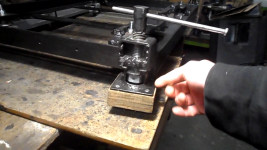
I've done much the same thing as yourself with the angle iron, and threaded some studs into the top.
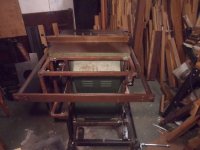
Didn't plan on getting a 24" bandsaw, it was just the cheapest route for a capable machine,
would've ended up with a tablesaw anyway, so hey ho.
All my stuff being aimed for some kinda productivity, (bar the second TS, which was kinda, only worth the hundred quid)
though I can certainly see why many might get the impression of anything otherwise.
The belt sander is needing a "makeover", so perhaps it might be a case of 6 of one...
Pretty much all I've been doing is working on saving space in some form or another,
and being in a damp moldy workshop, sheet goods not an option.
Plenty of metalworking to do in order to make things functional, but thankfully getting a bit closer
and not planning on getting another machine, well apart from a dust extraction system,
(which motor I was wishing to pilfer from said tablesaw)
Pretty much everything I'll be doing for the next while will involve wheels.
Sorry for possibly derailing the thread, as I guess someone considering a combo vs separate machine outlay,
likely doesn't have quite the same criteria as what I see fit as a necessity.
All the best
Tom
i.e the goal of having a no overheads workshop, (without real heavy duty stuff like a PT or whatever)
and one which could be moved and made functional somewhere else without too much bother, with no guarantee of space, needs be made compact, and also somewhat adaptable to whatever floor it may be on, what's turned out to be of importance,
as the floor is soft and crumbling in spots, which is on the list of workshop things.
I've done much the same thing as yourself with the angle iron, and threaded some studs into the top.
Didn't plan on getting a 24" bandsaw, it was just the cheapest route for a capable machine,
would've ended up with a tablesaw anyway, so hey ho.
All my stuff being aimed for some kinda productivity, (bar the second TS, which was kinda, only worth the hundred quid)
though I can certainly see why many might get the impression of anything otherwise.
The belt sander is needing a "makeover", so perhaps it might be a case of 6 of one...
Pretty much all I've been doing is working on saving space in some form or another,
and being in a damp moldy workshop, sheet goods not an option.
Plenty of metalworking to do in order to make things functional, but thankfully getting a bit closer
and not planning on getting another machine, well apart from a dust extraction system,
(which motor I was wishing to pilfer from said tablesaw)
Pretty much everything I'll be doing for the next while will involve wheels.
Sorry for possibly derailing the thread, as I guess someone considering a combo vs separate machine outlay,
likely doesn't have quite the same criteria as what I see fit as a necessity.
All the best
Tom
meccarroll
Nordic Pine
- Joined
- May 12, 2016
- Messages
- 815
- Reaction score
- 180
Moving up your skill level in woodworking is not going to depend upon buying new machinery. I think what you are saying is you feel ready to take on a woodwork project that is more challenging and are contenplating what machinery may be useful to that project?Hi all, I am in the process of moving up my skill levels onto making my own windows and doors, I have done similar with outbuildings and other small projects but now I want to move up into realms of better-quality finishes and woods. I do not have a large workshop so therefore thinking of a combi machine and looking on eBay I have come across a Record Maxi 26 but I cannot find any other information for this machine on the net other than discontinued so before I commit I am asking has anyone any experience of this machine? do you think it may be a little overkill for my needs and should I just get a decent table saw and routing table and improve my bandsaw.
Trevanion hit the nail on the head when he said you can make windows and doors using very basic machinery such as a table saw. I worked at a Hall many years ago and we used a combined saw/overhand planer/slot morticer to make windows and doors. The saw was used for rebates and grooves and even splays we then used a hand plane to clean up. We also cut the tenons with the table saw as it had an attachment which fixed to the fence for cutting the tenons. The slot morticer did all of the mortices. Simple but easy to make windows and doors on.
MikeG does a lot of very skilled woodwork using only hand tools most of the time.
Some people make doors etc using a Domino for mortice and tenons.
Some people make up windows and doors out of square section wood then put the moulds on using a routercutter with a bearing guide.
The way to decide to make the windows and doors will dictate what equipment you will find useful because you can actually do everthing using hand tools if you have the time and want to.
Mark
I have some of the best machines built, its taken 10 years to get my holy grail setup. Most pro joiners would be envious. And I am an extremely mediocre hobbyist. If I'd spent that time honing my woodworking skills I'd be half decent by now. Luckily the machines are half the fun for me.

Dr.Al
Old Oak
That's the beauty of a hobby: it doesn't matter how you spend your time or what others think you've achieved as long as you enjoy it.I have some of the best machines built, its taken 10 years to get my holy grail setup. Most pro joiners would be envious. And I am an extremely mediocre hobbyist. If I'd spent that time honing my woodworking skills I'd be half decent by now. Luckily the machines are half the fun for me.
It becomes a very different ball game if you are doing it commercially and have to make a profit.
It's a great pleasure to find one self in a position to simply go where the heart leads.
One of the positives of retirement perhaps...
It's a great pleasure to find one self in a position to simply go where the heart leads.
One of the positives of retirement perhaps...
Trevanion
Old Oak
Yup. And if you are space constrained then separates are going to be a challenge.
Not necessarily, I'd much rather have separates because you can lay them out effectively depending on the space rather than having a big lump sat in the middle of it. The only space-saving you really gain with a combination machine is usually that the spindle moulder is a part of the saw table.
In my home workshop, I have about 20sq/m of usable space which is essentially a square, in that I have a Multico 12" surface planer, Multico 12" thicknesser, 12" Scheppach bench saw, Sedgwick spindle moulder, Sedgwick Morticer, 10" Metabo mitre saw, 12" Scheppach bandsaw, lathe and a bench. It is a bit cramped by most standards, but I can produce most stuff in there without much issue because of the way I have laid out the machines so that nothing really fouls the other.
Be interesting to see your plan layout, Dan.Not necessarily, I'd much rather have separates because you can lay them out effectively depending on the space rather than having a big lump sat in the middle of it. The only space-saving you really gain with a combination machine is usually that the spindle moulder is a part of the saw table.
In my home workshop, I have about 20sq/m of usable space which is essentially a square, in that I have a Multico 12" surface planer, Multico 12" thicknesser, 12" Scheppach bench saw, Sedgwick spindle moulder, Sedgwick Morticer, 10" Metabo mitre saw, 12" Scheppach bandsaw, lathe and a bench. It is a bit cramped by most standards, but I can produce most stuff in there without much issue because of the way I have laid out the machines so that nothing really fouls the other.
meccarroll
Nordic Pine
- Joined
- May 12, 2016
- Messages
- 815
- Reaction score
- 180
Dan is this where you work or just your home workshop?Not necessarily, I'd much rather have separates because you can lay them out effectively depending on the space rather than having a big lump sat in the middle of it. The only space-saving you really gain with a combination machine is usually that the spindle moulder is a part of the saw table.
In my home workshop, I have about 20sq/m of usable space which is essentially a square, in that I have a Multico 12" surface planer, Multico 12" thicknesser, 12" Scheppach bench saw, Sedgwick spindle moulder, Sedgwick Morticer, 10" Metabo mitre saw, 12" Scheppach bandsaw, lathe and a bench. It is a bit cramped by most standards, but I can produce most stuff in there without much issue because of the way I have laid out the machines so that nothing really fouls the other.
I like you am cramped but still prefer seperate machines which I have on wheels. I do have an SCM S3 panel saw but don't need to use it with the drop on sliding carriage most of the time so I hang it on the wall and use it as a bench saw most of the time (saves space).
I also have a CNC which can dimension sheet material on and is excellent at producing clean edges on MFC (685x1430mm working area).
My planer thicknesser is a combination but like you I think seperates would be better.
Trevanion
Old Oak
Dan is this where you work or just your home workshop?
Just the home workshop, work is about 600sq/m so a fair bit more space to work in though even that can feel cramped at times if you’ve got a couple of staircases on the go and a bunch of windows and doors.
meccarroll
Nordic Pine
- Joined
- May 12, 2016
- Messages
- 815
- Reaction score
- 180
Now that is a nice big workshop but depends how many joiners work in it and the workflow I guess.Just the home workshop, work is about 600sq/m so a fair bit more space to work in though even that can feel cramped at times if you’ve got a couple of staircases on the go and a bunch of windows and doors.
Dan, I'm confused because in an earlier post you said this "....In my home workshop, I have about 20sq/m of usable space which is essentially a square, in that I have a Multico 12" surface planer, Multico 12" thicknesser,"
Trevanion
Old Oak
Dan, I'm confused because in an earlier post you said this "....In my home workshop, I have about 20sq/m of usable space which is essentially a square, in that I have a Multico 12" surface planer, Multico 12" thicknesser,"
Yes, my home workshop is around 20sq/m, where I work day-to-day is around 600sq/m.
Gotcha. Still very keen to see your layout as I suspect I will be facing similar constraints soon.Yes, my home workshop is around 20sq/m, where I work day-to-day is around 600sq/m.
meccarroll
Nordic Pine
- Joined
- May 12, 2016
- Messages
- 815
- Reaction score
- 180
Check this out if you want a Combination Machine £1,500 (FACEBOOK MARKET PLACE)
https://www.facebook.com/marketplac...wse_serp:d08c6971-0815-487e-afc6-d3ad97ef0a08
https://www.facebook.com/marketplac...wse_serp:d08c6971-0815-487e-afc6-d3ad97ef0a08

Phil
Old Oak
I fully support mobile machines where there is a space problem.
When we downsized I made wheely bases for table saw, TP, lathe and the scroll saws.
Router table, bench and RAS will not be moved around especially the RAS.
When we downsized I made wheely bases for table saw, TP, lathe and the scroll saws.
Router table, bench and RAS will not be moved around especially the RAS.