• Hi all and welcome to TheWoodHaven2 brought into the 21st Century, kicking and screaming! We all have Alasdair to thank for the vast bulk of the heavy lifting to get us here, no more so than me because he's taken away a huge burden of responsibility from my shoulders and brought us to this new shiny home, with all your previous content (hopefully) still intact! Please peruse and feed back. There is still plenty to do, like changing the colour scheme, adding the banner graphic, tweaking the odd setting here and there so I have added a new thread in the 'Technical Issues, Bugs and Feature Requests' forum for you to add any issues you find, any missing settings or just anything you'd like to see added/removed from the feature set that Xenforo offers. We will get to everything over the coming weeks so please be patient, but add anything at all to the thread I mention above and we promise to get to them over the next few days/weeks/months. In the meantime, please enjoy!

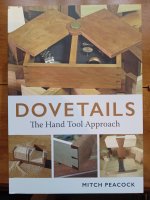
Book Review - Dovetails, the Hand Tool Approach by Mitch Peacock

AndyT

Old Oak
Joined
Nov 23, 2020
Messages
3,876
Reaction score
1,798
Location
Bristol
Name
Andy
I just want to spread the word about a new book that I had for Christmas.
IMG_20241229_123121.jpg

Many of you will already know about Mitch Peacock. He's written widely for woodworking magazines and has a really useful YouTube channel or two. (Start at https://www.youtube.com/@mitchwoodwork/featured or else jump to his long list of 70 joint cutting demonstrations at https://www.youtube.com/playlist?list=PL86lqISCtD7pLsvYJnhJenQlttsoAIZIk .)

And now he's published a book on Dovetails, and it's the most thorough and useful treatment I have ever seen.

I've taken a few snaps to give you a flavour.

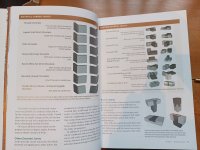
It's illustrated throughout, with hundreds of CAD drawings, as seen on this intro page:
IMG_20241229_123210.jpg

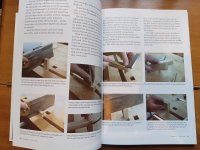
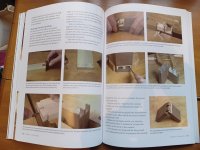
For every joint there are also step by step photos showing all the details you could need:
IMG_20241229_123314.jpg

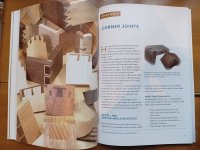
He covers all the basics, of course, but this introductory page shows some of the range of decorative options that are included:
IMG_20241229_123341.jpg

I'd seen photos before of "double dovetails" where each joint is lined with timber of a contrasting colour, but Mitch shows how to make them with simple tools, not an expensive special jig:
IMG_20241229_123441.jpg

There is a very thorough section on double bevel dovetails which describes three different methods to work out the angles, and includes the variants where the sides and ends slope differently.

As anyone who's watched Mitch's videos will expect, the text is all good clear content, with no waffle.
It's 160 pages, softcover but stitched in sections, not just glued, so should survive workshop use.

And it's less than you'd pay for a coffee and a snack on the motorway - only £14.99!

It's published by Crowood Press and is easily available from your preferred bookshop. More details here:


(And yes, I know it says it's £16.99 on that page, but my copy is clearly printed as £14.99 on the back. Either way, it's worth much more than that. )
 
Having experimented a few times recently with compound angle dovetails (I'll probably write-up my efforts on here in due course), I can say with some confidence that there's definitely more to it than "just get on and cut the dovetails" :)
 
I can do dovetails, but wouldn't even remotely dare to say I am proficient. This might be an interesting read for me. Thanks for the review!
 
Mike, I'm wondering what your version would be...

Chapter 1 - Just get on and cut the dovetails.​
Chapter 2 - That's it! Start something else!​
:)

I've spent the afternoon cutting dovetails in 6mm Far Eastern ply, and shuttering ply. It's like working with Hob Nobs........but yeah, you just mark it, cut it, chisel it, glue it, hammer it, move on.......
 
Dovetails. For show and mainly relegated to a bygone era. Dominos replaced everything. What will be next?

I would read the book with pleasure but not spend hard earned on it.
 
Dovetails. For show and mainly relegated to a bygone era. Dominos replaced everything. What will be next?

I would read the book with pleasure but not spend hard earned on it.
I think you don't need to look far beyond this forum to see that although dominos are undoubtedly used by some, dovetails remain really popular. :)

For some, it's probably because they don't want to spend hundreds of pounds on a one-trick machine. For others, it's because they enjoy learning and using the skills required.

You see a bygone era. I see an alternative approach that still works like it always did!
 
I like Mitch Peacock - his YT and magazine articles are always good imho. Thanks for the recommendation Andy.

I doubt that dominos are a nail in the coffin of dovetails. Both have their place but there will always be a premium (in price and appeal) of a handcut dovetail.
 
Dovetails. For show and mainly relegated to a bygone era. Dominos replaced everything. What will be next?

I would read the book with pleasure but not spend hard earned on it.
I think you're well off piste here Adrian. Dovetails primarily resist pull in one direction (something I delighted showing to kids in the workshop when big muscly yoofs couldn't pull one apart) whereas a Domino doesn't resist mechanical force as it's only the glue holding it in place. Hence the reason that dovetails should always be used when making a drawer and similar constructions where the joint has to resist a mechanical pulling force - Rob
 
Indeed and I agree with you Rob for a traditional hardwood drawer with thin sides, and I would do it like that with hardwood and fine work. I should have made that clearer, but I had in mind the shed load of very large kitchen drawers I made in 2022 out of 15mm ply. The front and back of each box was inside the sides, and ample room for several doms on each corner. Very strong, quick & accurate. I find cutting dovetails into ply always creates chips, so I don't do it.
 
I think you're well off piste here Adrian. Dovetails primarily resist pull in one direction (something I delighted showing to kids in the workshop when big muscly yoofs couldn't pull one apart) whereas a Domino doesn't resist mechanical force as it's only the glue holding it in place. Hence the reason that dovetails should always be used when making a drawer and similar constructions where the joint has to resist a mechanical pulling force - Rob

I am not a classically trained woodworker and have not spent decades building furniture using hand-cut dovetails. However, I have built lots of cabinets and drawers out of hardwood, plywood, and MDF. I use the Festool Domino floating tenons in nearly every project, when appropriate, and always ensure the tenons are in shear mode for drawer projects.

I am not opposed to hand-cut dovetails, and enjoy using them for small projects. For large projects, such as a kitchen refit in white oak, I will use the Leigh dovetail jig.
 
I own the DF 500 and think it is a great machine. I sure do use it a lot. However, I like the idea of being able to do things the traditional way whenever the need or desire pops up. I am not a pro, so for me woodworking is just as much about having fun and developing skills as it is about making stuff. A good book might help me with that. Or it might just be fun to read.
 
Horses for courses chaps, horses for courses...

I'm very much dominos for 'functional' and workshop stuff, but I do like trying the hand cut dovetail for showier stuff.

The book looks excellent though Andy, I might add to my collection of books that I never get chance to practice from... ;)

Roll on retirement...
 
Yes, I agree. I was a bit snarky without intending to be. Apologies. I've got quite a lot of woodworking books that I bought with enthusiasm but never use. Joyce is the exception and a couple of oak framing books.

Having time in retirement is an illusion or fantasy. I'm not retired, but getting there, and I am now doing restaurant cooking and giving more piano lessons than I ever intended in my fictional free time.....
 
A friend who's a few years ahead of me gave me some wise advice about retirement. When you're working, he said, if you can't fit in all the things you want to do, you can take some time off to catch up.

But after retirement, there's no source of catch-up time. If you can't fit it all in, you have to start leaving things unstarted.
 
Hmmm. I have a sneaking suspicion that retirement often kills people. I've had a few partners, then quite a bit older than me) from my former professional life who retired at 55 (as was normal in the practice). Some had made provision for a second career, or sailing, and a bunch of NEDS and some whose entire life had revolved around the firm, just got bored on the golf course and died young. I think some of us need to work.
 
I 'went' early, for reasons some on here are aware of. The first four years were turbulent; "firefighting" as the modern idiom has it. The last three have been dogged by ill health. Carpe diem, Folks!
 
I retired early from the MoD in 2011 and quite honestly, retirement is the best job I've ever had and I've been working constantly since 1967. The caveat is that whatever you do, it has to be done seriously and for me that's travel, workshop and the garden - Rob
 
Back
Top