• Hi all and welcome to TheWoodHaven2 brought into the 21st Century, kicking and screaming! We all have Alasdair to thank for the vast bulk of the heavy lifting to get us here, no more so than me because he's taken away a huge burden of responsibility from my shoulders and brought us to this new shiny home, with all your previous content (hopefully) still intact! Please peruse and feed back. There is still plenty to do, like changing the colour scheme, adding the banner graphic, tweaking the odd setting here and there so I have added a new thread in the 'Technical Issues, Bugs and Feature Requests' forum for you to add any issues you find, any missing settings or just anything you'd like to see added/removed from the feature set that Xenforo offers. We will get to everything over the coming weeks so please be patient, but add anything at all to the thread I mention above and we promise to get to them over the next few days/weeks/months. In the meantime, please enjoy!

Simple bar stool design

Guineafowl21

Nordic Pine
Joined
Dec 15, 2020
Messages
549
Reaction score
157
Location
Nairn
A mate of mine, who drives a harvester, is going to give me some timber in log form (and has already given me a HUGE amount of beef). In exchange, he wants me to make him two bar stools from Larch, which will also be provided in log form.

Now, a bar stool needs the legs to be angled outwards in at least one plane, for stability. 5 degrees, ie 2.5 degrees per side? He hasn’t given any dimensions yet, so assume around 750mm tall.

Rather than wedged and angled tenons into the seat, how about adapting this design, which I know how to make:
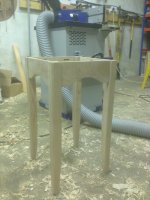
IMG_0008.jpeg

Just with an angle in one plane, and some extra stretchers lower down. Top fixed on with buttons.

Angled tenons no problem on the RAS, just with a 2.5 degree wedge against the fence. I was hoping to get away with straight mortices to receive them. Rather than arched aprons, how about a simple cock bead at the bottom?

Any thoughts? This project will obviously have to wait until the Larch has been planked and seasoned.
 
Last edited:
I think that would look good.

I think received wisdom is that it's better to angle the mortise rather than the tenon to avoid grain run out in the tenon (which would weaken it), but I think angled tenons are usually a fair bit easier to make (with hand tools at least) and will be strong enough if they're big enough and the angle isn't too severe.

You could add corner braces under the seat to make it stronger.

Cock bead would look good, but I think I prefer the curved aprons as they make it look a bit more delicate/elegant. Cock bead on a curved apron would be the best of both worlds😀.
 
I think that would look good.

I think received wisdom is that it's better to angle the mortise rather than the tenon to avoid grain run out in the tenon (which would weaken it), but I think angled tenons are usually a fair bit easier to make (with hand tools at least) and will be strong enough if they're big enough and the angle isn't too severe.

You could add corner braces under the seat to make it stronger.

Cock bead would look good, but I think I prefer the curved aprons as they make it look a bit more delicate/elegant. Cock bead on a curved apron would be the best of both worlds😀.
Thanks for the suggestions. I should point out that I’m a soul-less wood machinist!

Mortices on the Multico K.

Spindle moulder: T&G for the seat; for the aprons, cock bead cutters or template and follower bearing for arches. Possibly pre-cut on the bandsaw. Seat roundover. Slots in aprons to receive buttons. Oh, and rebate cutter for making the buttons…

Obviously RAS for the various angled cuts needed.

I might be tempted into picking up a hand chisel for fettling the angled tenons into the straight mortices. Might. ;)

Cock bead on a curved apron - it would add a touch of class. I’d need a home-made hand cutter a la Paul Sellers, but with a convex surface.
 
Last edited:
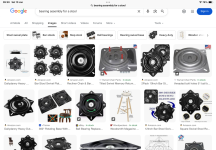
My SIL had a nice wooden rotating cake stand, for decorating, that had a warped top. I was able to tap the top free and run it through the drum sander (another machine of course). It was based around a bearing arrangement much like that^^^
 
How successful was it with icing (water) and cleaning?
My DIL wants me to make one. Her current one is plastic.
Fine. It’s made of spalted beech, with a turned pedestal atop which sits the bearing. The rotating top has a circular recess to accept the top part of the bearing, so everything overhangs, meaning any spills just drip down the top and hit the worksurface. I don’t think it had a drip groove underneath, but it would be a good idea and easy enough while turning the circular recess.

Seems to be a water-based varnish finish, at least, that’s what I gave it after drumsanding it, and it blended in well.
 
Last edited:
Thanks for the suggestions. I should point out that I’m a soul-less wood machinist!

Mortices on the Multico K.

Spindle moulder: T&G for the seat; for the aprons, cock bead cutters or template and follower bearing for arches. Possibly pre-cut on the bandsaw. Seat roundover. Slots in aprons to receive buttons. Oh, and rebate cutter for making the buttons…

Obviously RAS for the various angled cuts needed.

I might be tempted into picking up a hand chisel for fettling the angled tenons into the straight mortices. Might. ;)

Cock bead on a curved apron - it would add a touch of class. I’d need a home-made hand cutter a la Paul Sellers, but with a convex surface.
Nothing wrong with machines. Would angles mortises be easy enough on a mortising machine?
 
.......Cock bead on a curved apron - it would add a touch of class. I’d need a home-made hand cutter a la Paul Sellers, but with a convex surface.

I think a scratch stock would be the quickest and easiest (and certainly the cheapest) answer.
 
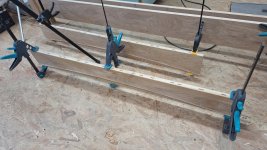
If you wanted a machine-based approach to a curved cockboad, you could do what I did on my bed last year.
Make the apron plain, then machine a separate piece with bull-nosed edges and glue it on. It will spring enough to mate well. I used theoffcut from bandsawing the curve as a caul for clamping. It worked very well indeed.


cap strip fits.jpgclamping of crestrail capstrip.jpg
 
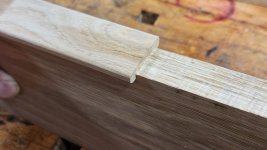
Thanks. That’s a ‘positive’ cock bead, probably a lot easier than the one I was thinking of below:
1768129412545.jpeg

The last time I did one, I used a scratch stock as suggested above, just a countersunk slot-head woodscrew with the top filed flat to sharpen it, and some relief filed into one side so it could bite. For the outer curve, a few swipes with a plane and then sandpaper.
 
Last edited:
Nothing wrong with machines. Would angles mortises be easy enough on a mortising machine?
I’d have to trig the leg at an angle with the same 2.5 degree wedge used to make the aprons. Easy enough in principle, but I can see some accuracy/consistency problems creeping in.
 
Thanks. That’s a ‘positive’ cock bead, probably a lot easier than the one I was thinking of below
I'm pretty sure that the "cock" bit means that it sticks up. Allegedly the term "cock-up" is a printer's term for a bit of type sticking up above the rest, and not rude at all...
 
I'm pretty sure that the "cock" bit means that it sticks up. Allegedly the term "cock-up" is a printer's term for a bit of type sticking up above the rest, and not rude at all...
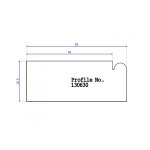
Ah, maybe I mean a ‘quirk’ bead then. Paul Sellers calls it that, but I thought he was just being delicate.

Whitehill tools call it a quirk cockbead, so that doesn’t really clear it up.

 
Looking at your original picture, my thoughts are that those curves are a bit tight for an applied cockbead. If the thickness is say 6mm, or even if only 4mm, it's quite a severe bend.
As for it being a quirk that sticks out, exactly the same approach could be made to keep the bead flush, rather than proud. But you still have the bendy issue.
If you can make a decent scratchstock, that may well be your best approach. You can make it any radius you like.
S
 
Back
Top