
-
Hi all and welcome to TheWoodHaven2 brought into the 21st Century, kicking and screaming! We all have Alasdair to thank for the vast bulk of the heavy lifting to get us here, no more so than me because he's taken away a huge burden of responsibility from my shoulders and brought us to this new shiny home, with all your previous content (hopefully) still intact! Please peruse and feed back. There is still plenty to do, like changing the colour scheme, adding the banner graphic, tweaking the odd setting here and there so I have added a new thread in the 'Technical Issues, Bugs and Feature Requests' forum for you to add any issues you find, any missing settings or just anything you'd like to see added/removed from the feature set that Xenforo offers. We will get to everything over the coming weeks so please be patient, but add anything at all to the thread I mention above and we promise to get to them over the next few days/weeks/months. In the meantime, please enjoy!
You are using an out of date browser. It may not display this or other websites correctly.
You should upgrade or use an alternative browser.
You should upgrade or use an alternative browser.
Suggestions for excavating this hole
- Thread starter RogerS
- Start date
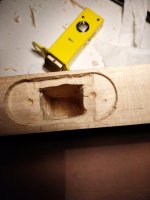
duke
Old Oak
I can only think of using a forstner bit and then a chisel to scrape the bottom.

HdV
New Shoots
I would be tempted to grab my band file. I don't know the dimensions of that hole though....
A bit of sandpaper glued to a countersunk washer that is screwed to a rod in a drill might work too. Would need a very coarse grit, I suspect.
A bit of sandpaper glued to a countersunk washer that is screwed to a rod in a drill might work too. Would need a very coarse grit, I suspect.
SamQ aka Ah! Q!
Old Oak
Router. Slot drill. Lemon squeezy.

Pete Maddex
Old Oak
Japanese bottom cleaning chisel.
Pete
Pete

Steve Maskery
Old Oak
Nah, I tried that, it didn't work very well at all. I've gone back to using paper.Japanese bottom cleaning chisel.
Pete
S

Trevanion
Old Oak
Most tubular latch mortices are drilled with a 25mm spade bit rather than making a rectangular mortice, which saves a lot of time. Obviously, you have to be more careful when drilling as it's very nearly the same size as the faceplate.

Yebbut…how do you stop it from routing out the side?Router. Slot drill. Lemon squeezy.
Would leave me with 3.5mm of wood on either side!Most tubular latch mortices are drilled with a 25mm spade bit rather than making a rectangular mortice, which saves a lot of time. Obviously, you have to be more careful when drilling as it's very nearly the same size as the faceplate.

Woodbloke
Sequoia
The classic ditty by Bernard Cribbins comes instantly to mind - Rob...hat, coat already on
Steve Maskery
Old Oak
Correct. They are that close.Would leave me with 3.5mm of wood on either side!
I have to do the same with a hardboad eggbox piece of nastiness right now. The existing lock has such a short backset that the rose of the handle fouls the door frame. French doors are ridiculous, they really are. They all seem to come with holes predrilled (or in some case just pre-hacked-out) for a tall narrow plate-mounted handle. The two holes are for spindle and keyhole. If you just want a latch rather than a lock, you have to blank off the keyhole. And you don't get a choice of backset (I think it is only 50mm, but I wouldn't swear to that).
So I brought over a new latch from the UK (I can't remember the backset, but it is at least 62mm). That means plugging the existing lock cavity, excavating the surface of the door around the old handle, grafting in a new piece on each side to make the flush surface good, and start from scratch with the latch. It's a lot of work for a scruffy old cheap door. But as I can't find what I'm looking for, I don't have a choice. At the mo I have to put my shoulder to it to open it. Nothing fits properly in this house.
I'm also replacing the lift-off French Hinges with proper steel butts and I've milled a load of moulding to make it look as if it is a panelled door.By the time I've fnished with it, it will look like a different door (mainly because it will largely be so).
S
Last edited:
Steve Maskery
Old Oak
I always think that the hardest part of fitting the darned things is keeping the drill straight. You wouldn't bethe first to drill out through the face of the door by accident. Ahem.
S
S
Last edited:
How do you stop that DW625 going all over the place as I like the ideaLong router bit, the long ones for cutting worktops.
Ironmongery direct….backset 44mm IIRCCorrect. They are that close.
I have to do the same with a hardboad eggbox piece of nastiness right now. The existing lock has such a short backset that the rose of the handle fouls the door frame. French doors are ridiculous, they really are. They all seem to come with holes predrilled (or in some case just pre-hacked-out) for a tall narrow plate-mounted handle. The two holes are for spindle and keyhole. If you just want a latch rather than a lock, you have to blank off the keyhole. And you don't get a choice of backset (I think it is only 50mm, but I wouldn't swear to that).
So I brought over a new latch from the UK (I can't remember the backset, but it is at least 62mm). That means plugging the existing lock cavity, excavating the surface of the door around the old handle, grafting in a new piece on each side to make the flush surface good, and start from scratch with the latch. It's a lot of work for a scruffy old cheap door. But as I can't find what I'm looking for, I don't have a choice. At the mo I have to put my shoulder to it to open it. Nothing fits properly in this house.
I'm also replacing the lift-off French Hinges with proper steel butts and I've milled a load of moulding to make it look as if it is a panelled door.By the time I've fnished with it, it will look like a different door (mainly because it will largely be so).
S
Trevanion
Old Oak
How do you stop that DW625 going all over the place as I like the idea
Do you have a bush for the router? Knock up a quick and morticing jig and clamp it to the door.
GaryR
Nordic Pine
That's what I would do.Japanese bottom cleaning chisel.
Pete

TomTrees
Sapling
- Joined
- Aug 19, 2014
- Messages
- 380
- Reaction score
- 98
Just posting this for fun really, since I've never seen anyone else do it,
Nor have I ever tried the method either...
but it just might be a suitable application....but that's only if you've got a pillar drill,
and can use it on the..(seemingly disassembled?) stile..
Or... if you've got a machine with tilting head.
I did say it was for fun.
Nor have I ever tried the method either...
but it just might be a suitable application....but that's only if you've got a pillar drill,
and can use it on the..(seemingly disassembled?) stile..
Or... if you've got a machine with tilting head.
I did say it was for fun.
Cabinetman
Sequoia
- Joined
- Oct 11, 2020
- Messages
- 5,528
- Reaction score
- 1,231
- Location
- Lincolnshire Wolds + Massachusetts
- Name
- Ian
And very interesting too thanks, I think I would have started with the bit further into the chuck, but it didn’t seem to cause any problems.Just posting this for fun really, since I've never seen anyone else do it,
Nor have I ever tried the method either...
but it just might be a suitable application....but that's only if you've got a pillar drill,
and can use it on the..(seemingly disassembled?) stile..
Or... if you've got a machine with tilting head.
I did say it was for fun.
I shall try to remember this, not that I can think of a possible use for this method though, haha.
As Dan says…..or freestyle but if your not confident stick to Dans idea.How do you stop that DW625 going all over the place as I like the idea
With the big routers you need to take control of them when they start and stop, and on a job like yours you can’t see what is happening so you need to listen so no ear defenders.
Steve Maskery
Old Oak
OK, so it would have been better to drill the barrel hole first, but you are where you are. So, this is what I would do in your shoes.
Make a jig:
1. Get a block of wood exactly the same width as the thickness of the door, say 32mm and about 50mm thick.
2 In the 32mm face drill a hole with your 25mm Forstner bit, deep enoung so that the whole head of the bit will retract into it.. Then drill right through for the shank of the drill, with as little cleance as you can get away with.
3 Glue a cheek to each 50mm face of the block. The jig can now fit over the edge of your door.
To use it:
1 Put the Forstner through the jig and into your drill.
2 Clamp the jig to your door.
3 Very carefully start to drill. You have no centre to guide the bit, but the jig should keep you steady for a while.
Once you are established, continue drill untill you run out of shank, but by then you can remove the jig and ontinue freehand.
I've never done any of this, you understand, but that is what I would try in your shoes.
S
Make a jig:
1. Get a block of wood exactly the same width as the thickness of the door, say 32mm and about 50mm thick.
2 In the 32mm face drill a hole with your 25mm Forstner bit, deep enoung so that the whole head of the bit will retract into it.. Then drill right through for the shank of the drill, with as little cleance as you can get away with.
3 Glue a cheek to each 50mm face of the block. The jig can now fit over the edge of your door.
To use it:
1 Put the Forstner through the jig and into your drill.
2 Clamp the jig to your door.
3 Very carefully start to drill. You have no centre to guide the bit, but the jig should keep you steady for a while.
Once you are established, continue drill untill you run out of shank, but by then you can remove the jig and ontinue freehand.
I've never done any of this, you understand, but that is what I would try in your shoes.
S

My hollow chisel mortiser (Mulitico) can double as a bench drill with the added advantage that the head can be turned 180 degrees on the pillar thus allowing it be be positioned over the edge of the bench.
My bad. I should have said that I bored out most of the hole with a Forstner bit in my pillar drill.OK, so it would have been better to drill the barrel hole first, but you are where you are. So, this is what I would do in your shoes.
Make a jig:
1. Get a block of wood exactly the same width as the thickness of the door, say 32mm and about 50mm thick.
2 In the 32mm face drill a hole with your 25mm Forstner bit, deep enoung so that the whole head of the bit will retract into it.. Then drill right through for the shank of the drill, with as little cleance as you can get away with.
3 Glue a cheek to each 50mm face of the block. The jig can now fit over the edge of your door.
To use it:
1 Put the Forstner through the jig and into your drill.
2 Clamp the jig to your door.
3 Very carefully start to drill. You have no centre to guide the bit, but the jig should keep you steady for a while.
Once you are established, continue drill untill you run out of shank, but by then you can remove the jig and ontinue freehand.
I've never done any of this, you understand, but that is what I would try in your shoes.
S

I'd use a narrow chisel, 9mm or so, and make a lot of straight down stabbing cuts across the bottom, close together. They will break up the wood at the bottom and wedge the chips sideways.
If they don't break off naturally, use a flat bladed screwdriver to snap the bits off. It doesn't have to be smooth or pretty down there.
If they don't break off naturally, use a flat bladed screwdriver to snap the bits off. It doesn't have to be smooth or pretty down there.
fuse
Sapling
- Joined
- Sep 4, 2025
- Messages
- 353
- Reaction score
- 289
- Location
- Herefordshire UK
- Name
- Martin
- LOCATION
- Uk
Multitool with a cut down blade?
I know,Im a hooligan...
I know,Im a hooligan...
as you got that far with your pillar drill are you sure you cannot either rotate the head or the base to give unlimited space under the chuck and use a longer drill?

SamQ aka Ah! Q!
Old Oak
Clamp long piece of wood to side of door, long to avoid clamps hitting router, thickness immaterial, use router fence to adjust positioning. Scoop out waste with 16,000 rpm bit. Tidy corners with THIN chisel. As Rob would say: " Dunn!".Yebbut…how do you stop it from routing out the side?
Spectric
Sapling
When I fitted tubular latches to some new doors I used the trend jig, a Dewalt 625 router with guide bush and one of these bits
https://www.wealdentool.com/acatalog/Catalogue_Deep_Pocket_233.html
This allowed me to cut the recess using a trim router and the 625 to get the plunge depth for the latch.
So make a jig as @Steve Maskery has suggested but route it out not drill.
Or are we all overlooking the obvious, a chiesel !
https://www.wealdentool.com/acatalog/Catalogue_Deep_Pocket_233.html
This allowed me to cut the recess using a trim router and the 625 to get the plunge depth for the latch.
So make a jig as @Steve Maskery has suggested but route it out not drill.
Or are we all overlooking the obvious, a chiesel !
Spectric
Sapling
I had to go 85mm for my tubular latches but they do come in various lengths depending how far in the knob ends up.they can be handy for fitting latches and locks if the 70mm plunge is deep enough
I did have one, Doug, but sold it to jimmys. Would be useful now for this job. C'est la vie.Am I right in thinking you have a Domino XL, they can be handy for fitting latches and locks if the 70mm plunge is deep enough?
Yup I am using the shortest latch and70mm would have been perfectI had to go 85mm for my tubular latches but they do come in various lengths depending how far in the knob ends up.

Inspector
New Shoots
- Joined
- Jan 5, 2026
- Messages
- 82
- Reaction score
- 95
- Name
- Pete
- LOCATION
- Aberdeen, Saskatchewan, Canada
Buy or make a router jig and practice with it on some scrap until you are comfortable using it. Fill the existing hole with a wood plug and a good epoxy to fill the gaps. Recut the hole.
Pete
Pete
TomTrees
Sapling
- Joined
- Aug 19, 2014
- Messages
- 380
- Reaction score
- 98
Haha, I missed that one Steve!Nah, I tried that, it didn't work very well at all. I've gone back to using paper.
S
Well, if there ever was one, I guessed this might be it,And very interesting too thanks, I think I would have started with the bit further into the chuck, but it didn’t seem to cause any problems.
I shall try to remember this, not that I can think of a possible use for this method though, haha.
but I guess RogerS isn't so silly as to potentially waste his time!
Scratchng me ceann again on another application on where it might be useful.
...until then I suppose.
Why? It’s done. Scruffy I agree.Buy or make a router jig and practice with it on some scrap until you are comfortable using it. Fill the existing hole with a wood plug and a good epoxy to fill the gaps. Recut the hole.
Pete
Inspector
New Shoots
- Joined
- Jan 5, 2026
- Messages
- 82
- Reaction score
- 95
- Name
- Pete
- LOCATION
- Aberdeen, Saskatchewan, Canada
With some of the comments about the sides being thin and talk of different jigs of various kinds I took the thread to be leaning towards redoing the mortice. Sorry if I misread things. I will also admit to never having seen a lockset like yours. Ours are all pretty much round that you drill a hole in from the edge of the door and another in from the side. There are lots of cheap to expensive drill jigs that come with the hole saws to do the holes, making it into a job of a few minutes. I have a cheap one I used in my basement to do a dozen doors. Plastic will probably be brittle and disintegrate when I need it next.
Pete
I would have respond on Wednesday but for some reason couldn't get the forum to open at all.
Pete
I would have respond on Wednesday but for some reason couldn't get the forum to open at all.

Accipiter
Nordic Pine
- Joined
- Oct 16, 2025
- Messages
- 569
- Reaction score
- 478
- Location
- Frome, Somerset
- Name
- Frank
- LOCATION
- Somerset
The forum was down until today Pete @Inspector - there's a thread titled 'It's back' ... thank goodness 

Eric the Viking
Nordic Pine
- Joined
- Dec 10, 2020
- Messages
- 897
- Reaction score
- 351
You read my mind!Am I right in thinking you have a Domino XL, they can be handy for fitting latches and locks if the 70mm plunge is deep enough?
It wouldn't do the entire depth, but you could get a very neat, almost rectangular mortice (do it from both sides of the door, with the fence adjusted to cut the side furthest from the fence each time - if it slips, it then won't wreck anything). Blocks clamped or screwed on to the door to define the ends of the mortice, and then excavate to depth with a proper mortice chisel.
You should then get really neat sides and the chiselling shouldn't mess it up.
Bit late to the game, I'm afraid.I'm struggling to clear the bottom few mm of this hole so that the lock (pictured) sits nicely in the stile. Any suggestions, chaps ?
View attachment 38644
Largest brace bit that will go down the hole, drill to depth + a little more.
Use a small chisel to chop out the corners left by the brace bit as best you can,
The brace bit creates a space for the corner waste to fall into.
Bod1