• Hi all and welcome to TheWoodHaven2 brought into the 21st Century, kicking and screaming! We all have Alasdair to thank for the vast bulk of the heavy lifting to get us here, no more so than me because he's taken away a huge burden of responsibility from my shoulders and brought us to this new shiny home, with all your previous content (hopefully) still intact! Please peruse and feed back. There is still plenty to do, like changing the colour scheme, adding the banner graphic, tweaking the odd setting here and there so I have added a new thread in the 'Technical Issues, Bugs and Feature Requests' forum for you to add any issues you find, any missing settings or just anything you'd like to see added/removed from the feature set that Xenforo offers. We will get to everything over the coming weeks so please be patient, but add anything at all to the thread I mention above and we promise to get to them over the next few days/weeks/months. In the meantime, please enjoy!

Alaskan milling, ‘carport’, roof trusses

Guineafowl21

Nordic Pine
Joined
Dec 15, 2020
Messages
514
Reaction score
129
Location
Nairn
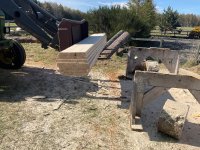
Just to show I don’t spend all my time on here yakking about sausages and fish recipes, here’s the start of filling in the gap in my U-shaped workshop, ex-stables. It’ll have a clear roof and be more of a covered yard:
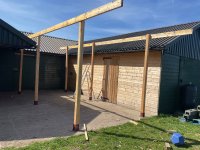
IMG_1419.jpeg
The post supports can only keep the uprights in place on the ground; they don’t provide much resistance to racking, so this frame will be braced, probably with some nice curved braces.

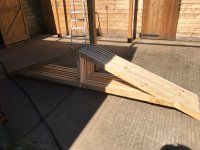
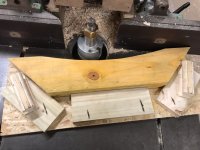
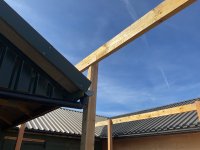
Close-up of the notch and join in the purlins(?), obviously the one that fitted best:
IMG_1420.jpeg

The purlins are commercial stuff, but the 4x4 uprights were milled out of one large larch log, only just, as you can see the waney edge on this one. As you’ll see below, I first use a ladder to face and edge the log, producing a half cant. In the case of the uprights, I milled 4” thick planks, then ‘reassembled’ the log with screw plates, and milled again 90* to the first cut, again at 4” thick, to produce the 4x4. Being larch, they bent and moved a bit as they emerged, but I don’t mind a rustic appearance.

Last step was to round the edges with a router, as the splinters at the corners were murderous.

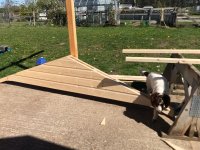
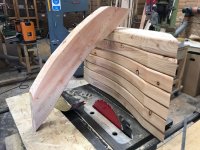
Now, why buy timber when you can have fun making a huge racket and producing it yourself? Here’s a spruce log being prepped to become the truss members:
IMG_1421.jpeg
IMG_1422.jpeg

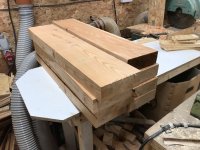
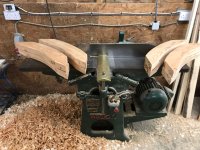
And, about an hour later…
IMG_1423.jpeg

The trusses will be simple kingpost ones with a bit of overhang, and OSB gussets at the joints, for strength, and to cover neatly the inevitable gaps in the joint lines.

It’s been a hot and sawdusty day. Beer time.
 
Your Alakan chainsaw mill is a great option to investing into a portable sawmill. Around here a 16' mill will set you back $12,000 to $15,000. Cdn.
Yes, and it’s hard to justify that for some home milling. I can’t remember exactly, but the mill frame, a 30” bar and rip chain wasn’t much more than £250 all in.

Disadvantages: slow, large kerf, surface finish and precision not great, and setting up the first two orthogonal cuts is a bit of a faff.

Running costs aren’t too bad - converting that spruce log ^ used about 2.5L of petrol, and that was with the chain not cutting quite right. A little bit of bar and 2-stroke oil, too, but not much.
 
Yep…been there and great fun. But still have a scar….long story
Please tell - it might be a valuable lesson. I don’t festoon myself with chainsaw safety gear when doing it, as I should. Just some earplugs on a string and my undivided attention.

Of all the chainsaw tasks I do, this seems fairly low-risk, to me. The saw is pretty well restricted, except for the beginning and, particularly, the end of the cut, when it breaks free and you suddenly have to take the weight. As I go along, I have a pocketful of small wedges to insert in the kerf, which seems to help.
 
Really good, that’s something I’d love to have a go at, but probably will leave it to the experts— I have two large Ash trees here that must come down this year, I certainly won’t be tackling that! and I’m hoping to find a felling co that can mill it too.
Safety, my good Lady really surprised me when she questioned my not wanting to chainsaw some logs without going on a course first, but she’s American and they all seem to have a different approach to safety.
 
Really good, that’s something I’d love to have a go at, but probably will leave it to the experts— I have two large Ash trees here that must come down this year, I certainly won’t be tackling that! and I’m hoping to find a felling co that can mill it too.
Safety, my good Lady really surprised me when she questioned my not wanting to chainsaw some logs without going on a course first, but she’s American and they all seem to have a different approach to safety.
I’d say, for snedding and logging up a felled tree, I could show you the ropes quite quickly, maybe working with you for the first bit. I’m not sure a formal course is needed.

For biggish trees on the ground, I’d go partially through all the way along, not letting the bar go in the dirt, then roll it to expose the uncut bit. Brush the dirt off, then nip each log one by one. Those orange wedges are great for keeping the cut open.
 
Yes, and it’s hard to justify that for some home milling. I can’t remember exactly, but the mill frame, a 30” bar and rip chain wasn’t much more than £250 all in.

Disadvantages: slow, large kerf, surface finish and precision not great, and setting up the first two orthogonal cuts is a bit of a faff.

Running costs aren’t too bad - converting that spruce log ^ used about 2.5L of petrol, and that was with the chain not cutting quite right. A little bit of bar and 2-stroke oil, too, but not much.
You can’t put a price on the satisfaction, and fun, of doing it yourself though.
 
I’d say, for snedding and logging up a felled tree, I could show you the ropes quite quickly, maybe working with you for the first bit. I’m not sure a formal course is needed.

For biggish trees on the ground, I’d go partially through all the way along, not letting the bar go in the dirt, then roll it to expose the uncut bit. Brush the dirt off, then nip each log one by one. Those orange wedges are great for keeping the cut open.
Well thank you, still want to go on a course though, we had a death near me of a novice when I was younger, hanging in a tree with his head nearly removed and it’s sort of stuck with me. Now I’m not going to be going up trees with a saw but still.
Ian
 
Back
Top