• Hi all and welcome to TheWoodHaven2 brought into the 21st Century, kicking and screaming! We all have Alasdair to thank for the vast bulk of the heavy lifting to get us here, no more so than me because he's taken away a huge burden of responsibility from my shoulders and brought us to this new shiny home, with all your previous content (hopefully) still intact! Please peruse and feed back. There is still plenty to do, like changing the colour scheme, adding the banner graphic, tweaking the odd setting here and there so I have added a new thread in the 'Technical Issues, Bugs and Feature Requests' forum for you to add any issues you find, any missing settings or just anything you'd like to see added/removed from the feature set that Xenforo offers. We will get to everything over the coming weeks so please be patient, but add anything at all to the thread I mention above and we promise to get to them over the next few days/weeks/months. In the meantime, please enjoy!

More P/T woes

Steve Maskery

Old Oak
Joined
Jul 27, 2014
Messages
2,317
Reaction score
1,264
Location
87290 Laplagne, France
Following on from EtV's thread about his Kity, I have problems, too.

When I bought the house, I also bought the Sedgewick P/T that was here. It's a much more industrial machine than my Kity.

Yes, it's built like a tank, but it is not very well designed. There is no rise/fall adjustment on the outfeed table to eliminate planing snipe (which there is on the Kity) and there is no alignment at all on the beds (there is on the Kity albeit about as crude as it is possible to be).

I've been unhappy with it for a while and, when starting a new project yesterday, I simply could not get an oak board flat. It didn't look right and it didn't sound right, either.

Now I had set this p only a few weeks ago with new knives. But I discovered that the knives were more protuberant than they should be. So I set them up again. It sounded better, but I still wasn't getting flat. I got a staight edge onto it. Ah. There was my problem. The two beds were like a hump-back bridge. Off came the infeed table. The sliding beds were pretty good but I cleaned them anyway and it did not solve the problem.

There appears to be zero adjustment. So I think I need to cut up a drinks can and shim up the outfeed table. I don't want to mess with the sliding mechanism of the infeed table. The alterative is to drill and tap the outfeed table and insert a grub screw to jack it up, but I think that might be a bit scary.
S
 
I would check that the bolts that hold down the infeed table are relatively snug before getting carried away, if they're not snug and the table isn't sitting on the slide ways correctly, it can droop a considerable amount.
 
I had a similar problem with my Sedgwick. I used some feeler gauges to adjust the heights
 
... so you can imagine my relief when I put a metre rule across my newly-lubricated infeed (and outfeed) table yesterday: no gaps anywhere - they seen to be co-planar when the infeed is fully wound-in. I was expecting far more of a fight.

My sympathy is with you, Steve!

E.

PS: Shimming it sounds like a much better idea. My late dad left me a tin of assorted brass shim stock, which I think he hadn't opened since the 1960s. It's recently seen use :-)
I wonder if a similar selection is available nowadays new... Googling 'assorted shim stock' yields a lot of vendors at a lot of different prices (steel mostly, rather than brass, but that's not terribly important in this context). Coke cans are grand, but nowadays mostly aluminium, which I wouldn't trust for heavy-duty porpoises.
 
Last edited:
The slideways are clean and snug.
I think I'm going to try the bits-of-Guinness-can fix first, though it will probably have to wait until tomorrow now.
S
 
When I was trying to beat my Holzmann P/T into submission, I needed small lengths of different thicknesses of shim stock so I could align the thicknesser pedestal. Rather than buy random rolls of stock, I bought an inexpensive steel feeler gauge set, about €2, and cut pieces from the leaves that I needed. In the end, I got rid of the Holzmann and bought a Minimax P/T.
 
When I was trying to beat my Holzmann P/T into submission, I needed small lengths of different thicknesses of shim stock so I could align the thicknesser pedestal. Rather than buy random rolls of stock, I bought an inexpensive steel feeler gauge set, about €2, and cut pieces from the leaves that I needed. In the end, I got rid of the Holzmann and bought a Minimax P/T.
That's good idea.
I thought we were going to be out all day today (it's a Bank Holiday here), but in fact we were done and dusted in an hour, so I might get some workshop time after all.
S
 
When I was trying to beat my Holzmann P/T into submission, I needed small lengths of different thicknesses of shim stock so I could align the thicknesser pedestal. Rather than buy random rolls of stock, I bought an inexpensive steel feeler gauge set, about €2, and cut pieces from the leaves that I needed. In the end, I got rid of the Holzmann and bought a Minimax P/T.
That's good idea.
I thought we were going to be out all day today (it's a Bank Holiday here), but in fact we were done and dusted in an hour, so I might get some workshop time after all.
S
Eh ? Did no-one miss post 3 ?
 
Ah, I see. I thought that you just meant you used feeler gauges. I didn't realise that you meant you used them as shims.
S
 
Last edited:
I understood what Roger was getting at, but that's probably partly as its something I've done before. When I had my mini-lathe, the tools had to be adjusted to centre height with shims (until I made a quick-change tool-post for the lathe). I bought a couple of cheap feeler gauge sets and used them as shims (with the size of each shim conveniently marked on them so I knew which shims to use). Having two full sets meant I could keep the feeler gauge stock with the tools and that made it a bit quicker to change tool.
 
When car ownership entailed maintenance, feeler gauges were pretty much essential for your toolbox, so there’s lots of them about.
Not being able to throw anything away, I’ve ended up with several sets , but haven’t used one for years, but I’m well prepared!!
Have quite a bit of proper shim too.
Maybe I should buy a P/T 🙂
 
Hi Steve. I'm not familiar with Sedgewick PTs but think that the outfeed table is bolted down on a horizontal surface on the chassis while the infeed is slid back and forwards on sloped ramps for depth of cut adjustment.

A few thoughts.

There are quite a few inter dependent alignments on a PT which need to be set up in the correct sequence. The following is just a whistlestop tour of the territory but it might make sense to check these out before focusing solely on the outfeed table.

There are gibs (clearance adjustment slips) on most jointers using the ramp system for table height adjustment. Could it be that they are on yours and need adjustment - that the table droop is a result of wear/wrong adjustment/clearance in the ramps?
It seems a bit odd that the outfeed table should be way off in that (unless I have it wrong) the horizontal mounting is fixed and presumably not subject to wear. A problem there might (?) suggest a machining error in or subsequent distortion of the chassis.

On the interdependent alignments on a PT - it may help to walk through them.

On the type I have with hinged tables the horizontal alignment/axis of the cutter block cylinder (not the knives) tends to be the starting point/datum - given an accurately manufactured chassis it's possible to adjust everything else to align with it. The Sedgewick is probably a little different - see below.

It's anyway useful to set PTs up on adjustable height feet so that when the dust settles after set up the cutter block is accurately levelled crosswise. Also so that the thicknessing table is accurately levelled in both directions. Levelling makes life easier when setting up rollers and/or extension tables if needed later. Feet tend to bring PTs up to a more comfortable working height too.

PT chassis despite appearances tend not to be very rigid/twist resistant, and most floors are not perfectly level - movement can take tables out of alignment. It's consequently better following levelling to mark the foot locations on the floor and to subsequently not move the machine.

Given the fixed alignment (is this correct?) of the infeed table delivered by the (hopefully tight) ramps on your Sedgewick it may make sense to instead treat the surface of this table as the datum and (having first made sure that it is twist free and flat) to level it crosswise and lengthwise using the above levelling feet under the machine chassis.
The axis of cutter block cylinder if the chassis is accurate should meanwhile be in a plane parallel to/coplanar with the infeed table. Presuming that there is no other adjustment it may be possible to shim under one of the cutter block bearings if needed to sort this out
Next up might be to verify that the thicknessing table is also accurately in the same crosswise plane as the cutter block and infeed table and accurately level lengthwise - they usually have adjustment in both axes.
Next step would be to check that the lip/leading edge of the outfeed table is accurately in the same plane as the cutter block cylinder, and that that table is also in a plane parallel to/coplanar with the infeed table - it's a this point that shimming might prove necessary.

Sedgewick should be able to specify a measurement for the height from the top surface of the cutter cylinder to the surface of the outfeed table.

Both jointing and the thicknessing tables ideally need to end up flat and in correct alignment to within perhaps 0.05mm/a couple of thou to perform reliably. Be careful of maker's tolerances for table flatness and the like - while the consequences will vary depending on the nature of the irregularity the 0.25mm/0.010in tolerance some quote as acceptable is far too much if doing fine work. (especially if humped in close to the knives - a disaster) This presumably is to minimise machining and pre-delivery set up time and side step warranty claims. It's for reasons of this sort unlikely that a service guy will set a machine up as accurately as is desirable...

Care is needed with all table shimming and height adjustments. Cast iron is not as rigid as it looks - it's very easy to while focusing on fixing one alignment unknowingly cause a twist or other misalignment in them. It can be a PIA to get them right simultaneously in both axes - and simultaneously in the case of the outfeed set at the correct height above the cutter cylinder. This requires adjustment of the hinges and support bolts/all four support points on the more common hinged table layout but shimming at both ends of the horizontal outfeed table seat on both sides may be required on the Sedgewick. Might they offer wedge shims for this purpose? The ramp type infeed table may well depend on the accuracy of machining of the ways for correct alignment/be non adjustable in that regard (??) - and for this reason as above be the de facto datum from which everything else including the horizontal axis of the cutter block cylinder must be set..

The last job is to set a sharp set of knives to the correct height above the outfeed table. 0.002in set accurately across the full width using a dial gauge works well on a tight machine with accurately flat tables but more may be necessary if the tables (especially outfeed) have the previously mentioned disastrous humps in near the cutter.

Test for straight jointing with some long pieces. Given truly flat and coplanar tables and a more or less correct knife height a PT will with no ifs buts or maybes joint straight across it's entire width - there should be no need for all of the witchcraft that gets talked in some quarters.

Test pieces run through the thicknessing at the opposite ends of the cutter should come out within a few thou of being the same thickness. If not fine tune the thicknessing table alignment. (a decent machine and set up will deliver the same thickness to within 0.1mm across the entire width of the table) This is another reason to set knife heights accurately using a dial gauge - variations in knife height will throw this out)

The requirement for set up and measuring equipment quickly rears its head in the above.

A good quality callipers (the vernier mechanical variety avoids the risks brought by dodgy electronics) will accurately measure shim thicknesses and the like.

A One Way gauge or DIY equivalent from a block of steel works very well for setting knife heights and checking cutter cylinder heights and horizontal alignment - but needs to be fitted with a good quality very low/almost zero backlash dial gauge like a Mitutoyo or equivalent (not the cheap Chinese variety passed off to woodworkers which in my experience will due to massive backlash mislead in this situation) One supplier here: https://www.hopewoodturning.co.uk/product/multi-gauge/?c=5

Table levelling/coplanarity can be set with a reliable straight edge (a good anodised level is probably the most practical option but check it out before use) and feeler gauges. This method can pick up twist in tables, but a precision (engineering) spirit level used crosswise with a straight edge is much faster and likely more accurate. A stock construction level isn't really sensitive enough for use as a level in this work......

Brass shim is available in packs of multiple or single thicknesses from most engineering supply places and even Amazon these days.

The above may seem like a lot of work and equipment, but the point is that once set up accurately and the data recorded the machine is left with a base set up which unless it's junk or is subsequently messed up will likely not change. It anyway can be checked by measurement against it at intervals. Knife changes for example will just be that - install, set once to the previously determined correct height and run with no problems..

Tackling problems in isolation without knowledge of the set up status of the rest of the machine can be a bit of a roulette given previous users efforts, wear and tear and the unfortunately current reality that many are delivered only very approximately set up and with the possibility of problems like out of flat tables.

Hope this helps..
 
Last edited:
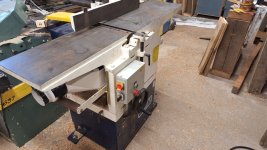
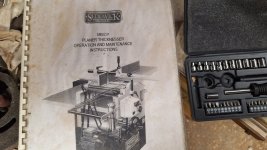
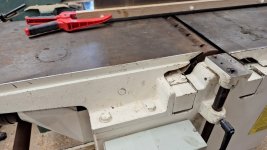
Well I've had a busy morning and some progress. Here are some pictures.
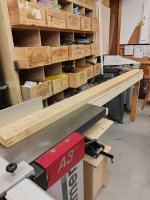
This is the offending machine.
general view (Medium).jpg

manual (Medium).jpg

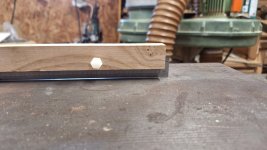
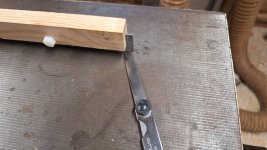
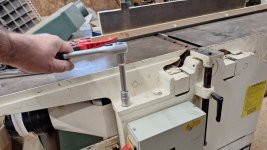
And this is the gap

daylight (Medium).jpg

feeler guage (Medium).jpg

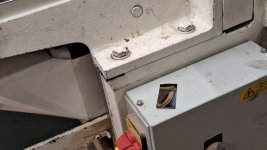
I don't want to mess with the infeed table. I've had it off, it's all clean and tidy and it slides nicely. So I decided to alter the outfeed table. These are the mounting bolts.
outfeed table bolts (Medium).jpg

So I "just" Loosened them. Ye gods I needed more spinach.

loosening bolts (Medium).jpg

What did I find underneath? A piece of shim! So someone has had a go at this before.

adding shims (Medium).jpg

I ended up with 12 layers of shim before that gap disapperead, which seemed a tad excessive to me. Which indeed it was. I'd forgotten that as the back end of the outfeed table came up, thereby making the two tables no longer coplanar. Oops.

So a bit of back and forth and I've ended up with 5 layers of Guinness can, no wind, and acceptably co-planer. I can get .004 (I assume that is mm, it doesn't actually say on the feeler gauges) under the first couple of inches by the cutter head, after that, it is all good. Given that, at this level, the straightness of the straight edge is fairly critical, and this is only a decent-quality 1m ruler, I'm happy with that.

I had to reset the blades and it is better. Still not as sweet as I would like. I might try another set of knives, but these haven't been on long and have not seen much action. They certainly are not knacked.

So progress. Got to go, I'm being nagged.
S
 
Last edited:
Thank you. But I've got it pretty well set up now. A new set of blades after levelling the tables (though the previous set had not been on long) and it is singing. It's the best it's been since I've had it.
S
 
Last edited:
Well I spoke too soon.
I came to use it this morning and all was not well. It cut the first few inches of a 7ft board and then nothing. It's not as iff the board was vey bowed.
So I checked the drag. It was about 12mm instead of 5mm. What the...? So I set the blades again. No better. OK, check the beds again.
I would have sworn that they were right when I finished the alignment process. Indeed the machine cut sweetly. But aparently it was temporary. Now I have too much shim. I have no idea what's going on. So I'm thinking of resorting to Plan B.

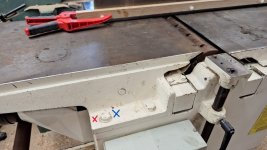
Plan B involves drilling and tapping an 8mm hole in the casting for an adjustment screw.

crosses.jpg

Ideally I'd like to do it at the position of the red cross, but I fear it may be too close to the edge of the casting. The blue cross is the alternative.

Has anyone got any thoughts on this? I'm pulling may hair out and ruining boards.
S
 
Hi Steve. I don't as before know Sedgewick machines but please don't drill the casting. Presuming the tables were coplanar with the bolts done up after you shimmed it and the knives properly set as you thought (that it was planing properly) it seems probable that something has moved. It's unlikely to have been the outfeed table.

It's hard to know from this distance but the obvious candidates are something to do with the cutter block and/or the infeed table. Badly worn cutter block bearings and/or a knife setting funnies are perhaps a possibility, but as before an issue with the gibs/shims or whatever adjustment the infeed table ramps have seems given the table droop you reported more likely.

Alternatively twist and/or inconsistent settings across the width of the tables could mean that it works OK at one location but less so at others.

This is why I tried to steer you towards a more comprehensive work up of the machine settings and condition taking account of the key set ups, how they can interfere with each other and consequently the sequence in which they need to be addressed. Also towards using set up equipment which which delivers reliable hard information.

Who knows what is going on/what else is out of whack. The machine has clearly been around for a while may have suffered some wear and tear - not to mention that somebody from what you said has already had a fiddle...

Long experience from this end suggests that it's normally worth putting in the time to understand the total picture before trying to fix items piecemeal on older equipment.

Spot repairs unless the overall condition of the rest of the machine is known or predictable amount to a roulette game - quite apart from missing the true cause of the difficulty and causing yourself a lot of frustration you can end up investing time and money in situation in which lots else is off which will mislead and keep on throwing up more problems.

It looks as though with a bit of TLC it can potentially be a very nice machine...
 
Last edited:
A quick PS Steve as my time is tight.

The first part is only a precaution because you said that the tables were out of alignment again.

A 7ft board that is not straight (as you say) and/or is heavy enough to be hard to reliably hold down tight on the tables is likely to be problematical. A roller stand or better still set of long extension tables (pic) is advisable - especially if starting with a less than straight board.

My approach (especially if the board is close to the required finish dimension/I can't afford to lose too much material on the PT) is to check a long board with a long straight edge like a level - the H&S brigade won't approve but if you want to risk it it can be helpful to nibble away with stopped cuts at the high sections until the board is fairly straight and then go for a full length pass. An alternative if it's the edge that is the problem is to straighten it on a saw using the usual technique. Hand planing to reduce high areas might be an option if it's the face.

Did you try the machine with the presumably shorter test piece from yesterday that seemed to work and if so was it OK?

Presuming that it's the machine - grab the outboard end of the infeed table and heave up and down on it to see if you can detect any slack in the ways.

Ditto if that's OK the outfeed table (in case something funny is going on that it's not bolting down tight on the shims. Slack there will make the knife height setting meaningless.

Failing those and being very careful regarding the knives (use heavy gloves) try to find a way to heave up and down on the cutter block/cylinder to check for looseness in bearings etc..

All of the above assumes genuinely flat tables. A quite moderate hump of more than few thou in either table (especially close in to the knives) can also play havoc by lifting/tilting the work .

Twist or inaccurate height settings across the width of the tables may mean that the machine joints straight on one line of cut, but is way off elsewhere...

IMG_20231209_175241.jpg
 
You are right, of course, it should probably be stripped down and rebuilt. I really REALLY don't want to do that.
I've had another go at it today. I took out nearly all the shims I added the other day. It was, as of 4pm today (by which time I'd had more than enough) running nicely again.
You are right about 7ft boards, as well. Oak, they weigh a ton. But, as you say, infeed and outfeed supports help enormously. I use both.
I'm not sure how much time I'll get in the next week or so, we have friends coming to stay and I've been put on a cleaning rota before they arrive.
Thank you for your input, it is much appreciated.
S
 
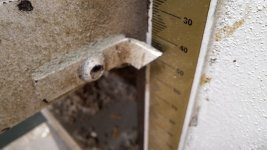
Just an update to this. The machine continues to work as it should, hoorah! But the cutting depth indicator is fictitious. There is a scale on the main casting by the side of the infeed table and a bent tin pointer on the infeed table itself. I forgot to take a photo, but it looked like the one on the thicknessing table:

thicknesser pointer (Medium).jpg

I don't know if it was ever accurate, but now that the machine is behaving itself, it was indicating a negative cut when in fact it was taking off 2mm. And as it was riveted in place, it was not adjustable. No use whatsoever.

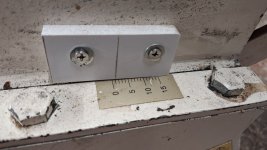
So I found a bit of plastic, drilled and filed a couple of slots and scribed a line. On the machine itself I drilled and tapped a couple of M4 holes. I don't have any roundhead machine screws long enough, so I've had to make do with countersunk ones instead.

The result is this:

new planer scale (Medium).jpg

It has plenty of adjustment and I've got it so that at the setting shown, my digital calipers tell me it is taking off 1.05mm. I'm happy with that.
S
 
Back
Top