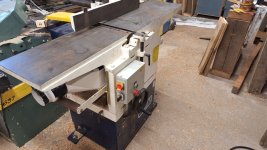
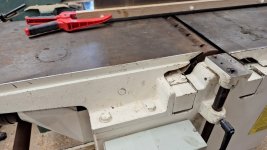
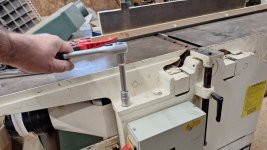
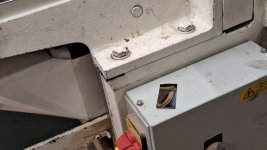
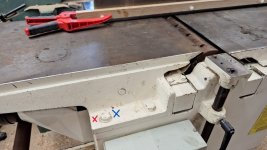
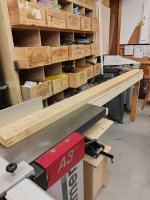
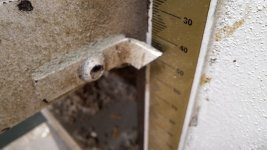
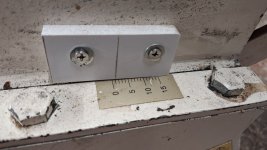
Hi Steve. I'm not familiar with Sedgewick PTs but think that the outfeed table is bolted down on a horizontal surface on the chassis while the infeed is slid back and forwards on sloped ramps for depth of cut adjustment.
A few thoughts.
There are quite a few inter dependent alignments on a PT which need to be set up in the correct sequence. The following is just a whistlestop tour of the territory but it might make sense to check these out before focusing solely on the outfeed table.
There are gibs (clearance adjustment slips) on most jointers using the ramp system for table height adjustment. Could it be that they are on yours and need adjustment - that the table droop is a result of wear/wrong adjustment/clearance in the ramps?
It seems a bit odd that the outfeed table should be way off in that (unless I have it wrong) the horizontal mounting is fixed and presumably not subject to wear. A problem there might (?) suggest a machining error in or subsequent distortion of the chassis.
On the interdependent alignments on a PT - it may help to walk through them.
On the type I have with hinged tables the horizontal alignment/axis of the cutter block cylinder (not the knives) tends to be the starting point/datum - given an accurately manufactured chassis it's possible to adjust everything else to align with it. The Sedgewick is probably a little different - see below.
It's anyway useful to set PTs up on adjustable height feet so that when the dust settles after set up the cutter block is accurately levelled crosswise. Also so that the thicknessing table is accurately levelled in both directions. Levelling makes life easier when setting up rollers and/or extension tables if needed later. Feet tend to bring PTs up to a more comfortable working height too.
PT chassis despite appearances tend not to be very rigid/twist resistant, and most floors are not perfectly level - movement can take tables out of alignment. It's consequently better following levelling to mark the foot locations on the floor and to subsequently not move the machine.
Given the fixed alignment (is this correct?) of the infeed table delivered by the (hopefully tight) ramps on your Sedgewick it may make sense to instead treat the surface of this table as the datum and (having first made sure that it is twist free and flat) to level it crosswise and lengthwise using the above levelling feet under the machine chassis.
The axis of cutter block cylinder if the chassis is accurate should meanwhile be in a plane parallel to/coplanar with the infeed table. Presuming that there is no other adjustment it may be possible to shim under one of the cutter block bearings if needed to sort this out
Next up might be to verify that the thicknessing table is also accurately in the same crosswise plane as the cutter block and infeed table and accurately level lengthwise - they usually have adjustment in both axes.
Next step would be to check that the lip/leading edge of the outfeed table is accurately in the same plane as the cutter block cylinder, and that that table is also in a plane parallel to/coplanar with the infeed table - it's a this point that shimming might prove necessary.
Sedgewick should be able to specify a measurement for the height from the top surface of the cutter cylinder to the surface of the outfeed table.
Both jointing and the thicknessing tables ideally need to end up flat and in correct alignment to within perhaps 0.05mm/a couple of thou to perform reliably. Be careful of maker's tolerances for table flatness and the like - while the consequences will vary depending on the nature of the irregularity the 0.25mm/0.010in tolerance some quote as acceptable is far too much if doing fine work. (especially if humped in close to the knives - a disaster) This presumably is to minimise machining and pre-delivery set up time and side step warranty claims. It's for reasons of this sort unlikely that a service guy will set a machine up as accurately as is desirable...
Care is needed with all table shimming and height adjustments. Cast iron is not as rigid as it looks - it's very easy to while focusing on fixing one alignment unknowingly cause a twist or other misalignment in them. It can be a PIA to get them right simultaneously in both axes - and simultaneously in the case of the outfeed set at the correct height above the cutter cylinder. This requires adjustment of the hinges and support bolts/all four support points on the more common hinged table layout but shimming at both ends of the horizontal outfeed table seat on both sides may be required on the Sedgewick. Might they offer wedge shims for this purpose? The ramp type infeed table may well depend on the accuracy of machining of the ways for correct alignment/be non adjustable in that regard (??) - and for this reason as above be the de facto datum from which everything else including the horizontal axis of the cutter block cylinder must be set..
The last job is to set a sharp set of knives to the correct height above the outfeed table. 0.002in set accurately across the full width using a dial gauge works well on a tight machine with accurately flat tables but more may be necessary if the tables (especially outfeed) have the previously mentioned disastrous humps in near the cutter.
Test for straight jointing with some long pieces. Given truly flat and coplanar tables and a more or less correct knife height a PT will with no ifs buts or maybes joint straight across it's entire width - there should be no need for all of the witchcraft that gets talked in some quarters.
Test pieces run through the thicknessing at the opposite ends of the cutter should come out within a few thou of being the same thickness. If not fine tune the thicknessing table alignment. (a decent machine and set up will deliver the same thickness to within 0.1mm across the entire width of the table) This is another reason to set knife heights accurately using a dial gauge - variations in knife height will throw this out)
The requirement for set up and measuring equipment quickly rears its head in the above.
A good quality callipers (the vernier mechanical variety avoids the risks brought by dodgy electronics) will accurately measure shim thicknesses and the like.
A One Way gauge or DIY equivalent from a block of steel works very well for setting knife heights and checking cutter cylinder heights and horizontal alignment - but needs to be fitted with a good quality very low/almost zero backlash dial gauge like a Mitutoyo or equivalent (not the cheap Chinese variety passed off to woodworkers which in my experience will due to massive backlash mislead in this situation) One supplier here:
https://www.hopewoodturning.co.uk/product/multi-gauge/?c=5
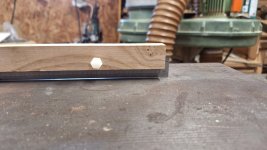
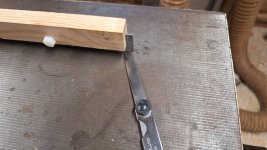
Table levelling/coplanarity can be set with a reliable straight edge (a good anodised level is probably the most practical option but check it out before use) and feeler gauges. This method can pick up twist in tables, but a precision (engineering) spirit level used crosswise with a straight edge is much faster and likely more accurate. A stock construction level isn't really sensitive enough for use as a level in this work......
Brass shim is available in packs of multiple or single thicknesses from most engineering supply places and even Amazon these days.
The above may seem like a lot of work and equipment, but the point is that once set up accurately and the data recorded the machine is left with a base set up which unless it's junk or is subsequently messed up will likely not change. It anyway can be checked by measurement against it at intervals. Knife changes for example will just be that - install, set once to the previously determined correct height and run with no problems..
Tackling problems in isolation without knowledge of the set up status of the rest of the machine can be a bit of a roulette given previous users efforts, wear and tear and the unfortunately current reality that many are delivered only very approximately set up and with the possibility of problems like out of flat tables.
Hope this helps..