

Accipiter
Nordic Pine
- Joined
- Oct 16, 2025
- Messages
- 765
- Reaction score
- 593
- Location
- Frome, Somerset
- Name
- Frank
- LOCATION
- Somerset
Hi... I know there are threads already from other members that have renovated old hand planes. However, a brief search with "hand plane renovation" didn't bring anything up. However, although I'm sure I'd pick up the 'how to' I'd like to ask for your help and guidance on how to approach the renovation of these.
My 2nd door renovation/fitting got me to a stage where I needed my old block plane, hidden in the back room with my other planes which I'd put away in a drawer after coming across them after a roof leak (split sheeting) unbeknownst to me at the time of the leak. I dried and wiped over then sprayed with WD40 and put in the drawer. That's got to be about 8 to 10 years ago - maybe more I'm ashamed to have to say ..
.. 
Anyway... having dug out the block plane, cleaned up a bit and sharpened the blade to use it and it helping me achieve what was needed, my mind has turned to rescuing the remaing three. I'm therefore asking members with experience of returning old planes to use for your help and guidance... step by step would be extremely appreciated - please . It felt really good to have a hand plane (even if only a block plane) in my hands again
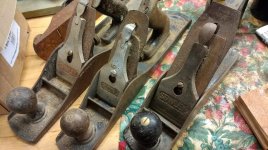
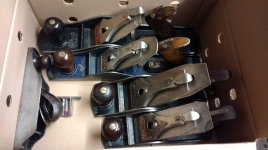
I got them many, many years ago... possibly around 1968~69. One is a Stanley (Bailey), while two others are marked as 'SALMENS' . A quick Google comes up with numbers of No 4 Jack and No 5 Smoothing planes on the sizes of the sole measured from heel to toe. The SB is 9½" (No 4) and the block 6".
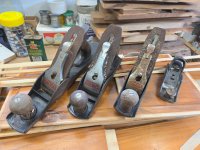
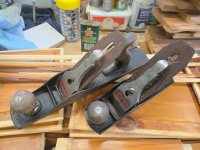
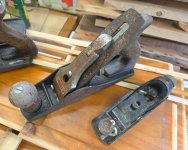
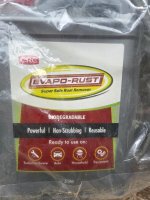
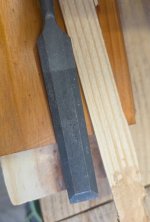
I did use some rust treatment (Evapo Rust) on some old hand chisels but, as you'll see in a photo, left a dull grey cover on the metals of the chisels. I'd like to avoid this with these planes - if possible. Apart from dismantling as the starting point what would be the next steps and treatment/s to use... white vinegar for one? Or use the Evapo Rust and clean of with ????
My 2nd door renovation/fitting got me to a stage where I needed my old block plane, hidden in the back room with my other planes which I'd put away in a drawer after coming across them after a roof leak (split sheeting) unbeknownst to me at the time of the leak. I dried and wiped over then sprayed with WD40 and put in the drawer. That's got to be about 8 to 10 years ago - maybe more I'm ashamed to have to say
.. Anyway... having dug out the block plane, cleaned up a bit and sharpened the blade to use it and it helping me achieve what was needed, my mind has turned to rescuing the remaing three. I'm therefore asking members with experience of returning old planes to use for your help and guidance... step by step would be extremely appreciated - please
. It felt really good to have a hand plane (even if only a block plane) in my hands again I got them many, many years ago... possibly around 1968~69. One is a Stanley (Bailey), while two others are marked as 'SALMENS' . A quick Google comes up with numbers of No 4 Jack and No 5 Smoothing planes on the sizes of the sole measured from heel to toe. The SB is 9½" (No 4) and the block 6".
I did use some rust treatment (Evapo Rust) on some old hand chisels but, as you'll see in a photo, left a dull grey cover on the metals of the chisels. I'd like to avoid this with these planes - if possible. Apart from dismantling as the starting point what would be the next steps and treatment/s to use... white vinegar for one? Or use the Evapo Rust and clean of with ????




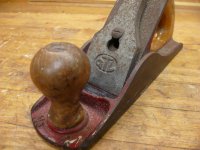
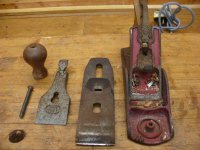


 ) and the blade avoiding the cutting edge - just the 'flat' surfaces - rubbed up and down on the fine sandpaper laid on a piece of pine. Then the cutting edge sharpened on a old oil stone... hoping I was on the right track.