• Hi all and welcome to TheWoodHaven2 brought into the 21st Century, kicking and screaming! We all have Alasdair to thank for the vast bulk of the heavy lifting to get us here, no more so than me because he's taken away a huge burden of responsibility from my shoulders and brought us to this new shiny home, with all your previous content (hopefully) still intact! Please peruse and feed back. There is still plenty to do, like changing the colour scheme, adding the banner graphic, tweaking the odd setting here and there so I have added a new thread in the 'Technical Issues, Bugs and Feature Requests' forum for you to add any issues you find, any missing settings or just anything you'd like to see added/removed from the feature set that Xenforo offers. We will get to everything over the coming weeks so please be patient, but add anything at all to the thread I mention above and we promise to get to them over the next few days/weeks/months. In the meantime, please enjoy!

A trip down Memory Lane

RogerS

Moderator
Staff member
Joined
Jul 21, 2014
Messages
15,492
Reaction score
1,223
Location
Somerset
Way, way back when, I started up a very small computer manufacturing company called Country Computers. We were doomed to failure being very young , underfunded and naive! But we still had a crack at it and this is the story. I hope you find it interesting...

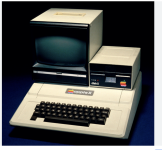
It was the early '80's and long before the IBM PC came out. Remember the Apple II computer ?
Screenshot 2024-04-15 at 09.15.13.png

And therein lay the rub because if you wanted to move it around, you had to either unplug everything or try and scoop it all up in your arms. Then, of course, the first hard drive came out to give a lot more storage than a floppy disc. Then folk found out that a 40 character per line screen wasn’t much cop and so an 80 column card was developed and plugged in. Then someone came out with a card running CP/M. All those separate bits of kit. Bit of a dogs dinner, we thought.

So why not put it all together in a single housing? Why not have an 80 column card already installed ? Why not build the hard drive in ? Why not have a detachable keyboard ? Why not make it with some programmable keys ? Why not have a single key to toggle between 40 and 80 columns ?

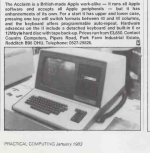
And that’s what we did. We bought Apple II’s, discarded the case etc. Put in a more powerful power supply, a hard drive. I designed and developed the keyboard (running a 6502) and this was the end result
Country Computers Acclaim.png


We had some issues with the keyboard. At times, it would fire up but the characters were not mapped correctly to their corresponding keys. The incorrect mapping was consistent. Thought it was power supply problems down the curly-wurly lead. Bit of a headache, TBH. Then one day I had a flash of inspiration. The 6502 could be told to operate in ‘decimal’ mode (IIRC) rather than binary. I’d assumed that being essentially a digital device, it would always default to binary. Wrong! Felt a bit of a fool, TBH, but problem solved. Then I thought to myself, wonder what Apple did in the Apple II ? The source code was always available in the manual. I looked. First line of code …Put in binary mode. Commented by ‘Get it right this time!’. Even Steve Jobs got it wrong. I didn’t feel quite so bad.

And then…….

First of all we got a snotty letter from British Leyland asking us to change the name as it conflicted with one of their cars …the Triumph Acclaim. In hindsight, a fatuous claim by them but we were naive. But the killer was the Cease-and-Desist letter from Apple. We weren’t making a bootleg version of their motherboards. We couldn’t understand it. But we stopped.

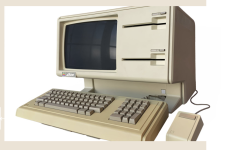
Then three months later, this was released - the Apple Lisa - and all became clear!
Screenshot 2024-04-15 at 09.12.59.png


Cheers

Roger
 
very interesting - that is pretty much the era in which I got into computers - so look forward to hearing more
 
My first computer bought for work was an Amstrad 8086 with a 20MB hard drive. Learned the hard way about backing up with that computer. Self assembled every PC after that.

My friend taught me how to use ms-dos when I got the Amstrad. Now I help him if his computer goes wrong!

I still have a Simply Computers price list from '96 (PC parts supplier). The prices of parts back then were so high for what is now primitive kit.
 
My firsts were a Commodore 64 and BBC B just home stuff and did a little bit of programming but now I can't remember any of it and have to make notes of stuff I don't use regularly. Old age is a real PITA. o_O

I did the same as you Robert, I used Simply Computers for some parts and started going to the weekly computer fairs and building PCs for myself and others. From memory my first PC had a huge RAM capacity of 4mb and I doubled that at extortionate expense. First CD writer was a Sony with slide out tray costing £200 and I got that back in a few of weeks, I won't say how but I wouldn't do it now. 😳 I think I got 1 good burn from every 2 or 3 attempts. Interesting days.
 
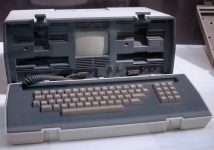
The first computer I bought for personal use was a gray case Osborne 1in 1982 similar to the image below. It was portable (luggable), had a whopping 64KB of RAM, two dual-density 5.25 inch floppy drives (the floppies were flipped over to use the other side), and a built-in five-inch monitor. The IT director of the engineering firm where I worked had the original tan case version, and after a test run on his Osborne, I plopped down $1,825 for my own. The bundled software package was the selling point for me. At the time, I was writing technical manuals for the equipment we designed, and making minor edits to the typed pages could be tedious. Major edits required retyping entire pages or sections, depending on where the edit was needed. We made good use of "This page intentionally blank" pages in the tech manuals to give us room for expansion.

The IT manager and I were the first (for a long time) owners of personal computers in the company. The IBM mainframe was used primarily for accounting, HR, and inventory control. I was the first engineer to have a computer in the lab. I sold it to the IT manager when I left for Korea in 1984 for about the same amount as I paid. By then Kaypro portables were becoming available and MS-DOS was replacing CP/M as the PC operating system.

Osborne.png

After I arrived in Korea, I bought an Apple IIe from the Air Force base exchange. I can't remember what I paid for it but used it for many years before replacing it with an IBM-clone desktop computer. Now I have Macs throughout the house, but keep one HP laptop for the rare occasion for testing.
 
A bit before Country Computers - (maybe late 1970's) - , my father had some $$$$$ in a US bank. It was around the time of a Labour Govt and strict controls regarding bringing money in or out of the country. I was in my late 20's and we hatched a "Good Idea". I was to fly over to the States with an empty suitcase on Friday afternoon. Get to the New York bank before closing, fill said suitcase with $$$$ and fly back the next day. I was in my late 20's and never flown to the States before.

I also didn't want to take any more annual leave off than needed. So I only took half a day off. Looking back we were so naive. No concept of delayed flights etc. I had an hour after landing to get to the bank and get the $$ before they closed for the weekend. I was late getting to Heathrow. I checked in, ran to the departure gate, to find no-one around. Everyone was on the plane. An airline rep took my boarding pass away from me and gave me a piece of paper explaining their deliberate overbooking policy and that they would get me on the next available flight. My heart sank. Five minutes later, she came back and gave me my boarding pass and told me I could board. I didn't even bother to look at it. I walked up the steps and started to turn right. The flight attendant looked at my boarding pass and stopping me told me to turn left into ........First Class. Bloody Hell..what a result. Chateaubriand and a nice bottle of Bordeaux mid-Atlantic. Perfect. :cool:

I got to the bank and got the cash. Then I had another 'Good Idea'...and we're back to the early days of personal computers...I decided to buy some computers and bring them back instead, sell them for a profit...double result. So I am in the check-in queue at La Guardia with my trolley piled high with boxes of computers. Including a box proudly stating that inside was a Commodore PET. A few minutes later, I felt a sharp jab in my back and turned round. A wizened old lady proceeded to berate me forcefully and that I was a 'cruel man....a VERY cruel man..and how was my pet going to breath on the flight when there weren't any air-holes' :)
 
Commodore VIC20 was my first one. 6502 chip IIRC. I learnt to machine code on it, and wrote a programme to double the character count per line by remapping the keyboard to a character set of my own design. Don't ask me why. And used the RS232 port for an electric saxophone I made.

Ludicrously low memory. And a cassette deck for programmes.

You’d tell that to people today, and they wouldn’t believe you…
 
1978. PDP8. Apple keyboard, gubbins the size of a filing cabinet, and...perforated paper feed for program input - variably successful! Memory size? 8 meg. Did a Fourier analysis on it. 45 minutes from inputting 3000 data points to getting the first line of results out.
You had to be patient in those days. Floppy discs (8"-10", don't remember exactly) were a revelation. Then "mini" floppies at 5", wow!
 
Going back even further in time, does anyone remember the S-100 bus ? Huge cards plugged into a backplane...very power hungry. There waas a UK manufacturer based out in East Anglia. Comart ? Using the Intel 80186 or 80286 IIRC. I was doing some programming for a guy who used his computer to create mailing labels and stuff. He had two ..one as a spare. It started playing up. I could trigger it to misbehave by certain lines of Basic. Rang the company and they said they'd send someone out (to Evesham, Worcs). Told them I could save them a journey, just tell me what needed to be replaced/altered. Also told them that we had two machines. They insisted that they send someone. In that case, said I, he needs to be here at 9am sharp.

He arrived and started to get his tools out. I asked him what was he going to do but he was very, very evasive. "Any chance of a coffee?" he said. "Sure" I said and toddled off. When I got back he said it's all OK now. I was desperate to work out what he'd done. Soldering iron...cold. Nothing obvious but all working fine. "Here's the second one" I said. He went pale and said no-one had told him that there were two. "I'll have to come back tomorrow'. Result.

Two machines. One pre-modification. One post. Now what has he done :unsure:

I compared all the cards between the two machines looking for modifications. Nada. Then after about 30 minutes, lightbulb. The CPU chip. Were they the same? They were not. So all that he'd done was replace the CPU chip. I came to the conclusion that there must have been some masking error in the way the chip had been made or the internal logic/code. Not so much that they would be really bad ..just that under certain (but clearly rare) conditions, the fault would manifest itself. But if it leaked out that some of these chips were faulty then Intel would have a huge problem on their hands. Hence all the secrecy.
 
Very interesting stories. I think you guys were in at the real start of home / small business computing. The first ones I can remember were Compaq portable computers issued at work. Not sure of the date but I would think late 1980's. They were the size of an old fashioned brief case, quite heavy and had an orange screen. Maybe it was the 386? Compaq was a client. We had very little useful software for them, and I got put on a team to get that sorted out. There was an element of the blind leading the blind, and a lot of pushback against using the computers from staff, as they were slow and the learning curve was steep. In truth at that time they did nothing especially useful as we had no connectivity with the software or hardware used by our clients.
 
Delving further. I ran the first Boolean Logic search (that the University librarians were aware of) in 1980. It took 0.23 seconds via a dedicated B.T. line to Manchester University's four story main frame computer ("George"?? Correct me please) and cost £37 at the time. Be glad we now have Google.

I didn't get the printout for a week, no small thanks in part to being about 84th in order of prominence using the beast.
 
I started work for ICL in 1980. At that time they had the largest private mobile customer service engineering fleet in the country,
Mainframe computer suites that took up whole floors in office blocks were then commonplace.
ICL were the largest mainframe computer supplier to most of easter Europe at that time. Export licences for computers with less processing power than a smart phone was the order of the day as were letters of credit. Being interrogated by gun toting security guards in Prague as to the contents of 3.5” floppy disks will haunt me for ever.
 
1973, an Israeli built 12 bit machine called an Elbit. 4k of core memory, programmed in machine code only, data input was by teletype paper tapes. We made one of those run a quite complicated telemetry system collecting data from water pumping stations using voice frequency modems over ordinary telephone lines. Happy memories !
A quick Google search shows Elbit still around and making quote :
Elbit Systems offers a wide range of versatile, rugged and battle-proven tactical computers and displays, delivering C4ISR applications to the modern battlefield.
 
I remember the S100 bus, and also the SS50 bus, which was used by the SWTPC 6800 computer I had at work, later converted to 6809.
Wrote my own hard disk drivers to interface with Flex(tm). Hard drives and their control cards were hideously expensive back then.
Also rewrote the 6800 assembler to cross assemble 6502 code in an afternoon. Can't imagine doing that these days in less than a week. Also can't believe they supplied the source code on floppy.
 
Back
Top