Way, way back when, I started up a very small computer manufacturing company called Country Computers. We were doomed to failure being very young , underfunded and naive! But we still had a crack at it and this is the story. I hope you find it interesting...
It was the early '80's and long before the IBM PC came out. Remember the Apple II computer ?
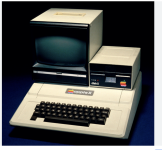
And therein lay the rub because if you wanted to move it around, you had to either unplug everything or try and scoop it all up in your arms. Then, of course, the first hard drive came out to give a lot more storage than a floppy disc. Then folk found out that a 40 character per line screen wasn’t much cop and so an 80 column card was developed and plugged in. Then someone came out with a card running CP/M. All those separate bits of kit. Bit of a dogs dinner, we thought.
So why not put it all together in a single housing? Why not have an 80 column card already installed ? Why not build the hard drive in ? Why not have a detachable keyboard ? Why not make it with some programmable keys ? Why not have a single key to toggle between 40 and 80 columns ?
And that’s what we did. We bought Apple II’s, discarded the case etc. Put in a more powerful power supply, a hard drive. I designed and developed the keyboard (running a 6502) and this was the end result
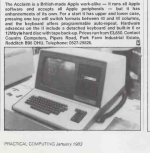
We had some issues with the keyboard. At times, it would fire up but the characters were not mapped correctly to their corresponding keys. The incorrect mapping was consistent. Thought it was power supply problems down the curly-wurly lead. Bit of a headache, TBH. Then one day I had a flash of inspiration. The 6502 could be told to operate in ‘decimal’ mode (IIRC) rather than binary. I’d assumed that being essentially a digital device, it would always default to binary. Wrong! Felt a bit of a fool, TBH, but problem solved. Then I thought to myself, wonder what Apple did in the Apple II ? The source code was always available in the manual. I looked. First line of code …Put in binary mode. Commented by ‘Get it right this time!’. Even Steve Jobs got it wrong. I didn’t feel quite so bad.
And then…….
First of all we got a snotty letter from British Leyland asking us to change the name as it conflicted with one of their cars …the Triumph Acclaim. In hindsight, a fatuous claim by them but we were naive. But the killer was the Cease-and-Desist letter from Apple. We weren’t making a bootleg version of their motherboards. We couldn’t understand it. But we stopped.
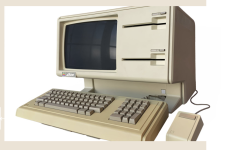
Then three months later, this was released - the Apple Lisa - and all became clear!
Cheers
Roger
It was the early '80's and long before the IBM PC came out. Remember the Apple II computer ?
And therein lay the rub because if you wanted to move it around, you had to either unplug everything or try and scoop it all up in your arms. Then, of course, the first hard drive came out to give a lot more storage than a floppy disc. Then folk found out that a 40 character per line screen wasn’t much cop and so an 80 column card was developed and plugged in. Then someone came out with a card running CP/M. All those separate bits of kit. Bit of a dogs dinner, we thought.
So why not put it all together in a single housing? Why not have an 80 column card already installed ? Why not build the hard drive in ? Why not have a detachable keyboard ? Why not make it with some programmable keys ? Why not have a single key to toggle between 40 and 80 columns ?
And that’s what we did. We bought Apple II’s, discarded the case etc. Put in a more powerful power supply, a hard drive. I designed and developed the keyboard (running a 6502) and this was the end result
We had some issues with the keyboard. At times, it would fire up but the characters were not mapped correctly to their corresponding keys. The incorrect mapping was consistent. Thought it was power supply problems down the curly-wurly lead. Bit of a headache, TBH. Then one day I had a flash of inspiration. The 6502 could be told to operate in ‘decimal’ mode (IIRC) rather than binary. I’d assumed that being essentially a digital device, it would always default to binary. Wrong! Felt a bit of a fool, TBH, but problem solved. Then I thought to myself, wonder what Apple did in the Apple II ? The source code was always available in the manual. I looked. First line of code …Put in binary mode. Commented by ‘Get it right this time!’. Even Steve Jobs got it wrong. I didn’t feel quite so bad.
And then…….
First of all we got a snotty letter from British Leyland asking us to change the name as it conflicted with one of their cars …the Triumph Acclaim. In hindsight, a fatuous claim by them but we were naive. But the killer was the Cease-and-Desist letter from Apple. We weren’t making a bootleg version of their motherboards. We couldn’t understand it. But we stopped.
Then three months later, this was released - the Apple Lisa - and all became clear!
Cheers
Roger


 I think I got 1 good burn from every 2 or 3 attempts. Interesting days.