• Hi all and welcome to TheWoodHaven2 brought into the 21st Century, kicking and screaming! We all have Alasdair to thank for the vast bulk of the heavy lifting to get us here, no more so than me because he's taken away a huge burden of responsibility from my shoulders and brought us to this new shiny home, with all your previous content (hopefully) still intact! Please peruse and feed back. There is still plenty to do, like changing the colour scheme, adding the banner graphic, tweaking the odd setting here and there so I have added a new thread in the 'Technical Issues, Bugs and Feature Requests' forum for you to add any issues you find, any missing settings or just anything you'd like to see added/removed from the feature set that Xenforo offers. We will get to everything over the coming weeks so please be patient, but add anything at all to the thread I mention above and we promise to get to them over the next few days/weeks/months. In the meantime, please enjoy!

Anti-rust paper

Steve Maskery

Old Oak
Joined
Jul 27, 2014
Messages
2,374
Reaction score
1,329
Location
87290 Laplagne, France
I used to have a wonderful workshop. Big, airy, light and above all, DRY.
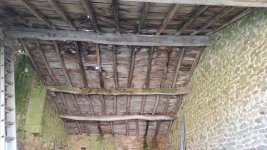
I now have a 200-year-old barn...
The roof has more holes than a pair of fish-nets.
I've been away for a couple of weeks and since then we have both been poorly, so not much has been done. I went into the barn yesterday to find my tablesaw covered in little rust spots and some smeared rust. It was't like that a month ago, but we have had some absolute deluges in that time, so I'm not surprised that some of it has found its way onto my saw.
I've cleaned the rust off as best I can, but some of it has etched the cast iron, so I can't get rid of it completely without cutting into the casting and risking losing the flatness (which is pretty good).
I have a roll of anti-rust paper (there is a proper name for it, but I've forgotten what it is), which I plan to stick to a thin board (twin-wall masking board) to cover the table. The paper has a shiny side and a matt side. Does it matter which side goes in contact with the casting?

Many thanks
Steve
 
Last edited:
When I've bought tools in the past and they've come wrapped in that paper, the shiny side has been against the tool.

Have you considered using a chemical rust converter to eat the rust that's there away? It should do it without eating into the rest of the casting and the rust should then brush away quite easily.
 
When I've bought tools in the past and they've come wrapped in that paper, the shiny side has been against the tool.
Excellent, thank you
Have you considered using a chemical rust converter to eat the rust that's there away? It should do it without eating into the rest of the casting and the rust should then brush away quite easily.
I hadn't, actually. Like Jenolite, you mean? Phosphoric acid IIRC. I've not seen anything like that for decades.

The table has come up quite well, all things considered and I've cut a piece of twin-wall board. I'll glue on the paper after dinner, but chef's hat calls.
 
Last edited:
I bought a tin of ACF50 spray a while ago, it's weird stuff but I've sprayed it on cast iron surfaces and rubbed it in and it does seem to help prevent the rust forming, though it does make wood a little dirty for a while after applying it.
 
I hadn't, actually. Like Jenolite, you mean? Phosphoric acid IIRC. I've not seen anything like that for decades.

I'm not really sure what they are. Whenever I've wanted to get rid of rust I've just used citric acid (which is cheap and easy to come by). White vinegar works too. I'm not sure whether the commercial ones are better in any way.

The table has come up quite well, all things considered and I've cut a piece of twin-wall board. I'll glue on the paper after dinner, but chef's hat calls.

Good news. I treat my bandsaw's table to a periodic wipe with "machine wax" (from Axminster). I'm sure there are cheaper options but it seemed like a sensible precaution. I also have a dehumidifier running in the workshop (humidistat controlled and with a drain pipe through the garage wall and onto a flower bed in the garden).
 
Someone gave me a tin of Briwax, I use that sparingly.
Wouldn’t use it for anything else mind.
 
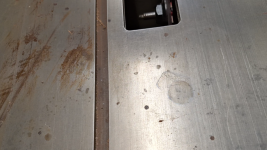
Here is a pic of what I found originally. As I say, it wasn't like that a month ago:rusty table (Medium).png

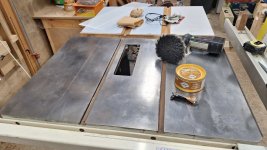
I used my ROS, then autosol then wax until it looked like this:
polished table (Medium).jpg

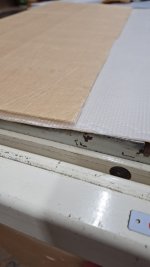
Then I stuck some of the magic paper to a piece of twinwall masking board


cover folded back (Medium).jpg

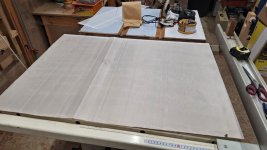
So the whole table is covered.

with cover (Medium).jpg

It does double duty really. The board is waterproof and the paper is in contact with the cast iron.

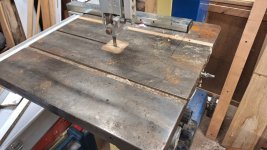
I just need to do the same with my bandsaw now:

bandsaw (Medium).jpg
 
Last edited:
Hmm, I'd never thought of that.
If you're worried about direct drips from above, have you considered making some sort of pitched "roof" for the table saw: a couple of bits of board joined at an angle in the middle (perhaps just with some tape) to make an open-ended and open-bottomed triangular prism. Any drips from above would go down the sides of the "roof" and fall to the floor. Combined with a periodic coat of wax or light oil (and/or a dehumidifier!) that would probably do a good job of keeping the cast iron safe.
 
Plenty of good advice in here so far.......but what about fixing the roof, Steve?
Next to the big barn is an open barn. The roof is in an even worse state, I wouldn't want to park my car in there (although it does house the trailer). I had a quote to replace it - £13K. The main barn is probably 10x the size....
That's a winning-the-lottery job (and I don't play the lottery).
 
Next to the big barn is an open barn. The roof is in an even worse state, I wouldn't want to park my car in there (although it does house the trailer). I had a quote to replace it - £13K. The main barn is probably 10x the size....
That's a winning-the-lottery job (and I don't play the lottery).

Next time you toddle off to France, move somewhere which isn't on the Swiss/ Italian border! If you were in the north of France a re-roof would have cost you a few days of food and accomodation, plus a bit of scaffolding. Once you organise access, rooves really are very easy for anyone without mobility issues.
 
Dr Al
How do you use your citric acid? Do you mix it to a solution or just a paste? I have a big tub of it in the kitchen cupboard.
S
I've never used it on something as big as a cast iron table top, but I've used it on various vices (including a big blacksmith's leg vice) and things of that sort of size.

The method for them was simple. Mix citric acid powder & hot water. Dunk offending items in the liquid & leave for an hour or two, preferably covered to keep the heat in for as long as possible.

Once the rust turns black, rinse off the acid, rub off the rust with a light abrasive (it comes off very easily), then oil before it goes rusty again!

I'm not sure about a table; perhaps a paste might work?
 
Next time you toddle off to France, move somewhere which isn't on the Swiss/ Italian border! If you were in the north of France a re-roof would have cost you a few days of food and accomodation, plus a bit of scaffolding. Once you organise access, rooves really are very easy for anyone without mobility issues.
It's not that Laplagne.
40 mins north of Limoges. 9 houses in total...
S
 
Well, Steve......I just clicked on the link below your name. :)

I cycled through that neck of the woods a year or three back on my way down to Spain. Anyhoo....post a photo of your roof, and let's see if there is some sort of plan possible.
 
VCI paper will help for a while but the active component is volatile. (volatile corrosion inhibitor). It works best if the metal can be wrapped in the paper and both sealed in a bag or box to keep the inhibitor from wafting away. Its corrosion protection lasts only for a couple of hours after the paper is removed from the metal since the inhibitor evaporates. Better than nothing but I think a layer of wax would be more effective.
 
Thank you all for the advice, much appreciated in an area about which I know very little.

Mike - check the postcode...
I'll try to get some photos tomorrow, but be warned, it's not pretty.
S
 
The location link just takes the text you entered and sticks it into a Google Maps search, showing you the first result. It appears that the correct location in Steve's case is actually the second result for that search, as Google thinks the town name is more important than the postcode and takes you straight to the biggest Laplagne it knows about.
 
I haven't tackled those Roman tiles personally, but they're pretty simple. The two main issues are how many can be removed successfully for re-use, and, as always, getting access. You then have a decision on whether the existing timbers are sound, or sound-enough. In this sort of secondary building, open, I'd not be so cautious as I would with a house roof. I'd try to leave the existing sarking boards alone as much as possible, just replacing the rotten ones below the obvious leaks. And I would look to leave all the rafters in place, if possible, and just "sister" any dodgy ones with a new piece of timber alongside. Again, a scaffold is going to be necessary internally if rafters need work. With the timberwork fixed up, I'd be tempted to over-board the sarking with ply or OSB, then felt and replace the tiles.
 
I haven't tackled those Roman tiles personally, but they're pretty simple. The two main issues are how many can be removed successfully for re-use, and, as always, getting access. You then have a decision on whether the existing timbers are sound, or sound-enough. In this sort of secondary building, open, I'd not be so cautious as I would with a house roof. I'd try to leave the existing sarking boards alone as much as possible, just replacing the rotten ones below the obvious leaks. And I would look to leave all the rafters in place, if possible, and just "sister" any dodgy ones with a new piece of timber alongside. Again, a scaffold is going to be necessary internally if rafters need work. With the timberwork fixed up, I'd be tempted to over-board the sarking with ply or OSB, then felt and replace the tiles.
Thank you.
That's not your workshop, though, is it?
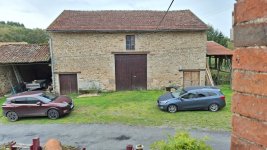
No, my workshop is the barn to the right.
 
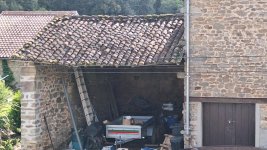
Here are pictures of my barn/workshop. The useable space is nowhere near the size of its footprint...
20241015_122922 (Medium).jpg

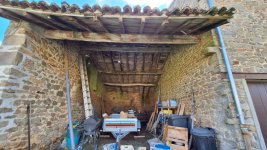
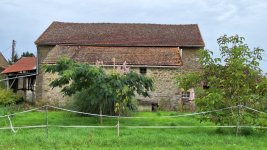
From the rear it looks like this:

20241015_123158 (Medium).jpg

The open barn is 5.2m wide and 7.8m deep.

The main barn is 13.7m long by 10m deep and the back end is another 4m deep.

The useable floor area is a LOT less than that.

I wish I could have picked p my Kirkby workshop and plonked it here. This is the crappiest house I've ever owned in the most wonderful location I've ever liven in. Can't have everything, I guess.

S
 
Why is the usable internal space so compromised Steve? Very thick walls or some other issue? From the photos the roof doesn't look bad on the main barn. Very compromised for light. Is there a mezzanine?
 
The barn is split into three sections. The two outer ones have a very low roof (I can touch it without extending my arm). Above those low rooves are mezzanine floors, good for storage, but ladder access.
The centre section has "cupboards" down the two sides, But they are not really cupboards - no floors ,no shelves, just empty space with a wonky door over the front. So they take up a considerable amount of footprint for very little storage space.
When we arrived there were just two dingy short fluorescent tubes in the man barn, I have, at least, installed some useful lighting.
 
Cupboards could be removed? If there is a mezzanine I am surprised that water is able to penetrate the tiled roof and the mezzanine floor to reach your cast iron machines.

I know this will sound odd, but a former partner of mine and his wife bought a chateau type place with barns. They had a leaky roof problem in the barns until they were repaired. As they were used for storage, the French workers hung some very large tarpaulins from the apex like sails and funnelled rainwater out into outlet pipes at gutter level. Might be worth a try as a temporary solution.
 
... the French workers hung some very large tarpaulins from the apex like sails and funnelled rainwater out into outlet pipes at gutter level. Might be worth a try as a temporary solution.
I've seen that done, but it does sound like there will be a lot of stuff in the way of that sort of solution in Steve's case.

Without knowing the inside, I wonder if building a studwork inner-room with a roof would be the best solution. This could even be the permanent solution, giving a space which is the right size to heat in the winter, and insulated so as to make that affordable.......whereas heating a huge stone barn is all but impossible.
 
Last edited:
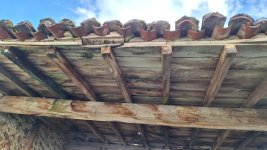
Right, well those look like orthodox pan tiles, and they look in decent nick from what you can see from photos. They are easily removable, and losses should be very low. A photo or two of the inside of the roof would be illuminating, but from what I am seeing of the outside I have hopes that fixing the roof will be towards the easier end of the scale. Pantiles are very quick and easy to re-lay.

I assume your 10m depth dimension is from the front wall top be back of the single storey outshot at the back. Is that right?
 
Last edited:
The single story outshot is the extra 4m.
Under the two side mezzanines it is drier than the centre section, but water does run down the walls when it is heavy, And I get a substantial puddle in the back bit that sticks out.
S
 
Ha! Back to my room in a room question of a few months ago, except that I don’t have a leaky roof and wanted to make it “almost” entirely from Kingspan.
In my case the question was made redundant as we will probably be moving North to Boston.
Lovely looking building Steve.
 
Back
Top