• Hi all and welcome to TheWoodHaven2 brought into the 21st Century, kicking and screaming! We all have Alasdair to thank for the vast bulk of the heavy lifting to get us here, no more so than me because he's taken away a huge burden of responsibility from my shoulders and brought us to this new shiny home, with all your previous content (hopefully) still intact! Please peruse and feed back. There is still plenty to do, like changing the colour scheme, adding the banner graphic, tweaking the odd setting here and there so I have added a new thread in the 'Technical Issues, Bugs and Feature Requests' forum for you to add any issues you find, any missing settings or just anything you'd like to see added/removed from the feature set that Xenforo offers. We will get to everything over the coming weeks so please be patient, but add anything at all to the thread I mention above and we promise to get to them over the next few days/weeks/months. In the meantime, please enjoy!

Any recommendations for a decent soldering iron?

Steve Maskery

Old Oak
Joined
Jul 27, 2014
Messages
2,372
Reaction score
1,327
Location
87290 Laplagne, France
I've never been very good at soldering. I have two irons, one a Lidaldi special, the other that looks like a ray-gun. I don't get on with either of them. Either I can't get stuff clean enough, or I can't get the tools hot enough, I don't now.
So does anyone have any recs for a decent soldering iron? I see adverts for cordless ones with a battery inside, but I have no idea if that is a good technology or not.
All experience gratefully received.
S
 
It depends on what you want to solder! Circuit boards need different irons to lumps of metal. Give us a clue Steve.
 
Good point.
I'm not into PCBs but I do often find myself needing to solder a couple of wires together, or soldering a wire to a tag of some sort.
Does that help?
S
 
I do have some "proper" old-fashioned solder, as well as some grease-type flux and some Baker's fluid (although, come to think of it, I've not seen th Baker's fluid since I moved. It may have grown legs).
I suspect that the biggest problem is my technique, or lack of it, but a bad workman always blames his tools, n'est-ce pas?
S
 
OK. This will be overkill for you. I mostly use a Weller S51 station. I never post about this on the forum but I like building point to point wired valve guitar amplifiers. I also have a Metcal (£££) and a much cheaper copy: Hakko FX951 (but there are cheaper ones like an 888 hobby iron).

If you are not doing precision work with careful heat control, a cheapish Weller is good. Avoid cheap Chinese stuff for precision work as the temps go up and down like a yo yo. For jewellery etc a lot of people use a fine torch as well and they are very useful and quite cheap if you go chinese.

Don't skimp on solder for good work. Flux cored clean solder is best for good quality work. I usually use Kester or Ersin or a 96S silver.
 
I have a Velleman ST-80D solder station which I am quite happy with.

But... if you are soldering wires wouldn't it be better to think of crimping instead of soldering?
 
I have a Velleman ST-80D solder station which I am quite happy with.

But... if you are soldering wires wouldn't it be better to think of crimping instead of soldering?
Soldering is better than crimping, you need the right tool the right crimp and wire size.
It’s easer to solder and heat shrink.

Pete
 
You've reminded me that I used to have a nice Weller. I think it grew legs :(
I do sometimes crimp, I have a selection box of them, but often it is repairing broken wires.
S
 
I used to think so too. But it seems (at least that is what I have been told by more than one professional) that nowadays crimping is preferred as the more secure and safe method. It gives more bulky connections though. And, of course, this does not go for soldering PCB and such.
 
We use Weller or Metcal temperature controlled irons. A high wattage (my current is a WTP90, 90W) pencil type is way better than a cheap 15/25W uncontrolled iron; it hots up quickly and does not lose so much temperature heating the materials to be soldered. Also don't make the mistake of going for tiny, fine tipped, slender bits - less copper to conduct heat into the work.

The iron-plated Weller bits seem to become hard to wet IME unless you take care of them - wet sponge cleaning, the brass swarf "pan scourer" for harder cases, and a little pot of the flux/solder paste tip cleaner to hand. Always coat the bit end with fresh solder when you have done.

Solder: we can't use leaded solder in commercial work. The standard 99C lead free (around 99.3% tin, 0.7 copper) is the main option, I prefer Multicore (Loctite), with one of the Crystal fluxes, 511 flows best. Lower activity fluxes like X39 are only usable for hand soldering with expert skills ! Easier still is a eutectic alloy solder - the 96.5% tin, 3.0% silver, 0.5% copper is close, and with the crystal flux is about as close lead free soldering gets to as easy as the old rosin cores 60:40 tin:lead.

Of course technique matters, I guess there are loads of videos on YT. Some might even show how to do it properly ! My approach is: make sure bit is wet with solder to give good thermal contact to the joint. Apply the iron, and first a small dab of solder wire to introduce some fresh flux. Once that starts to flow, it can be followed by adding more solder as needed. All done in < 3 seconds.

Soldering vs crimping - for stranded wires crimping is great. Good crimping terminals have 2 parts, one that crimping onto the wire, the other the insulation. Avoids the stress concentration where the solder stopped wicking up the stranded wire, and melted insulation. A good crimper is often £300 for just a single style of contact though, and the right tooling is critical.
 
OK. This will be overkill for you. I mostly use a Weller S51 station. I never post about this on the forum but I like building point to point wired valve guitar amplifiers.
Adrian, you are a man of hidden depths! That is so cool. Valve amplifiers Rule OK. Still have my Williamson
 
I've been happy with antex irons, I think mine is the XS25 I change the tips on it depending on the job, not too expensive.
 
Adrian, you are a man of hidden depths! That is so cool. Valve amplifiers Rule OK. Still have my Williamson
More obvious shallows Rog :cool:

It's a very long standing and obscure side hobby. I don't understand electronics all that well really, but I have been building amps since I was a kid. Got very focussed on both UK and US designed P2Ps and ended up making my own chassis and cabs. 47 Williamson is of course a pioneering design. I'm just a copyist. My dad had a Williamson from, I think the mid 1950s, and as far as I know it is still in my brother's store room. I've never seen it lit up. My dad told me he had a Peter Walker originated design Quad II as well apparently that my mother put into store and I have never heard. Not sure I have ever seen it in fact - I think he got that before he even met my mother and would have been long obsolete by the time I came along.

Also like old analogue recording gear and although I no longer use them much I doubt whether I will part with my Nagras or PR99. It was my dad's fault as he had an old Grundig when I was a very small kid and he taught me how to solder and so on. No expert sadly, but I do very much like the valve sound in both high quality guitar amps and hi fi.
 
If most of what you're doing is joining wires together, buy yourself a set of solder sleeves (and a heat gun if you don't already have one). This sort of thing: https://amzn.to/3XxB2eN

You push the wire in from each end and then apply heat with a normal heat gun. The heat shrink bit shrinks and squeezes the insulation, the solder ring in the middle melts and joins the wires together. Quick and very effective.

For soldering wires to tags then you'll need an iron of course, but it's not a demanding application and it doesn't sound like a frequent use so go with what's cheap and it'll probably be fine. However, the fact you say you're struggling makes me wonder if there's a more demanding use you have?

I've got two that I use regularly: a gas one which is really convenient for soldering away from power sockets (before discovering the solder sleeves I used it quite a lot on motorcycle wiring loom repairs). It seems to go through gas (filled up with cigarette lighter gas canisters) pretty fast, but works really well. It is, however, a little bulky and I wouldn't want to use it for populating PCB.

The other one I've got is an Aixun brand soldering station, which is temperature controlled and detects when you put the soldering iron into the (separate, but linked with a wire) stand and automatically cools the iron down (it heats up again very quickly when you pick it up). I bought that one after leaving a soldering iron on overnight and coming down in the morning to find it had destroyed its tip (thankfully without doing any damage to anything else). The Aixun one (bought from banggood, but not listed on their site anymore) works well. It's not a patch on the ones we use at work, but was an order of magnitude cheaper and does the job for anything I do at home.
 
I've been looking around.
I'd never heard of crimping solder sleeves. Sounds like a good idea
As regards machines, they seem to vary from 18W to over 700W. Some have a hot-air gun as part of the system.

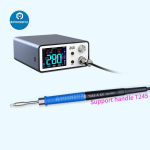
At the mo I'm leaning towards something like this (not necessarily this exact one, but that kind of station).. It's 60W. Is that enough, or would I be better going somewhat higher?

Thank you all for your input, much appreciated.
S
 
For the power, I think it depends on what you want to solder and also how long you're willing to wait for it to heat up. Mine is, apparently, 200 W, which is beneficial to me as it heats up in seconds. The other benefit of more power is you can solder bigger stuff more easily (as the iron will maintain its heat when you put it on what is essentially a heatsink). 60 W will probably be fine for basic soldering though.

The other thing to consider is the ergonomics of the handle if you expect to use it a fair amount or in awkward spots. I found my previous one quite cumbersome and my gut feel was the one at your amazon link might be a little chunky too for my preference (your preference may be different of course). This is what mine looks like (the tips are interchangeable and I've never used one that looks like the one in the picture, but it gives and idea of the shape):

1763900208395.png
 
I am used to the weller ones with a quite chunky handle, I used to use a small antex and I didn’t have any problems, I can understand that some people aren’t used to the extra girth but you soon get used to it.

Pete
 
Back
Top