• Hi all and welcome to TheWoodHaven2 brought into the 21st Century, kicking and screaming! We all have Alasdair to thank for the vast bulk of the heavy lifting to get us here, no more so than me because he's taken away a huge burden of responsibility from my shoulders and brought us to this new shiny home, with all your previous content (hopefully) still intact! Please peruse and feed back. There is still plenty to do, like changing the colour scheme, adding the banner graphic, tweaking the odd setting here and there so I have added a new thread in the 'Technical Issues, Bugs and Feature Requests' forum for you to add any issues you find, any missing settings or just anything you'd like to see added/removed from the feature set that Xenforo offers. We will get to everything over the coming weeks so please be patient, but add anything at all to the thread I mention above and we promise to get to them over the next few days/weeks/months. In the meantime, please enjoy!

Black Walnut turning saw made from kit.

SteveMP

New Shoots
Joined
Jun 18, 2026
Messages
101
Reaction score
153
Name
Steve
LOCATION
San Diego
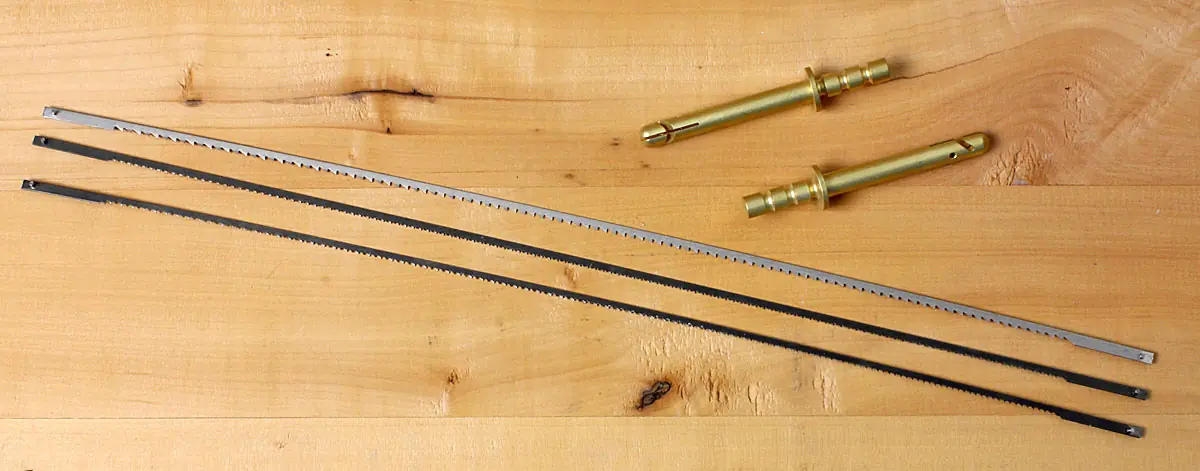
Wasn’t sure if this should go in projects or hand tools. This was the Gramercy Tools kit, got the hardware kit with the turned handles since I don’t really have a lathe. I used the plans available on their site to make all the wood bits. The tension pin was tricky without a lathe, but turned out ok, was just a TON of sanding. The other challenge was the loose mortise and tenons with curved faces. This joint has to move but not just completely fall apart when you loosen the tensioner. All the corners are faceted. And what i originally thought were merely decorative grooves near the brass pins, is actually a really handy finger groove that helps guide the saw with your index finger. Finished with my current favorite finish BeeNooba.
IMG_2058.jpeg
IMG_2059.jpegIMG_2060.jpegIMG_2061.jpeg
 
Lovely. I'd like to make a frame saw at some point (it might have to wait until I've got some space to store it in though!}
Thank you. I'll try and post my roubo frame saw at some point. I have to dig out from behind a large heavy cabinet in the garage. Its HUGE and i don't use it a ton so it stores away mostly. The way garages are built here there is a concrete footing around hte whole permiter that the walls are on top of, so there is a gap behind stuff thats on the floor, and its shoved back there with all kind of other "thin" stuff

I also have an old vintage German frame saw that works pretty well. Its much smaller than the roubo. Kind of inbetween this and hte roubo.
 
Thank you. I'll try and post my frame saw at some point. I have to dig out from behind a large heavy cabinet in the garage. Its HUGE and i don't use it a ton so it stores away mostly
I was definitely imagining something fairly small (perhaps that makes it a turning saw?} but I'm not really sure to be honest. I just thought it would be an interesting project really.
 
I was definitely imagining something fairly small (perhaps that makes it a turning saw?} but I'm not really sure to be honest. I just thought it would be an interesting project really.
Terminology doesn't seem to be super consistent. And perhaps regional. But from what i tend to hear is a smaller saw is typically called "bow saw" or "turning saw" as far as I know. Once you get to "frame saw" it tends to be in the 400mm, 600mm, 700mm range of blade. My roubo frame saw the blade alone is 4' long. But I guess technically they all have a frame, lol.

FYI, in Europe, this is basically the kit I used:
 
That's a nice looking saw. I use mine quite a bit.

My understanding of the terminology is that a frame saw has a blade in the middle and is used for ripping, sometimes with two people. I tend to call mine a bow saw......but I know zippo about these things, and will rely on one of the Andys for the real answer. This what I think of as a frame saw:

frame saw.jpg
 
I was definitely imagining something fairly small (perhaps that makes it a turning saw?} but I'm not really sure to be honest. I just thought it would be an interesting project really.
Pic for scale
The turning saw i made with an old vintage German frame saw.

image.jpg
 
Terminology doesn't seem to be super consistent. And perhaps regional. But from what i tend to hear is a smaller saw is typically called "bow saw" or "turning saw" as far as I know. Once you get to "frame saw" it tends to be in the 400mm, 600mm, 700mm range of blade. My roubo frame saw the blade alone is 4' long. But I guess technically they all have a frame, lol.

FYI, in Europe, this is basically the kit I used:

That's useful, thanks. I might have to add that to the birthday wish list!

I tend to call mine a bow saw
I don't think I ever would have thought to look that name up: I always think of these things when I hear "bow saw".
 
That's useful, thanks. I might have to add that to the birthday wish list!


I don't think I ever would have thought to look that name up: I always think of these things when I hear "bow saw".
That is also a bow saw. Thats why i said its confusing. By the way, if you have never seen this, this is what a master can do with a frame/bow saw:
 
Very nice. I used to love working with walnut, especially American Black. Your banana for scale reminds me of a particular Facebook group. 😀

Great job!
 
I do agree that the terminology, as so often is loose and not something to get hung up about.

But I'll add one thing to add to the discussion, which is to think about how to hold these saws. With the sort of small saw that Steve has just made, it's normal to have a long handle at one side and a smaller knob on the other. It's natural to hold the saw with the long handle in your dominant hand and the knob in your other, a bit like you would hold a large file. But it's not always the best way. As ever, we have variables such as the type of wood being sawn, its thickness and how it's orientated. So if your first grip doesn't feel right, try a different one.

Watching the video of Frank Klausz (who is clearly a very experienced craftsman worth watching closely) he starts off with the larger saw holding the frame above the obvious handle, which gives him better control to keep the blade vertical.

When he swaps to the other saw, he uses a two handed grip, with one hand wrapped around the other, enclosing the handle.

I suggest it's worth experimenting with both those grips, on any size of framed saw - the best one is whatever works best for you.

And here are a couple more illustrations of the two handed grip.

This is from Charles Hayward's "Tools for Woodwork" from 1946

IMG_20260804_144019636.jpg


And these are from Simon Barley's 2016 "British Saws" - I think it's from an old tool catalogue - where I think it's safe to assume that "Old Clegg" would have been quite well-informed about saw handles: :)

IMG_20260804_144527422.jpg

IMG_20260804_144535850.jpg
 
I do agree that the terminology, as so often is loose and not something to get hung up about.

But I'll add one thing to add to the discussion, which is to think about how to hold these saws. With the sort of small saw that Steve has just made, it's normal to have a long handle at one side and a smaller knob on the other. It's natural to hold the saw with the long handle in your dominant hand and the knob in your other, a bit like you would hold a large file. But it's not always the best way. As ever, we have variables such as the type of wood being sawn, its thickness and how it's orientated. So if your first grip doesn't feel right, try a different one.

Watching the video of Frank Klausz (who is clearly a very experienced craftsman worth watching closely) he starts off with the larger saw holding the frame above the obvious handle, which gives him better control to keep the blade vertical.

When he swaps to the other saw, he uses a two handed grip, with one hand wrapped around the other, enclosing the handle.

I suggest it's worth experimenting with both those grips, on any size of framed saw - the best one is whatever works best for you.

And here are a couple more illustrations of the two handed grip.

This is from Charles Hayward's "Tools for Woodwork" from 1946

View attachment 57209


And these are from Simon Barley's 2016 "British Saws" - I think it's from an old tool catalogue - where I think it's safe to assume that "Old Clegg" would have been quite well-informed about saw handles: :)

View attachment 57210

View attachment 57211
Good stuff! Thank you for sharing. Thats a beautiful saw that Old Clegg (not to be confused with Old Gregg) has there. The one i made definitely has a larger handle and a knob. I guess it also helps to tell which way the blade is since its hard to see those small teeth. Makes sense on the grip. Like I mentioned, i thought the little indents on the side were just decorative as I made them from the plans, but once i held them i realized it actually contours your finger really nicely.

By the way, for anyone that watches the Frank Klausz and does a double take at what his saw blade does when he cuts out the waste. Its a trick where you put a twist in the end of the blade. Bow/frame/coping saws you can have the handles and pins in separate planes, so one can be horizontal and the other vertical, use some pliers to twist the leading section to start the cut. This video explains it better than i can with words:
 
Last edited:
Back
Top