That's only the surface stuff.Apart from that everything is hunky-dory, eh?
S

The ex is behaving like a Chinese lower tool!

That's only the surface stuff.Apart from that everything is hunky-dory, eh?
S
Are you saying you just butt the panels and drive screws in ? Can you be more specific about these board screws.screw it together with the modern spax type board screw
So you glue the domino in the face frame and then during final fit you put the face frame on and just screw through from the side, effectively using the domino as a locating / fixing peg. This sounds like a good type of knockdown fitting that is way cheaper than either the Domino or the Lamello knock down fittings, I like the idea.a domino can be secured with a screw through the side of the cabinet


How about pre-glued iron on melamine coloured strips?I'm not a very experienced kitchen maker. I've done a couple and don't really want to do another, but something has to be done with ours, so I am still deliberating.
But I have had lay-on doors and I have had face-frame doors (currently the latter). From a romantic face-frame point of view, face-frames win hands down. But having had both, I would never go face-frame again. It's lay-on every time.
It does mean that I have to decide what to do about the front edges of every carcase panel, and that is not a trivial matter, as MFC is not easy to paint, so I have to find a good solution to that. I don't want to see coloured doors on a white carcase. OTOH I want to see white when I open the door. It's hard enough to find stuf as it is, without having to do it in the gloom.
BTW, I like the Le Mans magic corner fitings that Malc showed earlier. I had something similar in my last kitchen and they were very good. But the Le Mans has a load rating of 25kg *2 while mine were something like 10+15.kg. Far too easy to overload, which they do not like. It's not the metalwork that yields, it's the various bits of plastic that hold it all together. Not all Magic Corners are created equal.
S

Absolutely. I modified our kitchen a few years back. I kept the carcases but ditched the cupboard layout beneath the worktops and replaced with drawers, simply constructed from ply and MDF and supported on Blum runners. For people of advancing age, like me and my wife, bending down to rummage in the back of low cupboards became increasingly tiresome, though I still found it tiresome even when I was able to bend down.Drawers below work surface beat cupboards every time. Blum heavy duty runners. Wide and deep drawers are very flexible.

Yes indeed - if you can find the colour you want. Not as easy as you might think.How about pre-glued iron on melamine coloured strips?
Just take the challenge head on, you will avoid any stress due to 3rd party involvement and can adapt and alter at will without being restricted to standard anything.but something has to be done with ours, so I am still deliberating.

Yes butt the panels and screw with this type of screw. https://www.heco-schrauben.com/Products/Screws-accessories/Wood-screwsAre you saying you just butt the panels and drive screws in ? Can you be more specific about these board screws.
So you glue the domino in the face frame and then during final fit you put the face frame on and just screw through from the side, effectively using the domino as a locating / fixing peg. This sounds like a good type of knockdown fitting that is way cheaper than either the Domino or the Lamello knock down fittings, I like the idea.
Looking at @Mike G 's thread on his kitchen it is a great example of what can be done once you get the idea of the modern kitchen out of your head, ie not just boxes proping each other up but more like furniture built as solid units with good wood and not laminated weetabix.
Your assembly must be stronger because the sides are sitting on the bottom panel so any weight from shelves etc is transfered directly into that panel and not via any screws. I have used the Heco screws but in the very heavy duty range including the Combi Connect so a good brand.Yes butt the panels and screw with this type of screw
How about 15mm rod with 15/35 taper bearing X2 clamped by two pieces of plywood drilled half depth.I'm not a very experienced kitchen maker. I've done a couple and don't really want to do another, but something has to be done with ours, so I am still deliberating.
But I have had lay-on doors and I have had face-frame doors (currently the latter). From a romantic face-frame point of view, face-frames win hands down. But having had both, I would never go face-frame again. It's lay-on every time.
It does mean that I have to decide what to do about the front edges of every carcase panel, and that is not a trivial matter, as MFC is not easy to paint, so I have to find a good solution to that. I don't want to see coloured doors on a white carcase. OTOH I want to see white when I open the door. It's hard enough to find stuf as it is, without having to do it in the gloom.
BTW, I like the Le Mans magic corner fitings that Malc showed earlier. I had something similar in my last kitchen and they were very good. But the Le Mans has a load rating of 25kg *2 while mine were something like 10+15.kg. Far too easy to overload, which they do not like. It's not the metalwork that yields, it's the various bits of plastic that hold it all together. Not all Magic Corners are created equal.
S
I really wish I understood what you mean!How about 15mm rod with 15/35 taper bearing X2 clamped by two pieces of plywood drilled half depth.
Spacer between each set of bearings if two rotating shelves are required.
Bearing cost £16 rod £10.

I really wish I understood what you mean!
Do you have a drawing? A picture paints...etc.
S
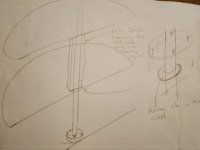
Do you have a link please?Bearing cost £16 rod £10.
Do you have a link please?
S

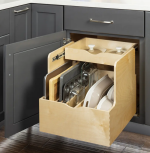
Nice Spectric, did you make them, the rollouts or the cabinets?Looks like a lot of wasted space, a semicircle in a rectangle ! To maximise available space I would use pull outs so you can use every inch of cabinet space and that includes the back of the cabinet where often so many unused gadgets lurk.
View attachment 34777
or even drawers in drawers
View attachment 34778
I was taking about a corner solution....Looks like a lot of wasted space, a semicircle in a rectangle ! To maximise available space I would use pull outs so you can use every inch of cabinet space and that includes the back of the cabinet where often so many unused gadgets lurk.
View attachment 34777
or even drawers in drawers
View attachment 34778
No I cannot take the credit for these but as I am looking to do a kitchen once my other project is done then I started my research. Having worked in engineering for decades I started with a clean sheet of paper and was not looking to re-invent the wheel, the first part was cleansing the brain of any pre conceptions of what most kitchens end up like if brought through the normal outlets, the good old euro 32 process. Why we have these cupboards where to get to the back contents you end up on your hands and knee's is just bad design, rather than getting too the items it has to be much better to bring the items to you.Nice Spectric, did you make them, the rollouts or the cabinets?


 www.kesseboehmer.com
I used two of these in our new kitchen, and 12 years after they were fitted they still function "as new". We appreciate the easy corner access and smoothness of operation long after we forgot what they cost! You need to make sure that what you store makes best use of the space available, and if you do I don't think there is much space wasted.Having worked with pretty much ever magic corner set up my go to when designing a kitchen is the Le Mans corner
LeMans kitchen corner unit solution from Kesseböhmer
The LeMans from Kesseböhmer is distinctive in its form and functionality. With its organically shaped shelves, it increases the storage area by up to 70%.
No, they look fine on a faceframe.Do drawers look funny in face frame kitchens?

The Blum templates are expensive, but if you are using their runners the template is pretty much essential if you want to get professional alignment.


I prefer the lazy susan setup in a cabinet that can take it, but if your layout dictates the other type of corner unit then you're stuck with the other options.
Nothing beats common sense and careful planing ! Why create a problem and then spend time fixing it.however if you are designing the layout from the start and building the cabinets to match you can usually avoid the blind corner.

