• Hi all and welcome to TheWoodHaven2 brought into the 21st Century, kicking and screaming! We all have Alasdair to thank for the vast bulk of the heavy lifting to get us here, no more so than me because he's taken away a huge burden of responsibility from my shoulders and brought us to this new shiny home, with all your previous content (hopefully) still intact! Please peruse and feed back. There is still plenty to do, like changing the colour scheme, adding the banner graphic, tweaking the odd setting here and there so I have added a new thread in the 'Technical Issues, Bugs and Feature Requests' forum for you to add any issues you find, any missing settings or just anything you'd like to see added/removed from the feature set that Xenforo offers. We will get to everything over the coming weeks so please be patient, but add anything at all to the thread I mention above and we promise to get to them over the next few days/weeks/months. In the meantime, please enjoy!

Choice of Router for High Accuracy Deep Plunge Cutting?

vaj

New Shoots
Joined
Jun 27, 2024
Messages
70
Reaction score
36
Name
ian
LOCATION
Ireland
Hi all. This is my first post in quite a few years - I've just re-registered.
A disappointing experience with a lightly used Bosch GMF 1400 CE in plunge mode has triggered the search for a replacement.
This post is in the hope that some with relevant deep plunge precision/finish sensitive slot/mortice etc cutting experience can offer some insight into how some of the various router brands are likely to perform in this situation.
Many are no doubt made down to a price but are not expected to perform to this level of accuracy..
The Festool 1400 sounds promising and is a possibility - but it's very expensive.
Is there perhaps is a more mainstream brand that offers the required accuracy when plunging at more moderate cost?
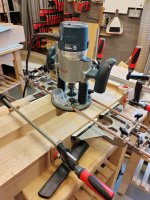
The Bosch previously did OK on undemanding bearing and bush guided profiling cuts etc, but it turned out when cutting a couple in 39mm deep x 45mm wide x 496mm long slots in beech that it doesn't control cutter alignment very well.
The passes were roughly 5mm deep (one stop at a time) full width of a 19mm dia x 50mm long new Trend cutter.
I've seen this cut done the same way without problems with a Festool 1400...
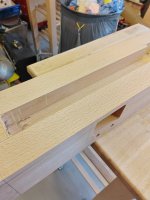
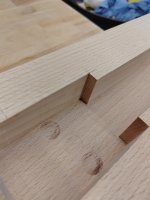
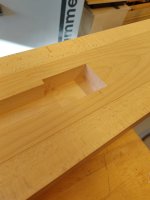
The result was unsightly divots out of the side of the slot and circular depressions at the plunge points. Also some small variations in depth of cut between adjacent passes - taken out using a hand router plane.
Stripping and measuring the plunge body revealed a number of likely causes of the problems - it's not a highly engineered device.
The twin fence set up by the way was done up as tight on both sides of the (wide) work and was not deflecting. The router was pushed from this level when cutting so that it was not accidentally tipped...

Thanks
 
I have a Triton TRA 001 set up in my router table. I quite like it.
 
I would love to fully back up Mike's hand-tool-only mantra, but arthritis etc makes grasping for sustained workouts diffiult and frustrating for me. Amazingly, I bought a nice big half-inch Makita RP 2301 FC router just before my left thumb ossified and even more amazingly (when you consider white finger et al) it exhibits almost no vibration - guaranteed to set off the tingles and aches! That, and the gravitas of this machine, make it a pleasure to use.

It's got some very slinky bearings for the plunge**, a wide base, runs smoothly and relatively quietly, and its overall ergonomics are 3000% better than the DeWalt 625e that I upgraded from.

**One 'professional' user, Doug I think, suspected his had a teeny weeny bit of "wobble" on those bearings, but he and I could not find it appearing as deleterious marks on a finished run. I wondered - after we briefly corresponded - if it was the "play" allowed in said bearings. I can't detect it on mine.

At one point I had 6 routers. :oops: I now have three; two immaculate and everyday workhorses, two Perles copies of the classic Elu96e and the Makita. This has been, without a doubt, the most pleasant and efficient one to use of them all. I still love the Perles', but their funky wee tightening knobs can be a pain.
I have never used a Cesspool, nor, at those prices, do I want to be a purple and green afficionado. They may well be superb; those who earn their daily bread by them may castigate me, but I am dead chuffed with my Maki.
 
If it does your job Rob, go for it. I am not such a Philistine as to castigate different tastes or pockets, just sayin' what works for me.
I hope Wiltshire is not too baked in this heat.
Sam
 
If it does your job Rob, go for it. I am not such a Philistine as to castigate different tastes or pockets, just sayin' what works for me.
I hope Wiltshire is not too baked in this heat.
Sam
Cooler here today Sam, so a little more pleasanter than the middle of the week. I've used a few respectable routers inc the Elu shown above (which is a damned fine machine) but in my very 'umble opinion, the OF1400 tops them all, the only downside is that you need to be able to use it with one leg and one arm 'cos you've used the other appendages to buy one😂 - Rob
 
Ta for the input guys.
I guess the $1m question is whether mainstream plunge routers such as those in your pic Pete will do the job, or whether it's necessary to get a mortgage for a Festool.
Do you happen to know whether or not they have proper bronze bushes on both posts, and if so whether or not they are to tight tolerances?
The GMF 1400 Bosch in the case of my (only lightly used) example definitely doesn't cut it on this sort of work due to sizeable slop in the guide post bushing. (only one post has a bushing) The second post runs in/ is located by only a rubber O ring in the plunge housing. There is also slop in the motor top bearing. The plunge housing is rather lightly built.
It's not with it's exchangeable fixed and plunge bases however a dedicated plunge router - perhaps it's to a lower spec than those in the pic?
My project as it happens is a bench build in beech. I've attached some pics on the introductions page. Also a few more here showing the slot that has resulted in the bother with the Bosch router. The white marks are filler in the gouges it took out of the side of the slot while plunging.
Some of the pics were taken after chiselling out the corners and cleaning up the bottom of the slot using a router plane..
You were very brave heading off into a bench project using hand tools Mike - I looked at your thread. The bench looks very nice - a hybrid between the more traditional English and the heftier Roubo types.
Mine is lightly modified version of the Benchcrafted split top Roubo.
There's quite a bit of hand work involved even using machines where possible - fitting the mortices and tenons, squaring the corners of the slots etc. I'd love to do it all by hand (it's very therapeutic taken at the right pace and it gives great control) but just wouldn't have the energy to put in the time it would take.
Manhandling 4m x300mm wide x 55mm thick rough sawn beech boards to break them down and plane them up was even using machines for me quite a workout. The sheer size of this task (even keeping track of all of the pieces and their LH/RH/ top/bottoms while keeping an eye on grain patterns and directions is quite an undertaking) plus lamination of the boards and the potential to screw up at this stage is actually the great unspoken in bench building.
Getting on to the actual joinery etc feels like recreation in comparison. (except when your router lets you down)

Keep the feedback coming...
 

Attachments

  • IMG_20240618_152213.jpg
    IMG_20240618_152213.jpg
    244.3 KB · Views: 8
  • IMG_20240619_174903.jpg
    IMG_20240619_174903.jpg
    176.6 KB · Views: 7
  • IMG_20240619_212907.jpg
    IMG_20240619_212907.jpg
    137 KB · Views: 7
  • IMG_20240620_183100.jpg
    IMG_20240620_183100.jpg
    141 KB · Views: 8
Last edited:
Ta Pete. It's probably unsurprising that the Japanese product is well built.
If we can zero in on a few brands of the required quality I can set up a trip to check them out.
Price aside (it may be that that's what it costs to get a precision tool in todays markets) I'm a put off by the seeming attempts of Festool on their various websites to discourage DIY repairs and bounce customers into putting everything through their no doubt expensive service operations.
I can't in trying to assess how the thing is built even raise a proper parts list for their 1400, only a small scale drawing. I'm not even sure from the websites whether or not it's possible to buy parts...
 
I have the Hitachi 3hp. Great for roughish work in Green oak. And the Big Elu. And a Trend 11 in a router table (hate it).

None of these are as repeatably dead on accurate as the Festool 1400. I currently have one lent to me and it is head and shoulders better as I dont get the annoying small plunge depth difference and the chip clearance (which is a big accuracy factor I think) is massively better than the others (Festool big vac).

The other aspect is bit quality. Mike G suggested Wealdon bits a few years ago as they are just down the road from me and I was not getting on at all well with Trend bits. Buy good bits - makes a considerable difference. I think full depth cutting with long bits is potentially dangerous as there is a lot of stress on the shaft and cutting edges, so I wear safety glasses and a face shield, as eyes are expensive even by Festool standards.
 
Will the minor transgression of the bearings be seen in the finished article? If the answer is "no" then I would not entertain either a mortgage or the loss of appendages route.
Even if they are seen, for future projects I would learn from the experience and plunge cut narrower on each side (say 1mm) and then finish by shaving off that 1mm either with a full depth cut with the router or a trusty wide chisel.
 
Hi AJB.
That's the sort of direct comparison information that's puts the situation in perspective. Thank you.
I suspect that poor chip clearance and cutting on the end of a two sided router cutter are at least a part cause of the dimples seen at the bottom of a plunge. That in retrospect it makes sense to go close to the final depth before making a final very light finish cut.
The bit in this case was Trend professional bought locally - all that was available. I used to buy everything from Wealden but Brexit and attendant customs delays importing to Ireland have made that a high risk undertaking.
I wasn't by the way cutting full depth - I worked down using the plunge stops on the router one by one - in increments of perhaps 4 - 5mm per pass.
 
Last edited:
Have you considered second hand? I only have one Festool machine that I could justify its cost, and I bought it at a significant discount. All the other Festool machines, systainers and trolley I have bought second hand through Facebook marketplace.

And as you say in your post above, a final pass after several shallower passes is how CNC machines make the milled edge smooth. That's how I program mine.
 
Thanks P.
The marks are deeply irritating but not functional in this case.
A light final cut would probably have improved the situation by reducing cutting forces and lateral movement consequent to deflection of the O ring locating the second post (yes, really!!) but I suspect it probably wouldn't prevent the thing flopping about while plunging as a consequence of the clearance in the guide bush the other post runs in.
A fixed base router would avoid this issue, but is not easily used in this situation.
As previously I'd seen a similar cut made using my method trouble free with a 1400 Festool and in my innocence thought that the Bosch would perform similarly...
 
Used is very likely an option for Festool Malc.
Our market however is rather small - it'd be a matter of waiting for a lightly used one to come up...
 
Just to ring the Makita bell one more time, the under-table height adjustment is SO easy with this model, they even provide a screw that you can modify or incorporate to allow above-table adjustment.
 
Hear you on Makita Sam - will definitely take a look although the requirement is probably for a mid size router for hand use.
That said a look on the local selling sites at lunchtime today brought up what looks like a little used Festool 2200 at about 60% of the new price.
It looks like a bit of a brute for hand use however and seemingly (over here at least) is sold with very little by way of accessories. (unless somebody knows different)
 
Ian, I went through a router discovery period a little over seven years ago, starting with the Bosch GOF 1600CE (with both bases) and ending with the Festool line. Somewhere in the middle was the Triton TRA001 (superseded by the TRA002) and a few other forgotten manufacturers. With one exception, I am happy with the Festool routers.

The plunge version of the Bosch had a bit of wobble, as if the bushings riding on the vertical rods were slightly too big for the rods. Once plunged and locked, the Bosch was great. Unfortunately, the chip and dust collection was horrible so it was forever a garage or outside tool. This wasn't too much of a problem as long as my shop plans included the garage. When the shop location changed to the basement, the Bosch had to go.

I never used the Triton, since I bought it for a router table and changed my mind during the shop build. I sold it to a woodworker in the Netherlands and bought the AUKTools MK2 motor for my router table. I can't remember what I did with the other forgotten brands, but they went to new homes.

I now have the Festool MFK700, OF1010, OF1400, and OF2200. The OF1400 and OF2200 are great routers, with one significant exception. The failure in both of these is the guide bushing adapter plates. The adapter plates snap into the base of each router and the alignment is fixed. There is no adjustment possible if the center of the bushing is not centered over the arbor. Also, the adapter plates move slightly in the base, which is not good for a guide bushing. This is well documented in the Festool Owners Group, and the OF1010 does not suffer from this design flaw. If you anticipate using the router with guide bushings, you might not be happy with the results if repeatability is a factor...unless you determine the amount of movement and factor this in with your measurements.

A member on the FOG developed a new base plate for the OF1400 using 9mm Lexan that replaces the existing 3mm phenolic plate. His design, which he released to the public, accepts the Porter Cable style of two-piece guide bushings and allows for alignment using an centering cone in the arbor. The extra thickness is required to provide relief cuts for the attachment screws, guide bushing components, and router base protrusion. I have the SVG file for the plate, but have not made one yet.
 
Hi Mike. Your description of your experience with the Bosch GOF 1600 CE when plunging seems to mirror mine with the GMF 1400 CE - moving about on the guide posts until the plunge is locked.
My dust collection is also marginal. I didn't mention it as I figured that the problem was possibly a consequence of the moderate suction on a (surprise!) Bosch vacuum.
It's always nice to have somebody corroborate your experience - I was given the 'experts' all over the web pushing the product starting to wonder whether or not I might have ended up with a bum example of the tool.
Thanks for the tip off regarding the potential inaccuracy of the guide bush set up on the larger Festool routers - I have a Domino and one of the original track saws but am a relative stranger to Festoolology. That said I found and also asked this same question on the Festool Owner's group.
I did notice from videos that they seemed to rely on the accuracy of pressed metal parts to locate bushes which is living dangerously - but had presumed that they had found a way to make it work.
I'm not sure yet if I'll go for a Festool router, but could you possibly say where the drawing for the Lexan baseplate can be had from? It happens that I have a set of Porter Cable router bushes of the type you mention - bought to use in the variant of the Incra router table plate magnetic insert designed to take them.
What's your/the Festool cognoscenti's view on the handling of the 2200 router for hand use? I'm tending towards the 1400 but there's as above a lightly used one for sale locally. Given its size and weight it seems possible that it could be a bit of a hefty/unstable brute to balance on narrower work when cutting slots or mortises?
 
Last edited:
Here is the link to the SVG file on the Shaper Hub website:


He used his Shaper Origin to make the base plate, so he uploaded the file to the Shaper site. There are two versions. One is for a round base plate the same diameter as the original. The second has an extended side for use on the Leigh dovetail jig.

Here is the thread on the FOG where this was discussed:


The OF2200 is a large router, but I don't think it was any more ominous than the Triton. The first time I used it was to help my brother-in-law cut deep mortises in 150x150mm oak timbers. I made a sled for it, similar to the Lexan sled Festool sells, using 12mm MDF. I can't remember the diameter or length of the cutter he bought, but it had a 12mm shank and was not large enough to cut the full width of the slot in one pass. Using the home made sled made the process a bit easier and repeatable, but it required several passes to cut the mortises.

I would not hesitate to use the OF2200 on thinner stock as long as the router was attached to a similar sled for stability.
 
Thank you for the links Mike - I'll put the drawing on file pending a decision on which router to go for.
The FOG group (unlike one or two other brand specific forums that have been around) seem pretty factual and open in what they report.
I don't have CNC but do run a round column Taiwanese mill drill and think the Lexan base can probably be made using it.
It seems remarkable that Festool didn't long ago resolve the guide bush location issue - although delaying admissions and fixes is a trait not unknown among German manufacturers.
I notice that the Bosch guide bush system also took some criticism in the FOG thread.
I've done a few light guide bush jobs with the GMF 1400 (fine finishing of previously milled large but shallow mortices to size using a template and experienced no problems - helped in light of subsequent experience by the fact that the cutter was small, the cut very light (<1mm) and the plunge locked. The nature of the job demanded this, it unknowingly avoided the later problems described in this thread which emerged when plunging with a larger cutter.
I was wary of the pressed metal design and found that the tubular part of one or two of the larger sized bushes was not accurately circular, but the smaller size I used was properly round and fitted tightly into the quick release holder in the base.
Centring using the supplied mandrel was feasible but took a bit of care - the short taper of the mandrel and the general layout made if difficult to be sure that the taper was properly seated.
It might be OK especially if re-fitted in the same orientation but I'd be cautious about removing and replacing the bushing without re-checking the centring.
 
Last edited:
My router is used in the router table. I did use it many years ago free hand for a specific project.


First one a Ryobi, which is still used.

There was also a Makita 3602 which I killed (it was about 5th hand).


Then very recently bought a Makita RP0900. It is supposed to have bearings and not bushes.

My only gripe is the setting of the bit height.


Will do a thread on the router and table.
 
Here is the link to the SVG file on the Shaper Hub website:
Mike, thanks for the link. As the owner of a Festool OF1400 I have forgotten how much it cost, but remember how nice it is to use as it isn’t a screaming dust monster.

I am wondering whether I might be able to convert the file so I can print one out as that would be useful.
 
Back
Top