The mid size moxon vise hardware kit that I want has been out of stock for a long time. So I started looking at the individual parts. It uses 1/2"-13 threaded rod, nuts and cast iron wingnuts. From some of the local supply houses I can buy aluminum threaded rod not much more than the steel versions. This would save a bit of weight on my travel toolchest. But not sure if it would hold up for a light duty moxon vise that will be on the travel tool chest, mainly used for cutting dovetails. The "tensile strength" of the steel is 120,000 psi and the aluminum is 40,000 psi

-
Hi all and welcome to TheWoodHaven2 brought into the 21st Century, kicking and screaming! We all have Alasdair to thank for the vast bulk of the heavy lifting to get us here, no more so than me because he's taken away a huge burden of responsibility from my shoulders and brought us to this new shiny home, with all your previous content (hopefully) still intact! Please peruse and feed back. There is still plenty to do, like changing the colour scheme, adding the banner graphic, tweaking the odd setting here and there so I have added a new thread in the 'Technical Issues, Bugs and Feature Requests' forum for you to add any issues you find, any missing settings or just anything you'd like to see added/removed from the feature set that Xenforo offers. We will get to everything over the coming weeks so please be patient, but add anything at all to the thread I mention above and we promise to get to them over the next few days/weeks/months. In the meantime, please enjoy!
You are using an out of date browser. It may not display this or other websites correctly.
You should upgrade or use an alternative browser.
You should upgrade or use an alternative browser.
Do you think aluminum threaded rod and bolts good enough for light duty moxon style vise?
- Thread starter SteveMP
- Start date


Steve Maskery
Old Oak
Don't even think about it. Move away from the aluminium, nothing to see here.
S
S
slimshady
Seedling
Could you use Aluminium handwheel / wingnut with a stainless thread insert to take the wear.
Alex.
Alex.

Dr.Al
Old Oak
Just to further what others have said, I'd seriously think twice about aluminium threaded hardware. Ignore weight & strength for a moment & you'll find the aluminium much more likely to bind up ("gall") or distort & cause all manner of issues. The galling is what would concern me most.
If we think about weight again I think you'd be surprised how little you'll actually save. Sure, steel has a density of (from memory) about 7900 kg/m³ whereas aluminium is 2700 kg/m³, so aluminium is much lighter. However, as you've seen the tensile strength is much lower.
Depending on the grade of aluminium & the grade of steel, a steel screw may be slightly lighter than an aluminium screw with the same strength just because the steel screw can be much smaller diameter.
It's been far too long a day to do the maths rigorously (and I'm an electronics engineer, not a mechanical one) but back-of-the-envelope maths would put an M10 steel grade 10.9 screw similar in weight to a 6061 aluminium M16 screw but the smaller steel one will be stronger & the steel one won't have the galling issues you get with aluminium. Admittedly 6061 is a pretty weak grade of aluminium but hopefully it gets the point across.
A Moxon vice doesn't need a lot of strength so I'd advise saving the weight by dropping the size of the screw rather than changing the material.
The vice on my travel toolchest has M6 screws & I've never felt they lack the required strength for clamping box sides. I would definitely encourage you to go bigger than M6, but think about what you'll clamp & hence what strength you need. If your vice looks like mine you can always add some extra clamping force with an F-clamp or two tucked through the back rails.
If we think about weight again I think you'd be surprised how little you'll actually save. Sure, steel has a density of (from memory) about 7900 kg/m³ whereas aluminium is 2700 kg/m³, so aluminium is much lighter. However, as you've seen the tensile strength is much lower.
Depending on the grade of aluminium & the grade of steel, a steel screw may be slightly lighter than an aluminium screw with the same strength just because the steel screw can be much smaller diameter.
It's been far too long a day to do the maths rigorously (and I'm an electronics engineer, not a mechanical one) but back-of-the-envelope maths would put an M10 steel grade 10.9 screw similar in weight to a 6061 aluminium M16 screw but the smaller steel one will be stronger & the steel one won't have the galling issues you get with aluminium. Admittedly 6061 is a pretty weak grade of aluminium but hopefully it gets the point across.
A Moxon vice doesn't need a lot of strength so I'd advise saving the weight by dropping the size of the screw rather than changing the material.
The vice on my travel toolchest has M6 screws & I've never felt they lack the required strength for clamping box sides. I would definitely encourage you to go bigger than M6, but think about what you'll clamp & hence what strength you need. If your vice looks like mine you can always add some extra clamping force with an F-clamp or two tucked through the back rails.
Last edited:
OK thank all, I'll stick with steel. Next question is what type of steel. I see black oxide, plain, zinc plated, zinc yellow, stainless steel, black oxide stainless steel, etc. FWIW, the thumbscrews are cast iron with black oxide coating I believe.
Dr.Al
Old Oak
Stainless will be much weaker than any decent non-stainless (although I used stainless M6 screws on mine & they're fine).
It would be better if the grade were listed to be sure.
Don't get plain unless you want to weld something to it: they'll rust in no time.
Black oxide gives some protection but you'll find they tend to be oily for extra rust proofing & that might rub onto your wood if you're not careful. The big advantage of black oxide is they'll be available in all the strong steel grades.
Zinc plated is a good option for corrosion resistance (without the oiliness issue) but you may find they've picked a weaker grade of steel. I've no idea about "zinc yellow".
With strength vs weight being a key consideration I think I'd lean towards zinc plated steel just to save the hassle of oily screws. If (like me) you don't think strength is that critical then stainless is a nice option but probably pricier.
Oh, if you're going to weld anything to it, steer well clear of zinc & go for plain or perhaps black oxide (or stainless if you've got the kit to weld it).
It would be better if the grade were listed to be sure.
Don't get plain unless you want to weld something to it: they'll rust in no time.
Black oxide gives some protection but you'll find they tend to be oily for extra rust proofing & that might rub onto your wood if you're not careful. The big advantage of black oxide is they'll be available in all the strong steel grades.
Zinc plated is a good option for corrosion resistance (without the oiliness issue) but you may find they've picked a weaker grade of steel. I've no idea about "zinc yellow".
With strength vs weight being a key consideration I think I'd lean towards zinc plated steel just to save the hassle of oily screws. If (like me) you don't think strength is that critical then stainless is a nice option but probably pricier.
Oh, if you're going to weld anything to it, steer well clear of zinc & go for plain or perhaps black oxide (or stainless if you've got the kit to weld it).
Cabinetman
Sequoia
- Joined
- Oct 11, 2020
- Messages
- 5,828
- Reaction score
- 1,469
- Location
- Lincolnshire Wolds + Massachusetts
- Name
- Ian
Whichever, but perhaps use a little ingenuity and you can switch it round so you don’t have the threaded bars sticking out of the front, much nicer to use.
Ian
Ian

Not just wanting to be contrarian, but surely Mr Moxon (and Monsieur Felibien, whose pictures he nicked) would have used wood?
Stick to something dense and strong like beech, birch or walnut and you'll have an excellent strength to weight ratio.
Stick to something dense and strong like beech, birch or walnut and you'll have an excellent strength to weight ratio.
Eric the Viking
Nordic Pine
- Joined
- Dec 10, 2020
- Messages
- 933
- Reaction score
- 376
Brass?
Dr.Al
Old Oak
Agreed, wood would be a good choice if you can cope with a reasonably big diameter in the design.Not just wanting to be contrarian, but surely Mr Moxon (and Monsieur Felibien, whose pictures he nicked) would have used wood?
Stick to something dense and strong like beech, birch or walnut and you'll have an excellent strength to weight ratio.
Brass is heavier than steel & weaker than steel so not a good option if weight & strength are priorities.Brass?
Yeah exactly. The one i want is this one but its been out of stock for weeks. I called and they said they have the parts in the warehouse but haven’t made up thr kits yet. Has little brackets that hold the nuts inside and you loctite the thumbscrews on.Whichever, but perhaps use a little ingenuity and you can switch it round so you don’t have the threaded bars sticking out of the front, much nicer to use.
Ian
Wood instead of metal for threaded rods...? Have I missed part of the conversation here...?Not just wanting to be contrarian, but surely Mr Moxon (and Monsieur Felibien, whose pictures he nicked) would have used wood?
Stick to something dense and strong like beech, birch or walnut and you'll have an excellent strength to weight ratio.
Dr.Al
Old Oak
It's for a vice, so something like this (except with two screws as it's a Moxon):Wood instead of metal for threaded rods...? Have I missed part of the conversation here...?
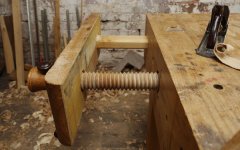
Is that Richard Maguire's shop? And if it is, thats kind of sad that I can recognize it from this picture. I can make 1 1/4" wooden screws, but that would take up almost all the room in my top drawer area.It's for a vice, so something like this (except with two screws as it's a Moxon):
View attachment 57557
I could do that, but I am only setup to make 1 1/4" threaded rods. That would take up quite a bit more room in the top section of my travel chest than the 1/2" metal rod.Not just wanting to be contrarian, but surely Mr Moxon (and Monsieur Felibien, whose pictures he nicked) would have used wood?
Stick to something dense and strong like beech, birch or walnut and you'll have an excellent strength to weight ratio.
Sounds like a perfect excuse for a new tool!I could do that, but I am only setup to make 1 1/4" threaded rods. That would take up quite a bit more room in the top section of my travel chest than the 1/2" metal rod.
If you don't want to find an old one (which may have subtle defects or not be a matched pair of box (die) and tap, there seems to be a single Chinese make, available worldwide under a variety of names, making sets in something similar to maple, with plenty of glossy varnish. They probably run from half inch up to an inch and a half.
I have one, 3/4" size, and it's a pretty decent tool, just right for anyone who feels like making their own traditional pattern tools, clamps and assorted nick-nacks.
One advantage over the threaded metal rod option is that they are much coarser, 6 tpi, so are quick and easy to use. 3/4" would be plenty strong enough for what you are making.
I suppose i could buy the 3/4” jig for mine. I have this one:Sounds like a perfect excuse for a new tool!
If you don't want to find an old one (which may have subtle defects or not be a matched pair of box (die) and tap, there seems to be a single Chinese make, available worldwide under a variety of names, making sets in something similar to maple, with plenty of glossy varnish. They probably run from half inch up to an inch and a half.
I have one, 3/4" size, and it's a pretty decent tool, just right for anyone who feels like making their own traditional pattern tools, clamps and assorted nick-nacks.
One advantage over the threaded metal rod option is that they are much coarser, 6 tpi, so are quick and easy to use. 3/4" would be plenty strong enough for what you are making.
Beall 1 1/4" Wood Threader Kit - Lee Valley Tools
 www.leevalley.com

Trevanion
Old Oak
I've no idea about "zinc yellow".
That'll be passivated in regular terms.
Personally, I would use bare steel or self-colour black oxide steel, coated steels aren't great for applications where the screw will be in constant use, as with a vice because the coating can wear off in time or even peel off and get stuck in the nut. Coated steels are good where you need a fastener that you install once and leave it exposed to the elements, but it's not necessary for something that will predominantly be indoors.
I would personally use an Acme thread instead of a regular UNC thread, as it's more suitable for pressure loads and generally stronger. I believe it's also pretty available in the U.S.
duke
Old Oak
I have seen some use an adjustable scaffold leg. Modified for the purpose.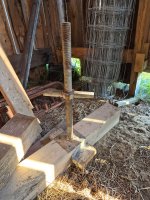
I've just remembered that Andy B found it easy to source trapezoidal threaded components, sold for 3D printer style projects, on his table saw repair jobI would personally use an Acme thread instead of a regular UNC thread, as it's more suitable for pressure loads and generally stronger. I believe it's also pretty available in the U.S
Thread 'Kity 619 table saw rise and fall repair' https://www.thewoodhaven2.co.uk/threads/kity-619-table-saw-rise-and-fall-repair.11484/
Dr.Al
Old Oak
That's a very good point about plating wear. Agreed that it's probably best to go unplated.That'll be passivated in regular terms.
Personally, I would use bare steel or self-colour black oxide steel, coated steels aren't great for applications where the screw will be in constant use, as with a vice because the coating can wear off in time or even peel off and get stuck in the nut. Coated steels are good where you need a fastener that you install once and leave it exposed to the elements, but it's not necessary for something that will predominantly be indoors.
I would personally use an Acme thread instead of a regular UNC thread, as it's more suitable for pressure loads and generally stronger. I believe it's also pretty available in the U.S.
Acme or trapezoidal threads are better if the vice is going to be worked hard but that might not be the case for a travel tool chest.